


Validate the Data Before Trusting the Analysis
Horse racing datasets can contain missing records, inconsistent definitions, incorrect timestamps, duplicate entries, undocumented adjustments and historical biases. If these problems are not identified first, even a sophisticated analytical model may produce misleading results.
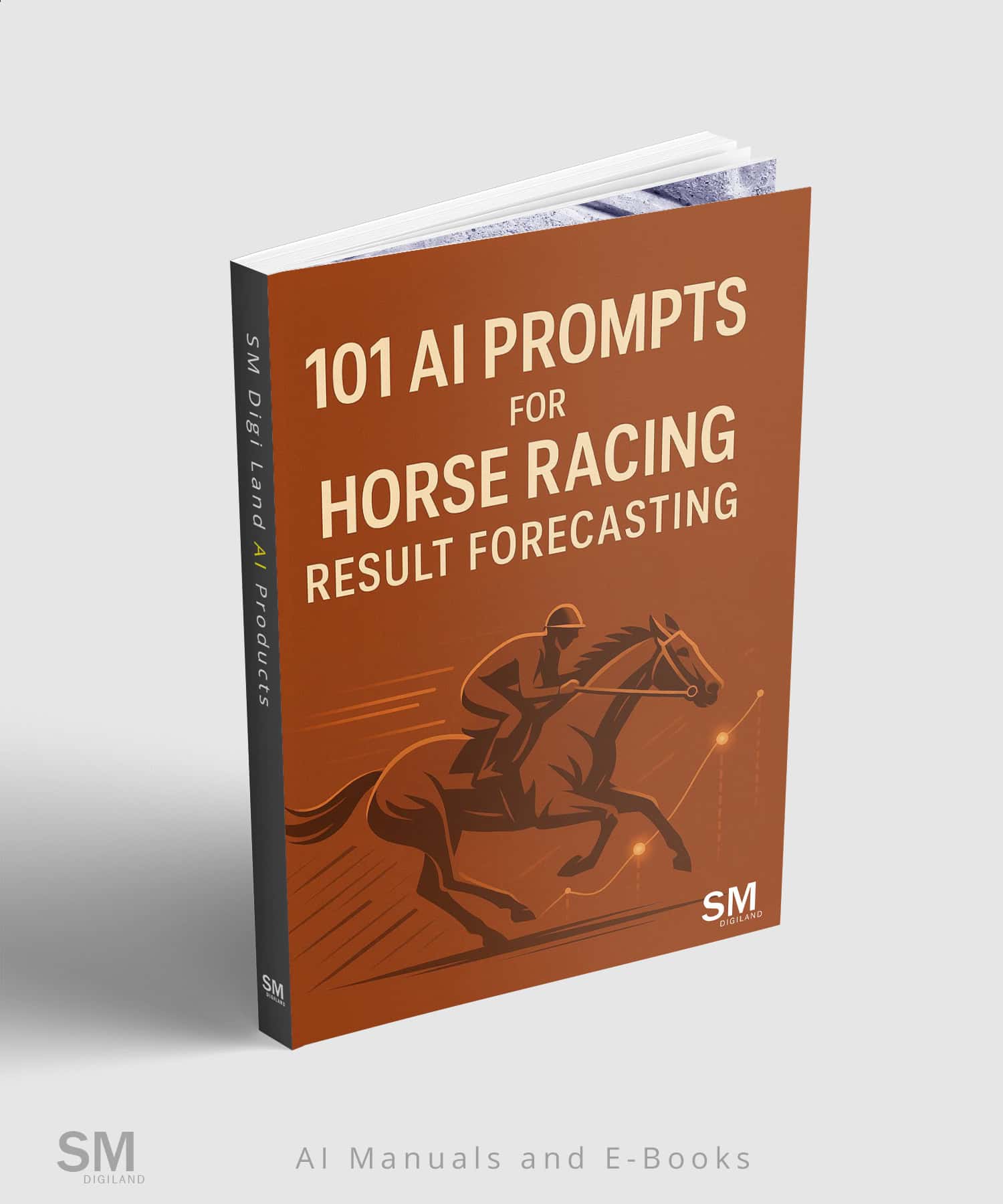
101 Advanced AI Prompts for Horse Racing Data Validation and Model Evaluation is an English digital guide designed to help analysts, researchers, students and racing-industry professionals review data quality and analytical-model reliability more systematically.
The prompts focus on data provenance, validation, documentation, bias detection, model evaluation, uncertainty and reproducibility. They are not designed to provide betting advice, horse selections, wagering strategies, odds or guaranteed race outcomes.
What Is Included?
- 101 advanced and customizable AI prompts
- A clear Goal for every prompt
- A concise Pro Tip for improving the output
- Copy-ready prompts with editable placeholders
- A dedicated Power Prompts section for multi-step validation workflows
- Prompts for documenting data sources, dates, definitions and limitations
- Workflows suitable for major general-purpose AI assistants
What the Prompts Help You Evaluate
Data Sources and Provenance
Document where each dataset originated, when it was collected, which permissions or licences apply and whether the source can be independently verified.
Schema and Variable Definitions
Check whether fields such as distance, surface, going, sectional time, finishing position and race classification are defined consistently across datasets.
Missing and Duplicate Records
Identify missing observations, duplicated races, repeated horse records and incomplete fields before beginning analytical work.
Timestamp and Event Integrity
Review whether race dates, scratches, weather observations, track changes and other events are recorded in the correct chronological order.
Outliers and Measurement Errors
Detect unusual values while distinguishing genuine exceptional performances from data-entry mistakes, unit inconsistencies or measurement problems.
Bias and Data Leakage
Identify selection bias, survivorship bias, hindsight bias, target leakage and other issues that may cause an analytical model to appear more reliable than it is.
Dataset Splitting and Benchmarking
Structure appropriate training, validation and testing procedures while preserving chronological order and avoiding contamination between datasets.
Model Evaluation
Compare analytical models against transparent baselines using properly defined evaluation metrics and documented assumptions.
Calibration and Uncertainty
Assess whether model outputs are appropriately calibrated and whether uncertainty, confidence ranges and limitations are communicated clearly.
Stability and Data Drift
Review whether relationships observed in historical data remain stable when track conditions, racing rules, equipment, competition levels or data providers change.
Reproducibility
Create documentation that allows another qualified analyst to understand the data, repeat the workflow and identify where professional judgment was applied.
How to Use the Book
- Select a prompt that matches your validation or evaluation objective.
- Replace every placeholder with relevant information.
- Use properly sourced and authorized data.
- Record the source and date of every material input.
- Define all variables and units before analysis.
- Separate verified data from estimates and assumptions.
- Generate an initial validation or evaluation report.
- Check every factual and numerical statement independently.
- Document missing information and unresolved limitations.
- Rewrite the final report in your own professional voice.
Important Limitations
- The book does not include live racing data or proprietary datasets.
- AI tools may invent records, variables, statistics, horses or historical events.
- Data from different providers may use inconsistent definitions.
- Small or unrepresentative samples can produce misleading results.
- Historical relationships may change over time.
- High model accuracy does not prove that the underlying data is reliable.
- Correlation does not establish causation.
- Evaluation results may be distorted by overfitting or Data Leakage.
- Every material fact and calculation must be independently verified.
- Relevant data-use, racing and professional requirements vary by jurisdiction.
Who Is This Book For?
- Horse racing data analysts
- Sports-data researchers
- Equine-performance researchers
- Racing-industry professionals
- Data-quality specialists
- Model-risk and validation professionals
- Data-science students and educators
- Prompt-engineering professionals
What Is Not Included?
- Betting advice or wagering strategies
- Horse selections or racing tips
- Guaranteed winner predictions
- Odds or bookmaker comparisons
- Value-bet identification
- Bankroll-management systems
- Live-odds monitoring or betting alerts
- Automated betting or wager execution
- Connections to bookmakers or betting accounts
- Live race-data subscriptions
- Implemented APIs, dashboards, bots or software
- Access to proprietary racing databases
- Financial-return or profit guarantees
- Access to an AI platform or AI subscription
- Automatic updates when data or regulations change
- A physical or printed book
Product Details
- Title: 101 Advanced AI Prompts for Horse Racing Data Validation and Model Evaluation
- Format: Digital PDF
- Language: English
- Core prompts: 101
- Power Prompts: [ADD VERIFIED NUMBER]
- Pages: [ADD FINAL VERIFIED PAGE COUNT]
- Price: $8.90, excluding applicable taxes
- Delivery: Digital download after successful payment and order processing
- SKU: SMDL-DL-041
- Edition: [ADD VERIFIED EDITION]
- Last updated: [ADD VERIFIED DATE]
Frequently Asked Questions
Does this book predict which horse will win?
No. It focuses on validating datasets and evaluating analytical methods. It does not provide horse selections or guaranteed race predictions.
Does it include betting strategies?
No. The book does not include wagers, odds comparisons, bookmaker recommendations, bankroll allocations or automated betting workflows.
Does it include live racing data?
No. Users must obtain and verify any required data from reliable and properly authorized sources.
Can AI validate data automatically?
AI can help structure validation checks, but it cannot independently confirm that a source is authentic or that a dataset is complete. Human review and source verification remain necessary.
Can a model with strong historical results still be unreliable?
Yes. Apparent performance may be affected by Data Leakage, overfitting, selection bias, incorrect labels or an unrepresentative sample.
Does the purchase include an AI subscription?
No. AI accounts, subscriptions, APIs and usage credits are separate and may involve additional costs.
Will I receive a physical book?
No. This is a downloadable digital PDF and no physical item will be shipped.
Use AI to Question the Data, Not to Manufacture Certainty
Use these prompts to document evidence, detect weaknesses and evaluate analytical methods more transparently. Always verify the underlying data and comply with applicable racing, data-use and professional requirements.
This product is independently created and is not affiliated with, sponsored by, certified by or endorsed by OpenAI, Google, Anthropic, any racing authority, racecourse, horse-racing organization, data provider, bookmaker or commercial-gaming operator. Third-party names and trademarks belong to their respective owners.


Reviews
There are no reviews yet.