


Use Generative AI More Effectively in Medical Education and Professional Workflows
Generative AI can assist with organizing information, developing educational material, reviewing supplied documents, planning research tasks, improving communication, and creating structured first drafts. However, useful results depend on the quality of the instructions, the reliability of the provided information, and careful review by a qualified person.
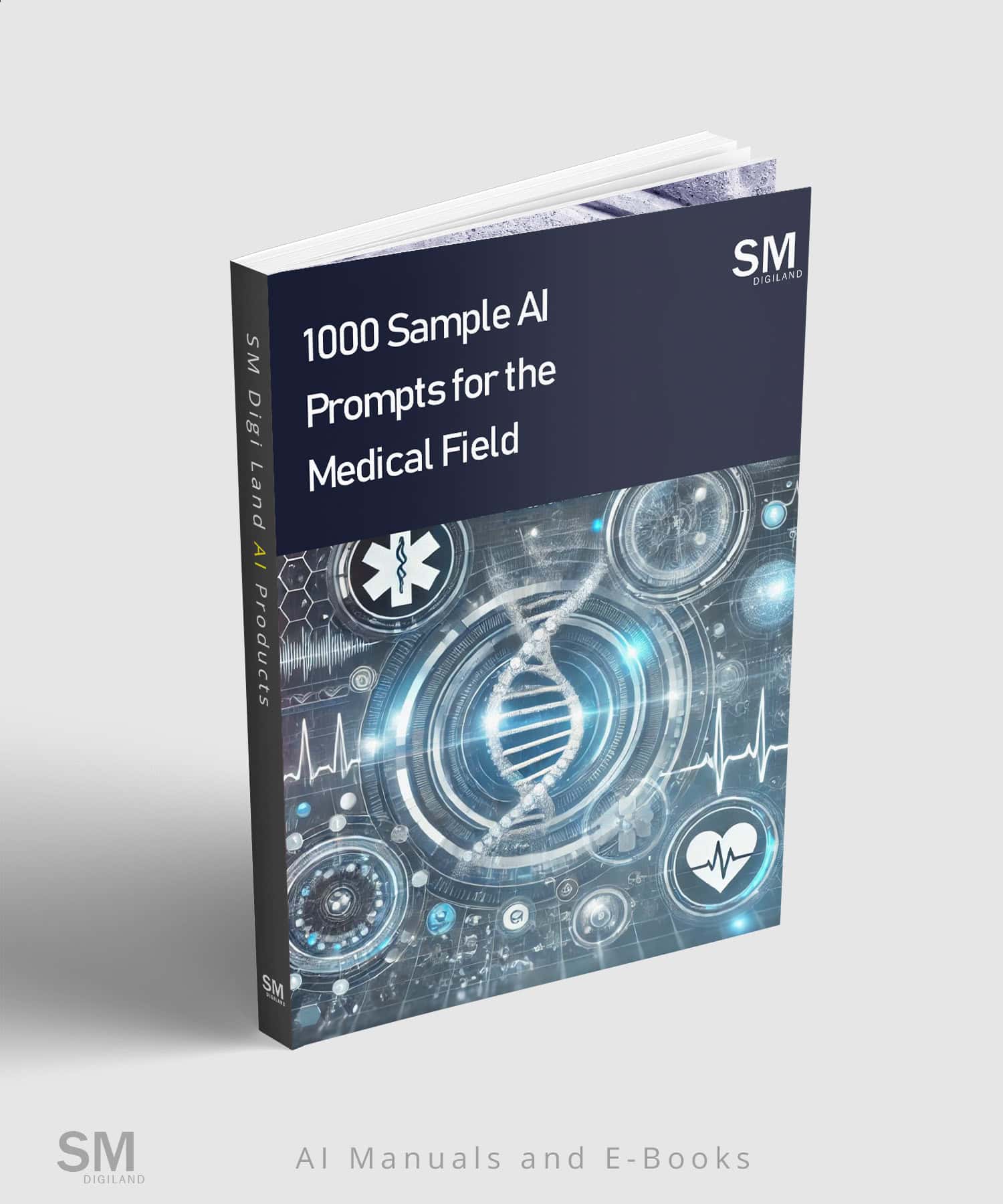
1000 AI Prompts for Medical Education, Research and Communication is a 138-page digital prompt book created for healthcare professionals, medical students, educators, researchers, and medical content creators.
The book contains 1,000 customizable prompt frameworks organized into 10 focused chapters. Each prompt is designed to help the user define a task, provide relevant context, specify the expected output, and establish appropriate limitations.
These prompts are intended to support learning, research organization, communication, documentation, analysis, and administrative workflows. They are not intended to diagnose a patient, recommend treatment, replace clinical judgment, or substitute for verified medical guidelines.
What Is Included in the Book?
- 1,000 structured and editable AI prompts
- 10 subject-focused chapters
- 100 prompts in each chapter
- A clear Goal explaining the intended outcome of every prompt
- A Usage section describing how and when the prompt may be applied
- A ready-to-customize Prompt containing editable fields
- Prompt frameworks suitable for different educational and professional scenarios
- Guidance for providing context, restrictions, source material, and output requirements
- Approaches that encourage verification rather than uncritical acceptance of AI output
Ten Medical and Healthcare Topics Covered
1. Medical Research and Literature Review
Use structured prompts to define research questions, organize search concepts, compare supplied studies, extract key findings, identify evidence gaps, create literature-review outlines, and prepare information for further professional evaluation.
2. Clinical Case Learning and Reasoning Practice
Develop educational case discussions, differential-reasoning exercises, question frameworks, information-gap analyses, and structured learning activities. These prompts are for supervised education and must not be used as autonomous diagnostic tools.
3. Patient Communication and Health Education
Create drafts of plain-language explanations, appointment instructions, educational handouts, question lists, counseling outlines, and communication materials based on verified and clinician-approved information.
4. Medical Documentation and Report Drafting
Organize de-identified information into structured draft formats, improve clarity, identify incomplete sections, develop templates, and review supplied text for consistency. All documentation must be checked and approved by an authorized healthcare professional.
5. Medical Study and Examination Preparation
Generate revision plans, practice questions, flashcards, comparison tables, concept explanations, case-based exercises, memory aids, and self-assessment activities for medical and healthcare education.
6. Evidence-Based Practice and Guideline Review
Structure clinical questions, compare user-supplied guidelines, summarize levels of evidence, identify uncertainties, and prepare information for professional review. Current official guidelines and original sources must always be checked independently.
7. Healthcare Marketing and Public Communication
Plan educational campaigns, service-page drafts, social media topics, public-awareness materials, frequently asked questions, newsletters, and ethical healthcare communication without making misleading or guaranteed medical claims.
8. Medical Research Data Analysis
Clarify research variables, organize analysis plans, explain statistical concepts, review table structures, develop data-quality questions, and prepare non-final interpretations for qualified statistical and scientific review.
9. Ethics, Privacy and Responsible AI Use in Healthcare
Explore informed consent, confidentiality, bias, transparency, accountability, human oversight, data governance, professional responsibility, and the limitations of generative AI in medical settings.
10. Time Management and Healthcare Workflow Organization
Develop task lists, educational schedules, meeting agendas, handover templates, process checklists, administrative workflows, and recurring communication frameworks while maintaining appropriate professional oversight.
How Every Prompt Is Structured
Each entry follows a consistent format that makes the book easy to scan and customize:
- Goal: Explains the intended result of the prompt
- Usage: Describes its practical application
- Prompt: Provides a structured instruction with editable fields
Placeholders such as [TOPIC], [AUDIENCE], [SOURCE MATERIAL], [OBJECTIVE], [OUTPUT FORMAT], and [LIMITATIONS] allow users to adapt the prompts to their own educational or professional context.
Sample Prompt Frameworks
The following examples demonstrate the type of structured medical prompting relevant to this product. They should be presented as product-page samples rather than confirmed excerpts from the PDF unless compared directly with the original book.
Sample 1: Review Supplied Medical Research
Goal: Create a structured summary of medical studies without inventing evidence or citations.
Usage: Use this prompt when reviewing abstracts, published papers, reports, or notes that you provide directly to the AI.
Prompt:
Act as a medical-literature review assistant. Analyze only the source material I provide below.
Research question: [QUESTION]
Population: [POPULATION]
Intervention or exposure: [INTERVENTION]
Comparator: [COMPARATOR]
Outcomes: [OUTCOMES]
Study material: [PASTE THE SOURCE MATERIAL]
Required output: [FORMAT]
Intended audience: [AUDIENCE]For each supplied study, identify:
- Study design and objective
- Population and sample characteristics
- Intervention, exposure, or comparison
- Measured outcomes
- Primary reported findings
- Limitations stated by the authors
- Potential sources of bias visible in the supplied material
- Information required before applying the findings
Do not create citations, statistics, methods, participant details, conclusions, or clinical recommendations that are not present in the supplied material. Clearly label missing information and statements that require verification from the original publication.
Sample 2: Draft Patient-Education Material
Goal: Convert clinician-approved information into a clearer patient-education draft.
Usage: Use this prompt to prepare a first draft that will be reviewed by an authorized healthcare professional before distribution.
Prompt:
Act as a health-communication editor. Rewrite the verified information below as a plain-language patient-education draft.
Topic: [TOPIC]
Clinician-approved source information: [INFORMATION]
Target audience: [AUDIENCE]
Reading level: [LEVEL]
Language: [LANGUAGE]
Communication format: [HANDOUT, EMAIL, WEB PAGE, OR OTHER]
Required sections: [SECTIONS]
Approved safety instructions: [INSTRUCTIONS]
Information that must not be changed: [RESTRICTIONS]Create:
- A clear title
- A short introductory explanation
- Key points in plain language
- A step-by-step section if supported by the supplied information
- Questions the patient may wish to discuss with a qualified professional
- A list of statements requiring final clinical verification
Do not add a diagnosis, treatment recommendation, dosage, prognosis, contraindication, emergency instruction, or medical claim that is not explicitly included in the clinician-approved material. Do not imply that the draft replaces professional medical advice.
Sample 3: Review a De-identified Documentation Draft
Goal: Check a supplied draft for structure, clarity, internal consistency, and missing sections.
Usage: Use only with properly de-identified information and according to applicable privacy rules and organizational policies.
Prompt:
Act as a medical-documentation quality-review assistant. Review the de-identified draft below without adding new clinical facts.
Document type: [TYPE]
Required template or sections: [REQUIREMENTS]
Intended professional user: [USER]
De-identified draft: [TEXT]
Organizational style rules: [RULES]Evaluate the draft for:
- Completeness of the required sections
- Clarity and readability
- Internal consistency
- Ambiguous wording
- Unsupported statements
- Duplicated information
- Information that appears to require professional verification
Return a table containing the issue, its location, why it may require attention, and a suggested wording change. Do not infer missing findings, modify the clinical meaning, recommend treatment, or introduce facts that are not present in the supplied draft.
Who Is This Medical Prompt Book For?
- Physicians exploring responsible generative-AI workflows
- Nurses and allied healthcare professionals
- Medical, nursing, pharmacy, and healthcare students
- Medical educators and academic trainers
- Clinical and academic researchers
- Healthcare administrators and communication teams
- Medical writers and health-content professionals
- Public-health educators
- Professionals developing internal prompt libraries
How to Use the Prompts More Safely
- Select a prompt that matches your educational or professional task.
- Replace every editable field with accurate and relevant information.
- Use authoritative, current, and traceable source material.
- Remove personal identifiers and protected health information before using a third-party AI service.
- Ask the AI to identify uncertainty, missing information, and claims requiring verification.
- Check references directly instead of relying on AI-generated citations.
- Compare outputs with current guidelines, original research, and organizational policies.
- Have a qualified professional review any material intended for clinical or patient-facing use.
- Document important corrections when building a reusable prompt workflow.
- Do not use a general-purpose AI response as the sole basis for a clinical decision.
Product Details
- Title: 1000 AI Prompts for Medical Education, Research and Communication
- Format: PDF digital book
- Length: 138 pages
- Language: English
- Number of prompts: 1,000
- Structure: 10 chapters with 100 prompts per chapter
- Prompt format: Goal, Usage, and Prompt
- Delivery: Instant digital download after purchase
- SKU: SMDL-DL-007
- Price: $18
Important Medical and AI Limitations
Generative AI can produce inaccurate, incomplete, outdated, biased, contradictory, or fabricated information. It may also generate references, quotations, statistics, guidelines, drug information, or clinical details that appear credible but do not exist or are not applicable to the intended context.
Every medical statement must be checked against current authoritative sources, original publications, approved clinical guidelines, local regulations, organizational policies, and appropriate professional judgment.
Do not enter names, contact details, identification numbers, medical-record numbers, facial images, full dates, identifiable case details, or other protected or confidential information into an AI platform unless its use has been formally authorized and complies with applicable privacy rules.
AI output must not be used as the sole basis for diagnosis, triage, prescribing, dosage selection, treatment, emergency care, prognosis, interpretation of diagnostic tests, or another decision that may affect an individual’s health or safety.
What This Product Is—and Is Not
This product is a downloadable educational collection of customizable prompt frameworks for medical learning, research organization, communication, documentation, data-analysis planning, ethics, and workflow support.
It is not a physical book, AI platform, medical device, diagnostic system, clinical decision-support service, electronic health-record integration, professional consultation, medical course, accredited qualification, or personalized healthcare service.
The purchase does not include access to ChatGPT or any other third-party AI platform. Separate accounts, subscriptions, permissions, or organizational approvals may be required.
The book does not guarantee accurate medical answers, improved clinical outcomes, faster diagnosis, successful research, publication, regulatory compliance, examination results, workflow savings, or acceptance by a healthcare organization.
Frequently Asked Questions
Does the book contain exactly 1,000 prompts?
Yes. It contains 10 chapters with 100 prompts in each chapter, providing a total of 1,000 prompt frameworks.
Can these prompts be used to diagnose patients?
No. The prompts are intended for education, research organization, communication, drafting, and workflow support. They must not be used as an autonomous diagnostic or treatment system.
Is this book only for doctors?
No. It is designed for a broader audience that includes nurses, students, educators, researchers, medical writers, healthcare administrators, and other qualified professionals.
Can medical students use the book?
Yes. Several prompt applications relate to studying, revision, practice questions, concept clarification, literature review, and educational case exercises. AI-generated information must still be checked against approved learning resources.
Can I enter real patient records into the prompts?
You should not upload identifiable or protected patient information to a third-party AI service without appropriate authorization, safeguards, and confirmation that the use complies with applicable privacy rules and organizational policies.
Does the book include access to ChatGPT?
No. The purchase includes only the downloadable PDF book. Access to any AI platform must be obtained separately.
Will the prompts work with every AI model?
The general frameworks may be adapted to different generative-AI tools, but outputs, features, context limits, privacy terms, and supported file types vary between platforms and model versions.
Can AI-generated references be trusted?
No reference should be accepted solely because it was generated by AI. Confirm the title, authors, journal, publication date, DOI, study details, and conclusions using the original publication or a reliable academic database.
Does this product provide medical advice?
No. It is an educational digital product and does not provide individualized medical advice, diagnosis, treatment, or emergency guidance.
Is this a physical book?
No. It is an English-language PDF delivered digitally. No physical product will be shipped.
Build a More Structured Medical AI Workflow
Use this collection to develop clearer instructions for medical learning, research organization, communication, documentation, analysis planning, and recurring professional tasks—while maintaining privacy, independent verification, and qualified human oversight.
Download the 138-page PDF and customize its 1,000 prompt frameworks for your own approved educational and professional workflows.


