
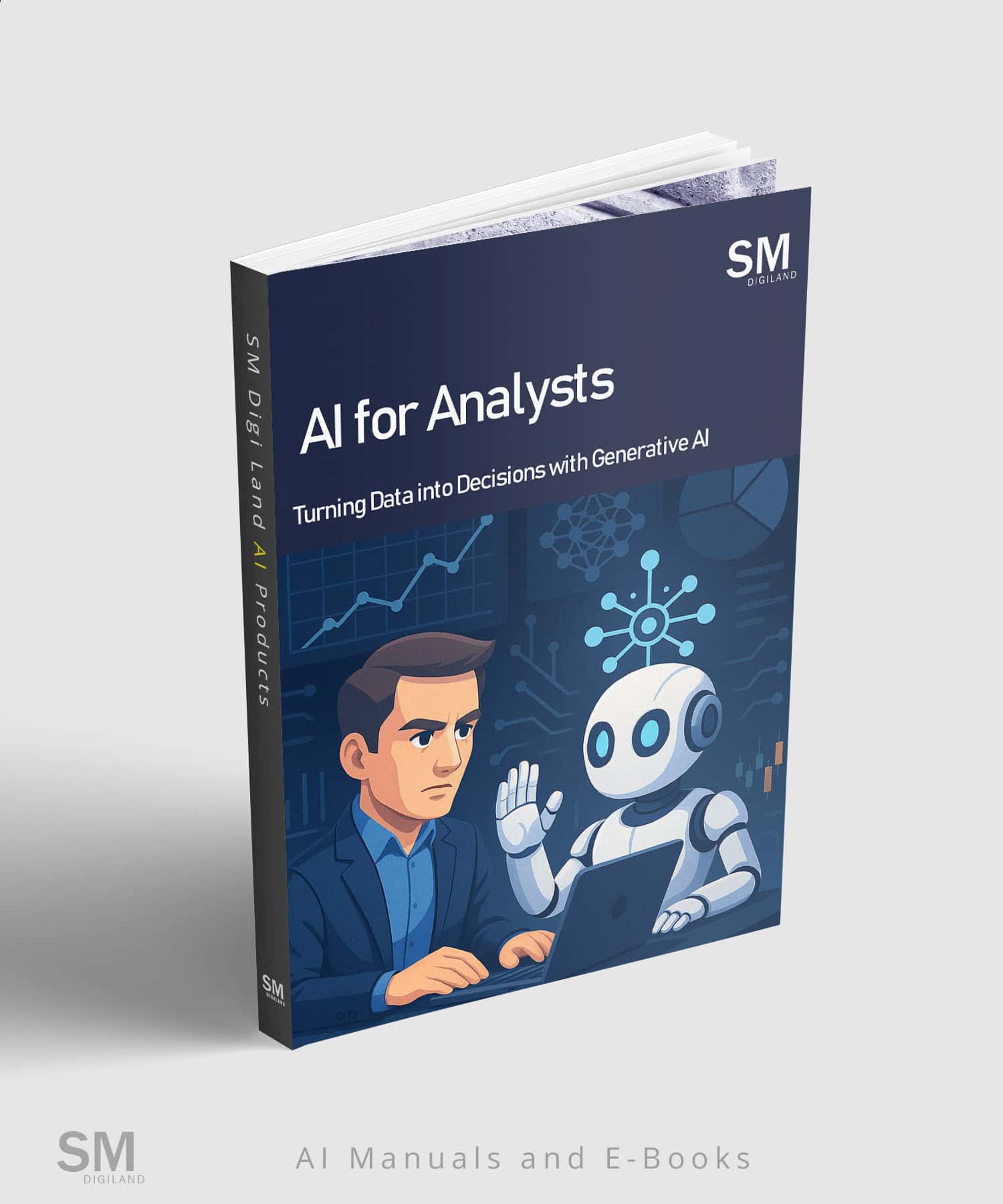


A More Structured Approach to AI-Assisted Data Analysis
Generative AI can help analysts organize questions, review supplied information, explore possible patterns and prepare draft reports. However, a confident AI-generated response is not proof that the underlying data, calculations or conclusions are correct.
AI-Assisted Data Analysis: Practical Prompts for Research, Reporting and Decision Support is a 101-page English PDF designed to help analysts use generative AI through a more systematic, transparent and reviewable workflow.
The guide provides adaptable prompts and practical frameworks for defining analytical objectives, examining data quality, exploring historical information, planning visualizations, developing reports and comparing alternative interpretations.
What Is Included?
- 101-page downloadable English PDF
- Practical prompts for AI-assisted data analysis
- Analytical-question and objective frameworks
- Data-requirement and data-quality reviews
- Data-cleaning support workflows
- Descriptive and historical trend analysis
- Calculation and statistical-reasoning checks
- Visualization and dashboard planning
- Reporting and executive-summary prompts
- Decision-support frameworks
- Alternative interpretation exercises
- AI hallucination and limitation checks
- Privacy and confidentiality guidance
- Instant digital delivery after purchase
Topics Covered in the Guide
Defining the Analytical Objective
Start by identifying the business question, intended audience, required decision, available data and acceptable limitations. A clearly defined objective makes it easier to evaluate whether an AI-generated response is relevant.
Understanding Data Requirements
Use structured prompts to identify the variables, date ranges, units, categories and contextual information required for an analysis. The AI should be instructed to identify missing information instead of silently inventing values.
Data-Quality Review
Examine user-supplied datasets for missing values, duplicate observations, inconsistent labels, unsuitable comparisons, unusual values and possible formatting problems.
An AI assistant may overlook errors or incorrectly classify legitimate observations as anomalies. Material changes to a dataset should always be reviewed by a qualified person.
Data-Cleaning Support
Develop cleaning plans that document proposed changes before they are applied. Prompts can help users create checklists, transformation rules and validation questions, but the resulting recommendations must be tested against the original data.
Descriptive and Historical Analysis
Organize questions involving distributions, totals, averages, changes over time, category comparisons and other descriptive observations based on supplied information.
Historical relationships do not prove causation and do not guarantee that the same pattern will continue.
Calculation and Statistical Checks
Ask the AI assistant to identify the required formula, show the calculation steps, explain assumptions and state which inputs were used.
Important calculations should be independently reproduced using verified formulas and suitable analytical software.
Visualization Planning
Use prompts to select possible chart types, define axes, identify comparison groups, draft chart titles and explain what a visualization should communicate.
The PDF does not automatically create a live dashboard or connect to business-intelligence software unless the user separately supplies and configures a compatible tool.
Reporting and Executive Summaries
Transform reviewed analytical notes into structured reports, management summaries, presentation outlines and action-item drafts for a defined audience.
AI-generated summaries may omit qualifications or overstate conclusions. The final report should remain consistent with the verified data and documented analysis.
Decision Support
Use AI to organize options, assumptions, evidence, uncertainties and possible trade-offs. The guide treats AI as a decision-support tool—not as an autonomous decision-maker.
Alternative Interpretations
Request several plausible explanations for an observed result and identify what additional evidence would help distinguish between them. This reduces the risk of accepting the first confident explanation generated by the model.
Forecasting and Scenario Analysis
If forecasting material is included in the final PDF, it should be used to organize assumptions and explore possible scenarios—not to guarantee future revenue, demand, market conditions or financial performance.
Forecasts are sensitive to data quality, timeframe, methodology, external events and assumptions. They require independent professional review before being used for a material decision.
Responsible AI Use
Consider factual accuracy, confidentiality, personal-data protection, intellectual property, bias, security and the limitations of generative-AI systems throughout the analytical workflow.
How to Use the Guide
- Select a prompt relevant to the analytical objective.
- Replace the example variables with your own information.
- Define the dataset, source and relevant date range.
- Explain the meaning and units of important variables.
- Ask the AI to identify missing information.
- Request visible assumptions, formulas and calculation steps.
- Separate factual observations from interpretations.
- Request alternative explanations and limitations.
- Independently reproduce important calculations.
- Document the final sources, assumptions and review process.
Who Is This Guide For?
- Business analysts
- Data analysts and analytics students
- Managers and team leaders
- Consultants and business strategists
- Marketing and operations analysts
- Researchers working with structured information
- Small-business owners reviewing performance data
- Professionals learning practical AI-prompt customization
AI-Generated Information Must Be Verified
Generative-AI systems can produce incorrect, incomplete, outdated, biased or fabricated information. They may also make calculation errors or claim to have analyzed data that was not actually provided.
Users should independently verify:
- Data sources and collection dates
- Formulas and calculated values
- Statistical interpretations
- Trend and causation claims
- Forecast assumptions
- Chart labels and units
- Quotations, references and external links
- Professional or regulatory conclusions
Privacy and Confidentiality
Do not submit personal data, employee records, customer information, payment data, passwords, API keys, confidential financial information, trade secrets or proprietary datasets to an AI service without appropriate authorization and safeguards.
Use public, fictional, anonymized or appropriately authorized information. Review the selected AI provider’s current privacy, security, retention and data-use terms before submitting non-public data.
Professional and High-Impact Decisions
AI-generated analysis should not be used as the sole basis for legal, financial, employment, medical, credit, insurance, compliance or other high-impact decisions.
Material decisions require suitable human review and, where appropriate, advice from qualified professionals.
Third-Party Tools and Software
The prompts may be adapted for compatible text-based AI assistants and analytical workflows. Features, compatibility, terminology and output quality vary between providers, models, subscriptions and locations.
The purchase does not include an AI subscription, API access, usage credits, spreadsheet application, business-intelligence platform, database, data source or professional consulting service.
Product Details
- Title: AI-Assisted Data Analysis: Practical Prompts for Research, Reporting and Decision Support
- Format: PDF digital guide
- Length: 101 pages
- Language: English
- Delivery: Instant digital download after purchase
- SKU: SMDL-OTH-008
- Price: $16.00, excluding applicable taxes
Frequently Asked Questions
Does this guide analyze my data automatically?
No. It is a static PDF containing prompts and frameworks. Users must provide suitable information to a compatible AI or analytical tool and review the resulting output.
Does it connect to Excel, Power BI, Tableau or a database?
No automatic connection, integration or software subscription is included with the purchase.
Does the guide guarantee accurate analysis?
No. AI-generated findings and calculations may be incorrect. Material results must be independently checked.
Can the prompts create a dashboard?
They may help users plan dashboard requirements, metrics, layouts and explanations. Creating a functional dashboard requires suitable software, verified data and separate implementation.
Can it be used for forecasting?
The prompts may help organize assumptions and scenario questions if forecasting is covered in the final PDF. They cannot guarantee future outcomes.
Can I upload confidential company data?
Only appropriately authorized information should be used. Confidential, personal or regulated data should not be submitted without suitable legal, privacy and security safeguards.
Does the purchase include an AI subscription?
No. AI accounts, subscriptions, APIs, usage credits and analytical software are separate.
Is programming knowledge required?
General prompts may not require programming. Any code, formula or technical workflow generated by an AI system must still be independently tested.
Is this a physical book?
No. It is delivered digitally as an English PDF. No physical product will be shipped.
Develop a More Critical Analytical Workflow
Use the guide to define clearer analytical questions, examine data quality, structure reports, compare interpretations and critically review AI-generated results.
This product is independently created and is not affiliated with, sponsored by, certified by or endorsed by OpenAI, Anthropic, Google, Microsoft, Tableau, Salesforce or any other AI, analytics or software provider. Third-party names and trademarks belong to their respective owners.


