
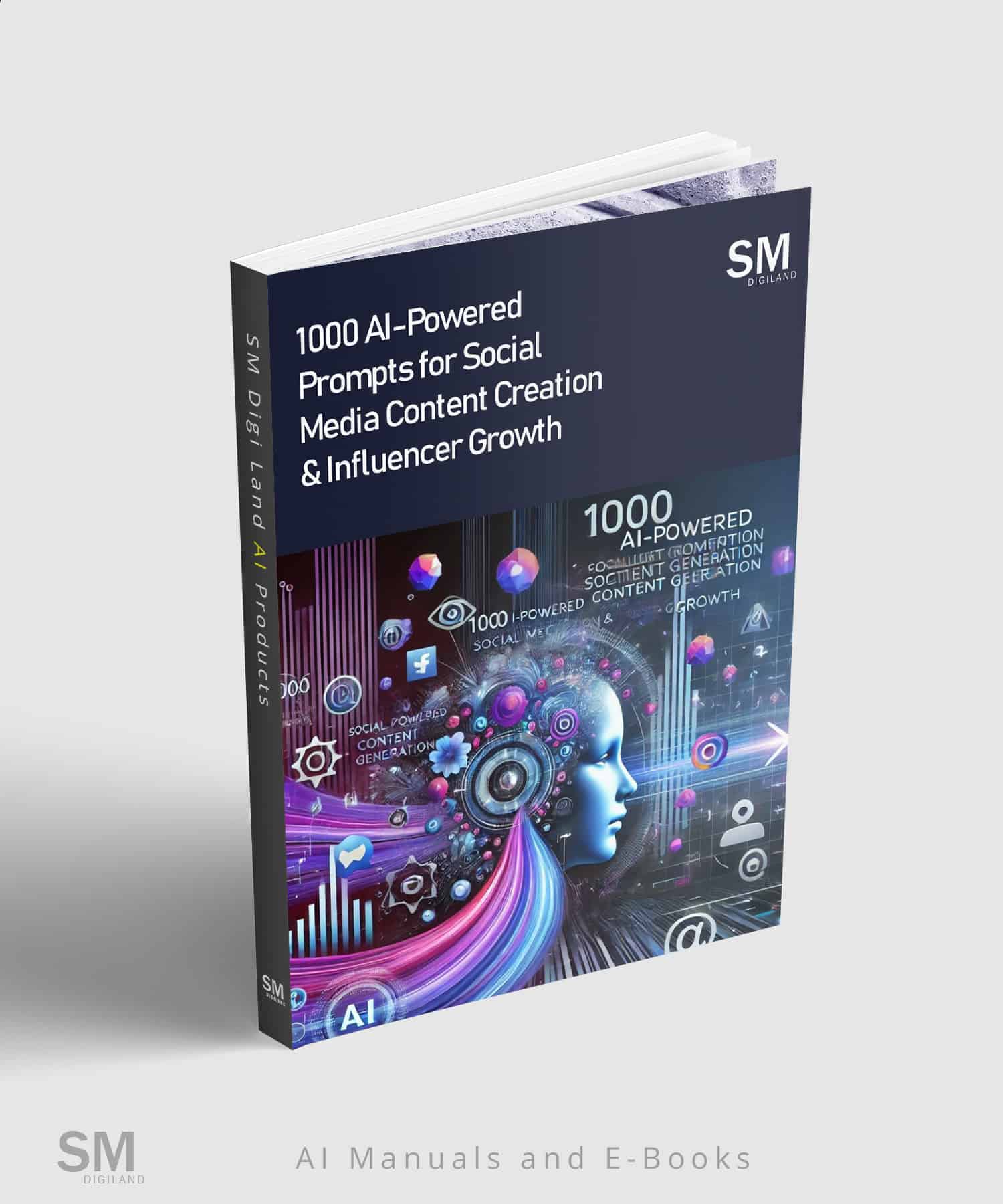


A Structured AI Prompt Library for Social Media Strategy and Content
Effective social-media content requires more than posting frequently or following every popular trend. Creators and businesses must understand their audience, brand position, communication objectives, available evidence, content formats, platform context, publishing resources, legal restrictions, and criteria for measuring results.
1000 AI Prompts for Social Media Strategy and Content is a 91-page digital prompt book designed to help users approach these activities with clearer instructions and more organized workflows.
The collection contains 1,000 customizable prompt frameworks organized into 10 social-media areas. It supports post ideation, caption development, storytelling, hooks, trend evaluation, short-form video scripting, carousel planning, infographic concepts, community engagement, content scheduling, cross-platform adaptation, brand-voice development, discoverability research, and performance-review preparation.
This is not a collection of one-line instructions promising instant popularity or automatic growth. The prompts help users define context, provide reliable information, identify assumptions, develop controlled variations, document requirements, and establish practical review criteria.
AI Can Support Content Creation—but It Cannot Guarantee Attention
Generative AI can assist with research organization, ideation, drafting, repurposing, editing, comparison, and analysis of information supplied by the user. It cannot independently know what an audience will value, confirm that a trend is current, access private account data, predict an algorithm, verify rights to an asset, or guarantee that content will perform well.
Without sufficient context and verification, an AI system may:
- Invent audience demographics, preferences, objections, behavior, comments, trends, benchmarks, or platform statistics
- Suggest outdated features, content dimensions, posting practices, hashtags, tools, or platform terminology
- Create unsupported product claims, statistics, testimonials, reviews, endorsements, awards, prices, or promotional conditions
- Misrepresent a person, event, organization, customer experience, or real-world situation
- Recommend copyrighted music, images, footage, characters, slogans, or creative concepts without confirming usage rights
- Use a person’s name, image, voice, likeness, or personal information without suitable authorization
- Create similar or non-exclusive content for different users
- Develop insensitive content about health, identity, religion, politics, trauma, disability, children, or other sensitive subjects
- Recommend engagement bait, spam, repetitive comments, undisclosed advertising, or artificial audience-growth practices
- Produce captions, subtitles, graphics, or calls to action that are inaccessible or difficult to understand
- Misinterpret reach, impressions, engagement, watch time, conversions, attribution, or audience-retention data
- Describe an observed correlation as proof that a specific post caused a business result
- Recommend posting schedules without considering audience location, resources, campaign periods, or reliable account data
AI-generated social-media output should be treated as provisional creative work requiring human judgment, factual verification, editing, testing, approval, and performance monitoring.
What Is Included?
- 1,000 customizable AI prompt frameworks
- 10 chapters with 100 prompts in each chapter
- A defined Goal for every prompt
- A Usage section explaining the intended application
- An editable Prompt ready for personalization
- Frameworks for defining audiences, platforms, formats, objectives, brand voice, resources, restrictions, and metrics
- Prompts for post ideas, captions, headlines, hooks, and storytelling
- Prompts for short-form video concepts and scripts
- Prompts for carousels, infographics, memes, and visual-content briefs
- Prompts for content calendars and cross-platform adaptation
- Prompts for community engagement and moderation preparation
- Prompts for personal and organizational brand consistency
- Prompts for discoverability and hashtag research
- Prompts for reviewing verified social-media data supplied by the user
- Reusable placeholders for adapting the frameworks to different projects
Ten Social-Media Areas Covered
1. Social-Media Post Ideas
Develop content pillars, educational posts, promotional concepts, behind-the-scenes content, customer-focused topics, thought-leadership directions, recurring series, and campaign ideas based on a defined audience and objective.
2. Captions, Headlines and Storytelling Hooks
Draft opening lines, captions, headlines, story structures, calls to action, and messaging variations while restricting the AI to verified information and an approved brand voice.
3. Trends, Challenges and Participation Concepts
Evaluate whether a trend, format, challenge, or cultural moment is appropriate for a particular brand and audience. Current trends and platform conditions must be verified before publication.
4. Short-Form Video Ideas and Scripts
Plan reels, short videos, talking-head content, demonstrations, interviews, tutorials, transformations, behind-the-scenes videos, and structured scripts with clear hooks, scenes, pacing, and calls to action.
5. Carousels, Infographics and Memes
Develop slide structures, visual hierarchies, educational sequences, comparison concepts, data-visualization briefs, and entertainment formats. Exact text, facts, numbers, charts, and relationships require independent verification.
6. Audience Engagement and Community Workflows
Create conversation starters, response guidelines, community questions, comment-management frameworks, moderation checklists, escalation procedures, and responsible user-generated-content campaigns.
7. Content Calendars and Cross-Platform Planning
Organize content themes, publishing schedules, responsibilities, approval stages, asset requirements, repurposing opportunities, and channel-specific adaptations without assuming that identical content will perform equally across platforms.
8. Brand Voice and Personal Branding
Define tone, message pillars, vocabulary, boundaries, visual direction, expertise themes, founder stories, creator positioning, and consistency guidelines for personal and organizational accounts.
9. Discoverability and Hashtag Research
Develop research questions, topic clusters, keyword directions, caption terminology, metadata ideas, and provisional hashtag groups. Current search behavior, platform functionality, competition, and hashtag relevance must be verified directly.
10. AI-Assisted Production and Analytics
Use AI to support briefing, ideation, drafting, repurposing, quality review, localization, reporting, and analysis of user-supplied data while documenting assumptions, missing information, tracking limitations, and required human approvals.
How Every Prompt Is Structured
Every entry follows a consistent three-part format:
- Goal: Defines the intended social-media task
- Usage: Explains when and how the framework may be applied
- Prompt: Provides a detailed instruction ready to customize
Editable fields may include [BRAND], [PRODUCT OR SERVICE], [PLATFORM], [TARGET AUDIENCE], [MARKET], [CONTENT OBJECTIVE], [CONTENT FORMAT], [CONTENT PILLARS], [BRAND VOICE], [APPROVED CLAIMS], [SUPPORTING EVIDENCE], [CALL TO ACTION], [CAMPAIGN PERIOD], [AVAILABLE ASSETS], [PRIMARY KPI], [ACCESSIBILITY REQUIREMENTS], [REQUIRED DISCLOSURES], [PROHIBITED TOPICS], and [PLATFORM RESTRICTIONS].
Illustrative Social-Media Prompt Examples
The following examples demonstrate the type of structured workflow supported by the collection. They should not be presented as verbatim excerpts from the PDF unless compared directly with the published book.
Sample 1: Build an Evidence-Based Content Strategy
Goal: Develop a practical social-media strategy without inventing audience evidence or promising growth.
Usage: Use before creating a campaign, monthly calendar, or recurring content series.
Prompt:
Act as a social-media strategist. Develop a content strategy using only the verified information provided below. Clearly separate supplied facts, assumptions, unanswered questions, and recommendations.
Brand: [BRAND]
Product, service or expertise: [OFFER]
Primary objective: [OBJECTIVE]
Target audience and supporting evidence: [AUDIENCE EVIDENCE]
Market and languages: [MARKET]
Selected platforms: [PLATFORMS]
Approved brand position: [POSITIONING]
Approved claims and supporting evidence: [CLAIMS AND EVIDENCE]
Existing content assets: [ASSETS]
Publishing capacity: [CAPACITY]
Campaign period: [PERIOD]
Primary KPI: [KPI]
Brand voice: [VOICE]
Restrictions and required disclosures: [RESTRICTIONS]Do not invent audience interests, customer problems, testimonials, market statistics, product capabilities, trends, platform features, expected engagement, or growth projections.
Provide:
- A concise strategy statement
- Four evidence-based content pillars
- The role of each selected platform
- Three repeatable content series for each pillar
- A recommended format mix based on available resources
- A four-week publishing framework
- A community-engagement workflow
- A measurement plan
- Risks, evidence gaps, and unanswered questions
- A pre-publication verification checklist
Do not guarantee reach, followers, engagement, leads, conversions, revenue, or viral performance.
Sample 2: Create a Controlled Short-Form Video Script
Goal: Draft a platform-aware video script using approved information and a clear creative structure.
Usage: Use for provisional reels, shorts, tutorials, demonstrations, interviews, or creator-led videos.
Prompt:
Act as a short-form social-video strategist and script editor. Create three script variations using only the approved information supplied below.
Platform and placement: [PLATFORM]
Target duration: [DURATION]
Audience: [AUDIENCE]
Content objective: [OBJECTIVE]
Topic: [TOPIC]
Verified facts: [FACTS]
Approved product claims: [CLAIMS]
Supporting evidence: [EVIDENCE]
Speaker or on-screen subject: [SUBJECT]
Available location and assets: [ASSETS]
Brand voice: [VOICE]
Call to action: [CTA]
Required disclosure: [DISCLOSURE]
Prohibited language or subjects: [RESTRICTIONS]Do not invent statistics, customer results, endorsements, product capabilities, urgency, scarcity, trends, or platform rules. Do not imitate a living creator’s distinctive voice or style.
For each variation, provide:
- A first-second visual hook
- An opening spoken hook
- A time-coded scene sequence
- Spoken dialogue
- On-screen text
- Camera and B-roll directions
- Caption and call to action
- Accessibility notes for subtitles and visuals
- Required disclosure or rights check
- The hypothesis being tested
Sample 3: Review Verified Social-Media Performance
Goal: Analyze supplied account data without fabricating benchmarks or overstating conclusions.
Usage: Use after exporting data from the relevant social, analytics, website, CRM, or sales systems.
Prompt:
Act as a social-media performance analyst. Analyze only the verified data supplied below. Do not invent missing metrics, audience behavior, platform benchmarks, algorithm explanations, attribution results, or causal conclusions.
Platform: [PLATFORM]
Reporting period: [PERIOD]
Account objective: [OBJECTIVE]
Published content: [CONTENT DATA]
Reach and impressions: [REACH DATA]
Views and watch time: [VIDEO DATA]
Reactions, comments, shares and saves: [ENGAGEMENT DATA]
Profile or website actions: [ACTION DATA]
Verified conversions: [CONVERSION DATA]
Audience data: [AUDIENCE DATA]
Paid distribution: [PAID DATA]
Tracking and attribution settings: [TRACKING]
Data limitations: [LIMITATIONS]
Comparison period: [COMPARISON]First audit the dataset for missing values, duplicates, inconsistent definitions, format changes, paid-versus-organic mixing, deleted posts, tracking changes, and sample-size limitations.
Then provide:
- Calculations with formulas shown
- Performance by content pillar, topic, format, and publication period where supported
- Observed patterns separated from possible explanations
- Alternative explanations and confounding factors
- Questions that cannot be answered from the available data
- Recommendations ranked by evidence strength, effort, cost, and risk
- A controlled follow-up test plan
- Metrics and guardrails for the next review
Do not describe correlation as proof that a post, format, hashtag, trend, or publishing time caused a result.
Who Is This Book For?
- Social-media managers and coordinators
- Content creators and influencers
- Digital-marketing professionals
- Brand and communications teams
- Copywriters and content strategists
- Video creators and short-form content teams
- Community managers
- Marketing agencies and consultants
- Freelancers managing client accounts
- Entrepreneurs and small-business owners
- Personal brands, coaches, educators, and subject-matter experts
- E-commerce and product-marketing teams
- Nonprofit and community organizations
- Students developing practical content workflows
How to Use the Prompts Effectively
- Select a prompt that matches the specific task and platform.
- Replace every placeholder with accurate and relevant information.
- Define the audience, objective, content format, brand voice, call to action, and publishing context.
- Provide verified facts, approved claims, customer evidence, and supporting sources.
- Ask the AI to identify missing information instead of inventing it.
- Separate verified facts from assumptions, hypotheses, and creative recommendations.
- Confirm current platform specifications, features, policies, and disclosure tools.
- Check rights to music, images, footage, fonts, trademarks, artwork, quotations, and user-generated content.
- Obtain suitable permission before using a person’s name, image, voice, likeness, or personal information.
- Review captions, subtitles, contrast, visual hierarchy, and other accessibility requirements.
- Use controlled content tests rather than assuming one version will perform better.
- Analyze results using verified platform exports and appropriate business data.
- Document paid distribution, reporting periods, attribution settings, and tracking limitations.
- Protect confidential client, employee, customer, and campaign information when using AI tools.
- Require human approval before publishing, scheduling, promoting, or automating content.
Product Details
- Title: 1000 AI Prompts for Social Media Strategy and Content
- Format: PDF digital book
- Length: 91 pages
- Language: English
- Number of prompts: 1,000
- Structure: 10 chapters with 100 prompts per chapter
- Prompt format: Goal, Usage, and Prompt
- Delivery: Instant digital download after purchase
- SKU: SMDL-DL-019
- Price: $22
Important Information About AI-Assisted Social Media
Generative-AI systems may produce inaccurate, incomplete, outdated, biased, misleading, or invented information. This can include fabricated trends, audience insights, platform benchmarks, hashtags, customer experiences, quotations, statistics, reviews, endorsements, results, and competitor information.
Users must independently verify factual statements, product claims, comparisons, statistics, prices, promotional conditions, testimonials, endorsements, disclosures, and calls to action before publication.
Platform algorithms, features, content dimensions, interface options, search behavior, monetization requirements, moderation systems, and community standards can change. Instructions generated by AI or included in a static PDF may become outdated.
Sponsored content, affiliate relationships, complimentary products, employment relationships, commissions, and other material connections may require clear and prominent disclosure. Platform disclosure tools may not replace every legal or contractual requirement.
Realistic AI-generated or substantially altered images, audio, and video may require platform-specific labels or disclosures. Some types of impersonation, manipulated media, cloned voices, or synthetic depictions may remain prohibited even when labeled.
Users must not fabricate reviews, testimonials, comments, customer experiences, followers, views, likes, shares, or other indicators of social influence. AI-generated profiles or coordinated engagement should not be presented as genuine audience activity.
Users should not provide passwords, account credentials, unpublished campaigns, confidential client assets, personal data, private messages, customer records, or restricted analytics exports to an AI platform unless authorized and appropriate security and privacy terms have been reviewed.
Social-media analytics depend on reporting definitions, tracking implementation, paid distribution, attribution settings, content availability, platform updates, external events, sample size, and data quality. AI cannot automatically correct incomplete or unreliable data.
What This Product Is—and Is Not
This product is a downloadable educational collection of customizable AI prompt frameworks for social-media strategy, content ideation, drafting, planning, repurposing, community-workflow preparation, and performance-review support.
It is not a social-media account, content-production service, marketing agency, influencer campaign, publishing tool, scheduling platform, analytics system, audience database, hashtag database, trend-monitoring service, automation system, moderation service, rights-clearance service, legal review, privacy audit, or performance guarantee.
The purchase does not include access to ChatGPT, Claude, Gemini, Jasper, Copy.ai, Instagram, TikTok, Facebook, LinkedIn, YouTube, Pinterest, X, a scheduler, analytics platform, stock library, music license, API, automation software, advertising account, or another third-party service. Separate accounts, subscriptions, credits, permissions, licenses, configurations, and advertising budgets may be required.
This product is independently created and is not affiliated with, sponsored by, or endorsed by OpenAI, Anthropic, Google, Meta, TikTok, LinkedIn, Pinterest, X, Jasper, Copy.ai, or another AI or social-media provider. Product and company names belong to their respective owners.
The book does not guarantee platform approval, reach, impressions, views, watch time, engagement, followers, subscribers, leads, conversions, sales, revenue, monetization, partnerships, sponsorships, reduced production time, account growth, algorithmic distribution, or viral performance.
Frequently Asked Questions
Does the book contain exactly 1,000 prompts?
The product is presented as containing 10 chapters with 100 prompts in each chapter, providing a total of 1,000 customizable prompt frameworks.
Does the book connect to my social-media accounts?
No. It is a PDF prompt book. It does not access, publish, schedule, monitor, manage, or modify content or settings in any social-media account.
Can the prompts guarantee viral content?
No. Viral distribution cannot be guaranteed. Performance depends on the audience, topic, creative execution, timing, platform conditions, competition, distribution, account history, paid support, and many other factors.
Will the prompts increase my followers or engagement?
The prompts can support planning and content development, but cannot guarantee follower or engagement growth. Results require publishing, testing, audience learning, quality control, and continued improvement.
Can AI identify current social-media trends?
Only when the selected AI system has suitable access to current and reliable sources. Even then, trend timing, origin, meaning, usage rights, cultural context, and suitability must be verified before participation.
Can the prompts analyze my account?
They can help analyze accurate data that you supply. The AI does not automatically access accounts, analytics dashboards, website data, CRM records, or sales systems.
Can I use the prompts for Instagram, TikTok, LinkedIn or YouTube?
The general frameworks can be adapted to different platforms. However, content formats, audience expectations, features, technical specifications, disclosure tools, moderation rules, and policies vary and may change.
Can the prompts create hashtags?
They can suggest provisional hashtag directions based on supplied information. Users must confirm that each hashtag is current, relevant, appropriate, correctly spelled, and suitable for the intended audience and platform.
Can I create sponsored or influencer content?
The prompts can support briefs and draft content, but material relationships, gifted products, affiliate links, commissions, sponsorships, employment relationships, and other incentives may require clear disclosure and platform-specific tools.
Can AI create customer reviews or testimonials?
The prompts must not be used to fabricate customer experiences, reviews, ratings, endorsements, or case studies. Published testimonials should reflect genuine, authorized experiences and include appropriate disclosures where required.
Do I need to label AI-generated content?
Requirements depend on the platform, content type, realism, degree of alteration, jurisdiction, and intended use. Users must review the current rules of each platform before publication.
Are AI tools or social-media subscriptions included?
No. The product includes only the downloadable PDF. AI subscriptions, platform accounts, schedulers, analytics tools, stock assets, licenses, APIs, and third-party services are not included.
Is this a physical book?
No. It is a 91-page English PDF delivered digitally. No physical product will be shipped.
Build More Intentional Social-Media Workflows
Use these 1,000 customizable prompts to organize content ideas, develop clearer briefs, draft controlled creative variations, plan repeatable series, strengthen community workflows, and review verified performance information more systematically.
Download the 91-page PDF and adapt the prompts to your brand, audience, platform, content format, market, available evidence, resources, rights, restrictions, and communication objectives.


