
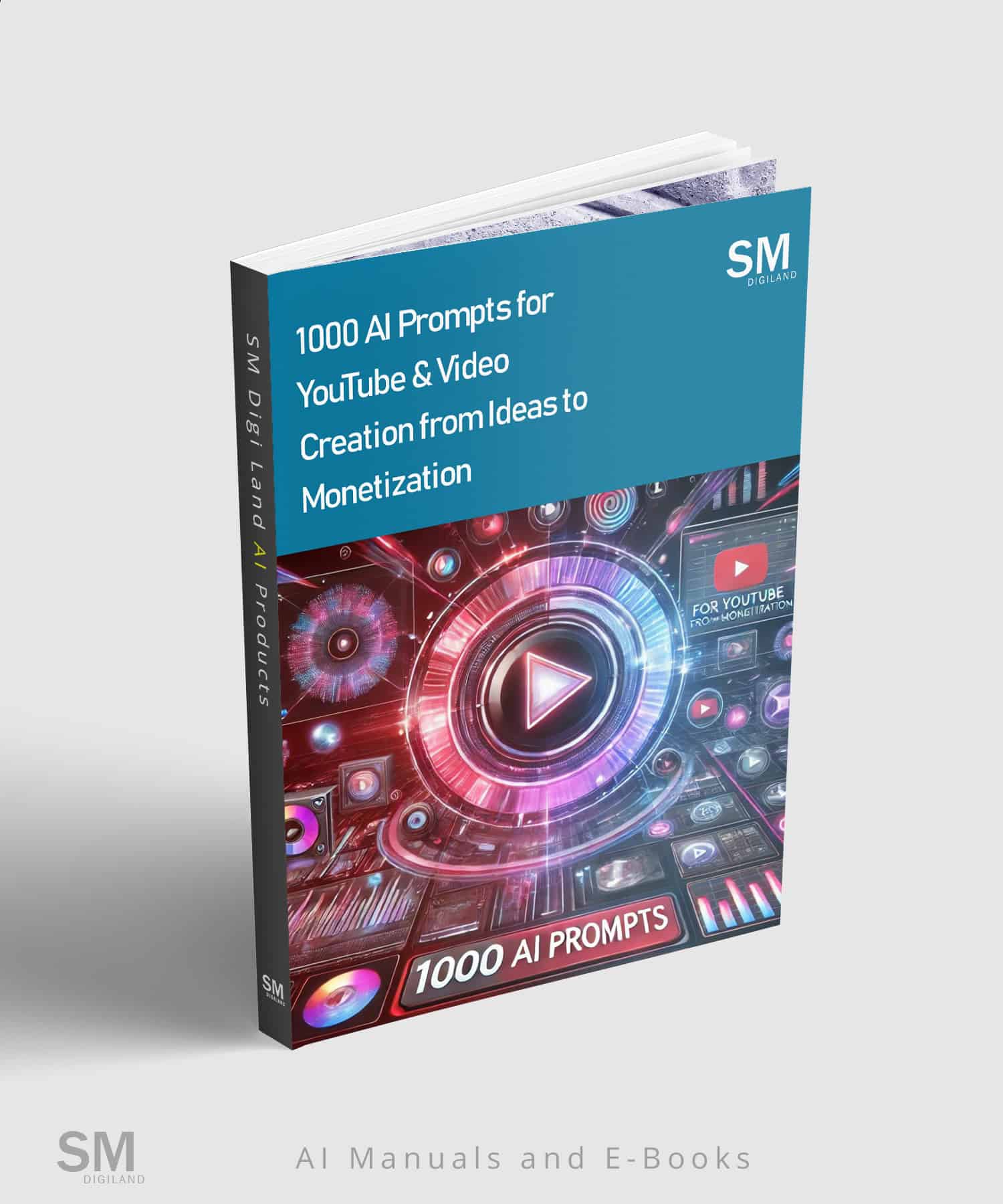


A Structured AI Prompt Library for YouTube and Video Workflows
Successful video creation involves much more than asking an AI tool for a viral idea. Creators must understand their audience, choose a clear topic, develop an original angle, verify factual claims, plan the production, create accurate packaging, publish responsibly, evaluate performance, and improve future videos using reliable evidence.
1000 AI Prompts for YouTube Video Creation and Channel Strategy is a 139-page digital prompt book designed to help creators provide generative-AI tools with clearer context, constraints, source material, audience information, creative direction, and output requirements.
The collection contains 1,000 customizable prompt frameworks organized into 10 focused chapters. It supports recurring workflows across video ideation, content planning, title and thumbnail development, scripting, storyboarding, audience engagement, channel branding, search discovery, collaboration, monetization planning, editing, repurposing, and performance analysis.
This is not a collection of vague instructions such as “make my video viral” or “grow my channel.” The prompts encourage users to define the channel, audience, niche, format, creative objective, available evidence, platform, production resources, brand voice, legal restrictions, and intended deliverable before requesting AI assistance.
Use AI as a Creative and Analytical Assistant
Generative AI can help organize ideas, compare possible creative directions, draft scripts, prepare interview questions, develop shot lists, create production checklists, review supplied analytics exports, and generate options for titles or thumbnail concepts.
However, an AI model does not automatically have access to a creator’s YouTube Studio account, current analytics, audience-retention reports, revenue information, copyright status, platform eligibility, private channel data, or complete real-time knowledge of trends and policies.
Without reliable inputs, AI may invent:
- Search volumes, audience demand, or trending topics
- Views, watch time, click-through rates, and retention findings
- Competitor performance and revenue estimates
- Viewer quotations, comments, preferences, or demographic information
- Current monetization requirements and platform policies
- Statistics, research findings, quotations, and source references
- Copyright ownership or licensing status
- Sponsorship, affiliate, or advertising claims
- Predictions about viral performance or future channel growth
The prompts are most effective when users supply accurate context such as:
- Channel niche, purpose, and positioning
- Target audience and primary viewer need
- Preferred video format and approximate duration
- Existing content and channel information
- Verified YouTube Analytics exports
- Audience feedback collected from real viewers
- Approved research and factual sources
- Production equipment, team, location, and budget
- Brand voice and visual identity
- Rights, licensing, disclosure, and compliance requirements
- Information the AI must not invent or assume
This approach keeps creative judgment, factual verification, publishing decisions, rights clearance, platform compliance, and accountability under human control.
What Is Included?
- 1,000 customizable AI prompt frameworks
- 10 chapters with 100 prompts in each chapter
- A clear Goal for every prompt
- A Usage section explaining the intended application
- An editable Prompt with contextual placeholders
- Workflows for ideation, planning, writing, production, publishing, analysis, and improvement
- Prompts for long-form videos, short-form content, educational videos, interviews, marketing content, and other adaptable formats
- Frameworks for separating verified information from assumptions
- Instructions for identifying missing information and validation requirements
- Reusable prompts for individual creators, brands, agencies, educators, and production teams
Ten Video-Creation Areas Covered
1. Video Ideas and Content Planning
Develop topic options, organize content pillars, explore audience questions, create provisional series concepts, plan publishing calendars, adapt ideas for different formats, and evaluate ideas against channel objectives and available resources.
2. Titles, Descriptions and Thumbnail Concepts
Create accurate title options, organize video descriptions, develop thumbnail directions, compare packaging concepts, clarify the main viewer promise, and prepare testing hypotheses without relying on misleading clickbait or unsupported claims.
3. Video Scripts and Storyboards
Develop hooks, narrative structures, scene sequences, voiceovers, interview questions, demonstrations, transitions, calls to action, shot lists, and storyboard notes based on the intended audience and production format.
4. Audience Engagement and Community Building
Prepare discussion questions, comment-response frameworks, community-post ideas, viewer-feedback requests, live-session plans, recurring audience activities, and ethical engagement strategies without generating fake comments or artificial interactions.
5. YouTube Search and Content Discovery
Organize supplied topic and keyword data, compare possible search intents, improve the clarity of titles and descriptions, develop chapter structures, review content relevance, and prepare discoverability experiments using verified platform information.
6. Channel Branding, Introductions and Conclusions
Define channel positioning, create brand-voice guidelines, plan visual consistency, develop introduction and conclusion options, organize recurring program elements, and create calls to action appropriate to the channel and audience.
7. Collaborations and Creator Outreach
Identify collaboration criteria, evaluate potential partners using supplied information, prepare personalized outreach, define responsibilities, develop interview formats, organize campaign deliverables, and document approval or disclosure requirements.
8. Monetization and Commercial Planning
Explore possible revenue models, sponsorship packages, affiliate-content structures, membership concepts, digital products, services, licensing opportunities, and commercial experiments without guaranteeing eligibility, revenue, advertiser approval, or financial results.
9. Video Editing, Optimization and Repurposing
Create editing briefs, pacing notes, caption workflows, B-roll plans, accessibility checklists, quality-control procedures, and platform-specific repurposing plans while preserving context, accuracy, rights, and audience value.
10. YouTube Analytics and Performance Review
Analyze supplied channel exports, compare reporting periods, investigate retention patterns, organize content-performance findings, develop test hypotheses, document limitations, and distinguish measured results from assumptions or forecasts.
How Every Prompt Is Structured
Every prompt follows a consistent three-part format:
- Goal: Defines the specific video or channel task the prompt is intended to support
- Usage: Explains when and how the prompt can be applied
- Prompt: Provides a detailed instruction ready to customize and use
Depending on the task, editable fields may include [CHANNEL], [NICHE], [TARGET AUDIENCE], [VIDEO FORMAT], [PLATFORM], [TOPIC], [OBJECTIVE], [VIDEO LENGTH], [BRAND VOICE], [SOURCE MATERIAL], [ANALYTICS DATA], [PRODUCTION RESOURCES], [CALL TO ACTION], [DISCLOSURE REQUIREMENTS], [KNOWN LIMITATIONS], and [DESIRED OUTPUT].
Sample AI Prompts for YouTube Creators
The following examples demonstrate the type of structured workflow supported by the collection. They should not be described as verbatim excerpts from the PDF unless compared directly with the published book.
Sample 1: Develop Evidence-Based Video Ideas
Goal: Generate relevant video concepts using supplied audience evidence without inventing trends or performance potential.
Usage: Use when planning a new content series or preparing the next group of videos for a channel.
Prompt:
Act as a video content strategist. Develop video concepts using only the channel information, audience evidence, and verified research supplied below. Do not claim that a topic is trending, highly searched, viral, underserved, or commercially valuable unless supporting evidence has been provided.
Channel purpose: [PURPOSE]
Niche: [NICHE]
Target audience: [AUDIENCE]
Audience problem or interest: [PROBLEM OR INTEREST]
Primary platform: [PLATFORM]
Preferred formats: [FORMATS]
Existing content: [CONTENT INVENTORY]
Verified audience feedback: [FEEDBACK]
Verified performance data: [DATA]
Available production resources: [RESOURCES]
Business objective: [OBJECTIVE]
Topics to avoid: [RESTRICTIONS]Provide:
- Ten distinct video concepts
- The audience need addressed by each concept
- A possible original angle for each concept
- The most suitable format and approximate duration
- The evidence supporting each recommendation
- Information that still needs research
- Possible factual, legal, copyright, or production risks
- A provisional priority rating with an explanation
- A simple validation method before production
- Three concepts recommended for further development
Clearly separate evidence, interpretation, creative suggestions, and assumptions. Do not predict views, subscribers, revenue, or viral performance.
Sample 2: Create a Source-Controlled Video Script
Goal: Prepare a useful video script without fabricating facts, quotations, experiences, or sources.
Usage: Use after selecting a video topic and collecting the required research or subject-matter input.
Prompt:
Act as a video script-development assistant. Create a script using the approved source material and creator information supplied below. Do not invent statistics, quotations, events, personal experiences, product capabilities, customer stories, expert credentials, or research findings.
Video topic: [TOPIC]
Primary audience: [AUDIENCE]
Audience objective: [VIEWER OBJECTIVE]
Video format: [FORMAT]
Approximate duration: [DURATION]
Creator perspective or experience: [EXPERIENCE]
Approved sources: [SOURCES]
Required facts: [FACTS]
Brand voice: [VOICE]
Primary call to action: [CTA]
Required disclosures: [DISCLOSURES]
Restricted claims or topics: [RESTRICTIONS]Create:
- A concise and accurate opening hook
- A statement of what the viewer will learn or experience
- A logical beginning, middle, and conclusion
- Scene-by-scene narration or dialogue
- Suggested on-screen text and supporting visuals
- Source notes for factual claims
- Clear transitions between sections
- A natural call to action
- A list of statements requiring verification or approval
- A pre-publication review checklist
Do not create false urgency or overstate what the video delivers. Mark any missing information instead of filling the gap with a plausible invention.
Sample 3: Review Supplied YouTube Analytics
Goal: Convert verified channel data into an organized performance review without claiming unsupported causes.
Usage: Use after exporting relevant data from an authorized YouTube Studio account.
Prompt:
Act as a YouTube analytics assistant. Analyze only the verified data supplied below. Do not claim to have accessed YouTube Studio, the channel account, competitor accounts, private revenue information, or live platform data.
Channel objective: [OBJECTIVE]
Reporting period: [PERIOD]
Comparison period: [COMPARISON PERIOD]
Video formats: [FORMATS]
Analytics export: [ATTACH OR PASTE DATA]
Data source and export date: [SOURCE AND DATE]
Recent channel changes: [CHANGES]
Known campaigns or external events: [EVENTS]
Data limitations: [LIMITATIONS]Provide:
- A summary of what the supplied dataset contains
- A list of missing fields or limitations
- Performance changes supported directly by the data
- Videos or formats requiring further investigation
- Observed retention, traffic-source, or engagement patterns where available
- Possible explanations clearly labeled as hypotheses
- Additional checks required to test each hypothesis
- Three low-risk content experiments
- The metric and evaluation period for each experiment
- A concise reporting summary for a creator or marketing team
Do not confuse correlation with causation. Do not estimate missing revenue, views, watch time, click-through rates, demographics, or competitor performance.
Who Is This Book For?
- YouTubers and aspiring creators
- Short-form and long-form video creators
- Social-media managers
- Digital marketers and content strategists
- Businesses operating branded channels
- Educators and online-course creators
- Video-production teams
- Freelance scriptwriters and editors
- Agencies managing client channels
- Podcasters repurposing content for video
- Personal-brand and thought-leadership teams
- Marketing and media students
Suitable Video Contexts
The prompt frameworks can be adapted for:
- Educational and tutorial videos
- Product demonstrations and explainers
- Interviews and video podcasts
- Reviews and comparisons
- Business and professional channels
- Personal-brand content
- Entertainment and storytelling formats
- YouTube Shorts and other short-form formats
- Livestream planning and follow-up content
- Social-media and marketing videos
- Multilingual and localized channels
- Agency and client video projects
Users must customize every prompt according to their audience, niche, platform, available evidence, production resources, intellectual-property rights, disclosure duties, applicable laws, and current platform policies.
How to Use the Prompts Effectively
- Select a prompt that matches the specific video task you are working on.
- Replace every placeholder with accurate and relevant information.
- Supply verified audience research, source material, channel data, or analytics where appropriate.
- State the source and retrieval date of important information.
- Separate verified facts from assumptions and creative suggestions.
- Ask the AI to identify missing information instead of inventing details.
- Review scripts and media assets for factual accuracy, originality, copyright, privacy, and brand requirements.
- Confirm current YouTube rules before publishing, promoting, or monetizing content.
- Disclose realistic altered or synthetic content where required.
- Measure results using verified platform data rather than assuming that a creative change was successful.
Product Details
- Title: 1000 AI Prompts for YouTube Video Creation and Channel Strategy
- Format: PDF digital book
- Length: 139 pages
- Language: English
- Number of prompts: 1,000
- Structure: 10 chapters with 100 prompts per chapter
- Prompt format: Goal, Usage, and Prompt
- Delivery: Instant digital download after purchase
- SKU: SMDL-DL-015
- Price: $14
Important Information About AI and Video Creation
Generative-AI systems may produce inaccurate, incomplete, outdated, biased, misleading, or invented information. This may include fabricated trends, audience preferences, performance findings, platform policies, statistics, quotations, competitor results, video recommendations, and revenue forecasts.
AI-generated scripts, images, audio, music, footage, voices, characters, and thumbnails may create copyright, trademark, publicity-right, privacy, impersonation, licensing, disclosure, or platform-policy concerns. Users are responsible for obtaining appropriate rights and approvals.
Realistic altered or synthetically generated content may require disclosure. Content involving real people, public figures, sensitive events, health, finance, legal matters, politics, conflict, or emergencies may require additional care and professional review.
Templated, repetitive, mass-produced, misleading, or minimally original content may be unsuitable for monetization even if AI tools were used to create it. Each published video should provide genuine creative, educational, informational, or entertainment value.
Titles and thumbnails should accurately represent the video. A compelling title or thumbnail does not guarantee distribution, recommendation, ranking, click-through rate, watch time, subscriber growth, or revenue.
What This Product Is—and Is Not
This product is a downloadable educational collection of customizable AI prompt frameworks for video ideation, planning, scripting, production, publishing, channel strategy, engagement, repurposing, analytics, and monetization planning.
It is not a video-production service, channel-management service, editing application, analytics platform, keyword database, monetization program, YouTube Partner Program application service, copyright-clearance service, legal review, advertising campaign, consulting engagement, or source of verified platform data.
The purchase does not include access to ChatGPT, Claude, Gemini, Microsoft Copilot, YouTube Premium, YouTube Studio integrations, editing software, stock-media libraries, music licenses, analytics tools, AI video generators, or other third-party products. Separate accounts, subscriptions, exports, licenses, or integrations may be required.
This product is independently created and is not affiliated with, sponsored by, or endorsed by YouTube or Google. YouTube and related marks belong to their respective owners.
The book does not guarantee views, impressions, recommendations, search rankings, audience retention, subscribers, engagement, sponsorships, monetization approval, advertising eligibility, affiliate income, product sales, revenue, or viral performance.
Frequently Asked Questions
Does the book contain exactly 1,000 prompts?
Yes. It contains 10 chapters with 100 prompts in each chapter, providing a total of 1,000 customizable prompt frameworks.
Can these prompts make a video go viral?
No prompt, tool, book, title, thumbnail, or content strategy can guarantee viral performance. The prompts can support planning and creative development, but distribution and audience response depend on many factors outside the product’s control.
Can the prompts write complete video scripts?
They can support outlines, hooks, scenes, narration, interview questions, storyboards, calls to action, and drafts. Scripts still require factual verification, original creative input, editing, rights review, and human approval.
Do the prompts connect directly to YouTube Studio?
No. No direct connection, account access, analytics integration, or platform subscription is included. Users may adapt relevant prompts using authorized exports and information from their own accounts.
Can the book help with YouTube Shorts?
Yes. Many frameworks can be adapted for short-form topics, hooks, scripts, shot plans, captions, repurposing, and performance review. Users must customize them for the current format and platform requirements.
Can the prompts analyze my channel?
They can help organize and interpret data that you supply. The AI cannot reliably analyze private channel performance or claim access to YouTube Studio unless an authorized integration and valid dataset are actually available.
Will the book help me qualify for monetization?
The prompts can help structure original content and commercial planning, but they cannot guarantee eligibility or approval. Monetization depends on current thresholds, location, account status, channel review, content quality, rights, and compliance with YouTube policies.
Can I use AI-generated voices, footage or music?
Possibly, depending on the content, tool license, applicable rights, disclosure requirements, and platform policies. Users must verify that they have the necessary commercial rights and make any required disclosures before publishing.
Will these prompts work with every AI platform?
The general prompt frameworks can be adapted to different generative-AI systems. Features, privacy terms, file support, context limits, integrations, data retention, and output quality vary between platforms and versions.
Is this a physical book?
No. It is a 139-page English PDF delivered digitally. No physical product will be shipped.
Build More Controlled Video-Creation Workflows
Use these 1,000 customizable prompts to explore ideas, define audience value, prepare scripts, organize production, improve video packaging, plan engagement, evaluate supplied channel data, and document creative decisions more clearly.
Download the 139-page PDF and adapt the prompts to your channel, audience, niche, format, production resources, brand standards, source material, rights, and business objectives.


