


Build More Structured Social Media Marketing Workflows with AI
Social media marketing involves far more than writing occasional captions. Brands and creators must understand their audiences, define a consistent voice, plan relevant content, adapt ideas to different platforms, manage campaigns, respond to their communities, review performance, and continuously improve their approach.
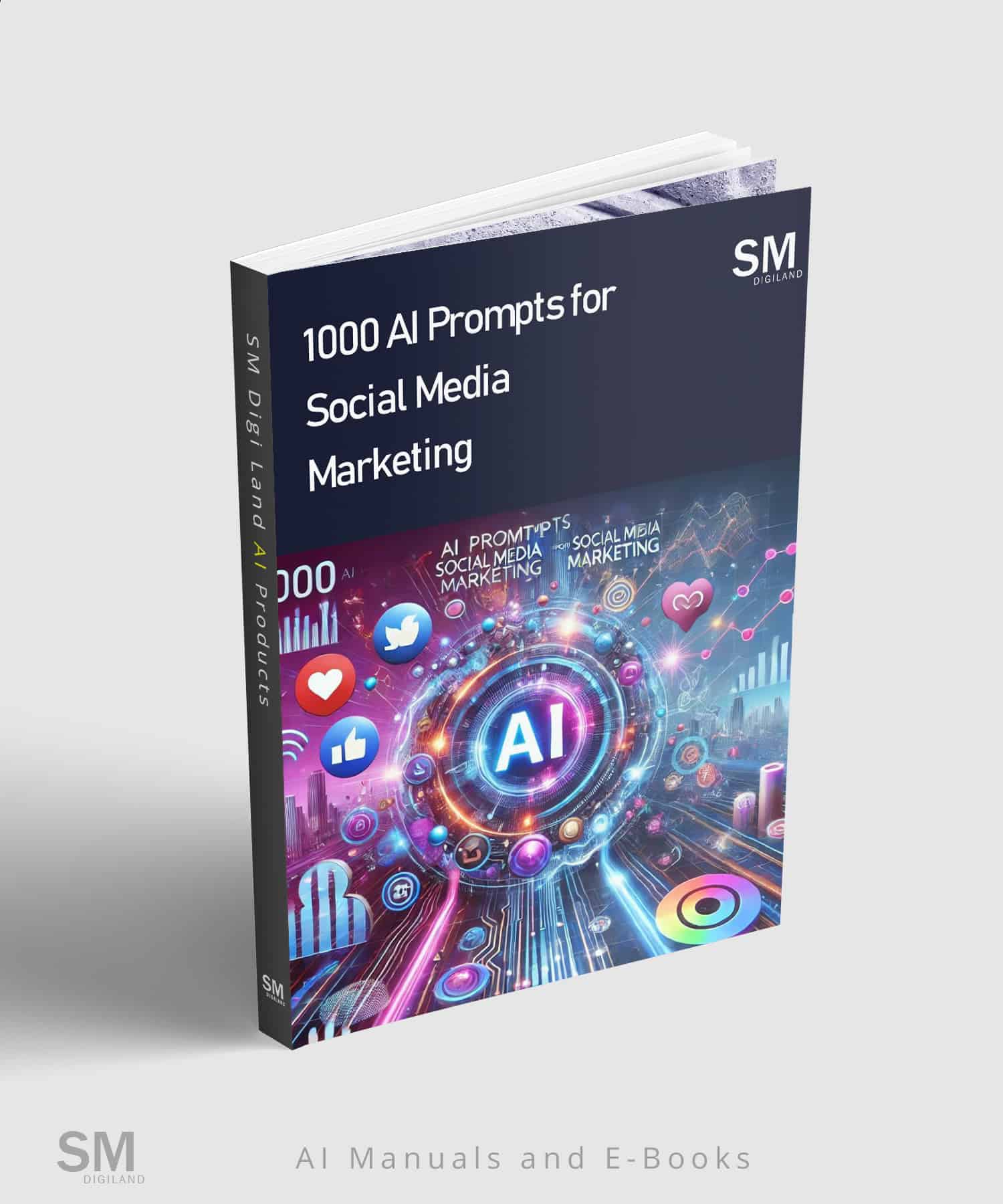
1000 AI Prompts for Social Media Marketing is a 138-page digital prompt book designed to help marketers, creators, agencies, entrepreneurs, and brand teams use generative AI more intentionally across these different responsibilities.
The book contains 1,000 customizable prompt frameworks organized into 10 focused chapters. Each chapter includes 100 prompts dedicated to a major area of social media marketing.
Instead of relying on short and generic instructions, users can provide information about their brand, audience, objective, platform, offer, content format, campaign stage, available assets, and communication style. This helps the AI produce material that is more relevant to the actual task.
What Is Included in the Book?
- 1,000 structured and editable AI prompts
- 10 focused social media marketing chapters
- 100 prompts in every chapter
- A clear Goal for each prompt
- A practical Usage explanation
- A ready-to-customize Prompt with editable fields
- Applications for major social media platforms
- Prompts for both organic and paid social media activities
- Frameworks adaptable to different industries and audience types
- Ideas for individual creators, small businesses, agencies, and marketing teams
Ten Social Media Marketing Topics Covered
1. Social Media Posts, Stories and Short-Form Videos
Develop content ideas for posts, stories, reels, short videos, carousels, educational content, promotional material, behind-the-scenes updates, and other platform-appropriate formats.
2. Brand Voice and Social Media Storytelling
Clarify brand personality, communication principles, message themes, narrative angles, vocabulary, emotional tone, and storytelling approaches that can support greater consistency across different channels.
3. Content Calendars and Campaign Planning
Create structured weekly, monthly, seasonal, launch-based, and event-based content plans based on marketing objectives, available resources, audience interests, and publishing capacity.
4. Captions, Hooks, Headlines and Calls to Action
Generate and improve opening hooks, captions, headlines, video introductions, carousel titles, promotional copy, audience questions, and calls to action for different campaign objectives.
5. Visual Content and Creative Direction
Develop creative briefs, visual concepts, shot lists, graphic directions, carousel structures, short-video scenes, mood-board descriptions, and AI-assisted image ideas aligned with the brand’s identity.
6. Audience Engagement and Community Management
Plan conversation starters, response frameworks, community activities, frequently asked questions, direct-message workflows, feedback requests, moderation guidelines, and approaches to recurring audience interactions.
7. Trend Research, Performance Review and Optimization
Organize trend research, review supplied performance data, compare content results, identify possible patterns, develop testable hypotheses, and plan future experiments without assuming that correlation proves causation.
8. Influencer Collaborations and Brand Partnerships
Prepare partnership briefs, creator-selection criteria, outreach drafts, campaign concepts, deliverable lists, content-review workflows, disclosure reminders, and post-campaign evaluation questions.
9. Product Launches, Promotions and Giveaways
Develop structured social media plans for new products, services, events, limited offers, lead-generation campaigns, contests, giveaways, and promotional periods while accounting for platform and local requirements.
10. Social Advertising and Cross-Platform Growth
Explore audience research, campaign-message development, ad-copy variations, creative testing, landing-page alignment, retargeting concepts, budget-planning questions, and cross-platform content adaptation.
How Every Prompt Is Structured
Each prompt follows a consistent three-part format:
- Goal: Explains the specific result the prompt is designed to support
- Usage: Describes when and how the prompt may be applied
- Prompt: Provides a structured instruction ready to customize and copy into a suitable AI tool
Editable fields such as [BRAND], [AUDIENCE], [PLATFORM], [OBJECTIVE], [PRODUCT], [TONE OF VOICE], [CONTENT FORMAT], [CAMPAIGN PERIOD], and [PERFORMANCE DATA] help users adapt each prompt to their own situation.
Sample AI Prompts for Social Media Marketing
The following examples demonstrate the type of structured workflow supported by this product. They should be presented as product-page samples rather than confirmed excerpts from the PDF unless compared directly with the original book.
Sample 1: Develop a Platform-Specific Content Strategy
Goal: Transform a business objective into a practical social media content strategy.
Usage: Use this prompt before creating a content calendar or individual posts.
Prompt:
Act as a social media strategist. Develop a platform-specific content strategy using only the information provided below.
Brand: [BRAND]
Industry: [INDUSTRY]
Products or services: [OFFERINGS]
Target audience: [AUDIENCE]
Primary market: [LOCATION OR MARKET]
Platforms: [PLATFORMS]
Marketing objectives: [OBJECTIVES]
Brand voice: [VOICE]
Available content assets: [ASSETS]
Publishing capacity: [NUMBER OF POSTS PER WEEK]
Current challenges: [CHALLENGES]First, identify important missing information. Then provide:
- A recommended role for each selected platform
- Five content pillars
- Suggested formats for each content pillar
- A practical publishing rhythm
- Audience-engagement opportunities
- Calls to action appropriate to each objective
- Three measurable experiments to run during the first month
- Information or assumptions that must be verified
Do not invent audience research, customer testimonials, performance results, market data, awards, partnerships, or product benefits. Do not promise follower growth, reach, engagement, leads, or sales.
Sample 2: Create a Four-Week Social Media Content Calendar
Goal: Produce an achievable content calendar based on available resources and verified information.
Usage: Use this prompt for monthly planning after defining the brand’s strategy and content pillars.
Prompt:
Act as a social media content planner. Create a four-week content calendar for the following brand.
Brand: [BRAND]
Audience: [AUDIENCE]
Platforms: [PLATFORMS]
Monthly objective: [OBJECTIVE]
Content pillars: [PILLARS]
Important dates: [DATES]
Products, services, or events to feature: [DETAILS]
Available photos and videos: [ASSETS]
Brand voice: [VOICE]
Posting capacity: [CAPACITY]
Restricted topics or claims: [RESTRICTIONS]For each proposed post, include:
- Publication date or sequence
- Platform
- Content objective
- Topic and angle
- Suggested format
- Opening hook
- Caption outline
- Visual direction
- Call to action
- Required assets
- Facts or claims requiring verification
Balance educational, engaging, brand-building, community-focused, and promotional content. Keep the plan realistic for the stated publishing capacity. Do not invent statistics, testimonials, partnerships, discounts, product details, or event information.
Sample 3: Analyze Supplied Social Media Performance Data
Goal: Turn supplied performance data into structured observations and testable next steps.
Usage: Use this prompt with exported or manually entered social media metrics.
Prompt:
Act as a social media performance analyst. Analyze only the data I provide below.
Platform: [PLATFORM]
Evaluation period: [PERIOD]
Business objective: [OBJECTIVE]
Content categories: [CATEGORIES]
Performance data: [PASTE DATA]
Important campaign changes: [CHANGES]
Known limitations in the data: [LIMITATIONS]Provide:
- A concise performance summary
- The strongest and weakest content categories
- Observable patterns by format, topic, timing, and call to action
- Possible explanations clearly labelled as hypotheses
- Missing information needed for a stronger analysis
- Five practical tests for the next content period
- Metrics that should be monitored for each test
Do not invent missing metrics or treat correlation as proof of causation. Do not claim that a specific change will guarantee reach, engagement, followers, leads, conversions, or revenue.
Who Is This Book For?
- Social media managers
- Content creators
- Digital marketing professionals
- Marketing and creative agencies
- Small-business owners
- Entrepreneurs and startup teams
- Personal-brand managers
- Freelance marketers and copywriters
- E-commerce marketing teams
- Professionals building internal AI prompt libraries
How to Get Better Results
- Choose a prompt that matches a real marketing task.
- Replace every placeholder with accurate information.
- Provide examples of the brand’s existing voice and content when relevant.
- Specify the intended audience, platform, objective, and content format.
- Ask the AI to identify missing information instead of inventing details.
- Generate multiple alternatives before selecting a final direction.
- Edit every output to match the brand’s real voice and standards.
- Verify all names, dates, prices, claims, links, statistics, and product information.
- Review current platform rules before publishing advertisements, promotions, or giveaways.
- Compare results with relevant business metrics rather than relying only on vanity metrics.
Product Details
- Title: 1000 AI Prompts for Social Media Marketing
- Format: PDF digital book
- Length: 138 pages
- Language: English
- Number of prompts: 1,000
- Structure: 10 chapters with 100 prompts per chapter
- Prompt format: Goal, Usage, and Prompt
- Delivery: Instant digital download after purchase
- SKU: SMDL-DL-008
- Price: $15
Important Information About AI and Social Media Marketing
Generative AI may produce inaccurate, outdated, repetitive, biased, generic, or invented content. It may also misunderstand brand context, platform requirements, audience expectations, cultural sensitivities, advertising restrictions, and legal obligations.
Every output should be reviewed and edited before publication. Names, dates, prices, product features, statistics, quotations, testimonials, links, promotional conditions, disclosure statements, and campaign claims must be independently verified.
Users should review the current rules of each social media platform and any applicable advertising, privacy, intellectual-property, promotional, or consumer-protection requirements before publishing content.
Do not upload confidential client information, unpublished campaign plans, private audience data, customer records, passwords, access tokens, or other sensitive material to a third-party AI service without appropriate authorization and safeguards.
What This Product Is—and Is Not
This product is a downloadable educational collection of customizable AI prompts for social media strategy, content creation, communication, campaigns, partnerships, advertising, analysis, and workflow planning.
It is not a physical book, AI subscription, social media management service, personalized campaign, advertising account, content-production package, consulting engagement, analytics platform, or guarantee of marketing results.
The purchase does not include access to ChatGPT, Canva, Jasper, Copy.ai, or another third-party platform. Separate accounts or subscriptions may be required.
The book does not guarantee viral content, follower growth, reach, impressions, engagement, leads, conversions, sales, return on advertising spend, influencer partnerships, platform approval, or business growth.
Frequently Asked Questions
Does the book contain exactly 1,000 prompts?
Yes. It contains 10 chapters with 100 prompts in each chapter, providing a total of 1,000 customizable prompt frameworks.
Which social media platforms can I use the prompts for?
The frameworks may be adapted for platforms such as Instagram, Facebook, TikTok, LinkedIn, YouTube, Pinterest, X, and other relevant channels. Features, formats, and platform rules may change, so each prompt should be adjusted to the current platform environment.
Is this book only for social media professionals?
No. It may also be useful for creators, entrepreneurs, small-business owners, freelancers, agencies, personal brands, and marketing students.
Does the book generate content automatically?
No. The book provides prompt frameworks that users can customize and enter into a suitable generative-AI platform.
Does the purchase include ChatGPT or another AI platform?
No. The purchase includes only the downloadable PDF. Access to third-party AI tools must be obtained separately.
Will the prompts work with every AI model?
The general frameworks may be adapted to different generative-AI tools, but output quality, supported features, context limits, privacy terms, and file capabilities vary between platforms and model versions.
Can these prompts guarantee viral posts?
No. Content performance depends on factors such as audience relevance, creative execution, timing, competition, platform distribution, brand credibility, budget, consistency, and market conditions.
Can agencies use the prompts for client projects?
Agencies and freelancers may use the frameworks to support their own approved workflows. All generated material must still be reviewed against the client’s brief, brand standards, factual information, permissions, and applicable rules.
Is the content suitable for beginners?
Yes. The consistent Goal, Usage, and Prompt structure makes the collection accessible to beginners, while the editable frameworks can also support more advanced workflows.
Is this a physical book?
No. It is an English-language PDF delivered digitally. No physical product will be shipped.
Turn Marketing Tasks into Repeatable AI Workflows
Use these 1,000 prompt frameworks to plan content more consistently, explore new creative directions, improve marketing communication, organize campaigns, evaluate supplied data, and develop reusable social media workflows.
Download the 138-page PDF and customize the prompts around your brand, audience, platforms, objectives, resources, and communication style.


