


A Structured Prompt Library for Manufacturing Professionals
Generative AI can help manufacturing teams organize questions, explore possible causes, prepare initial drafts and structure process-improvement discussions. However, AI-generated information may be inaccurate, incomplete, outdated or unsuitable for a particular facility, machine, product or regulatory environment.
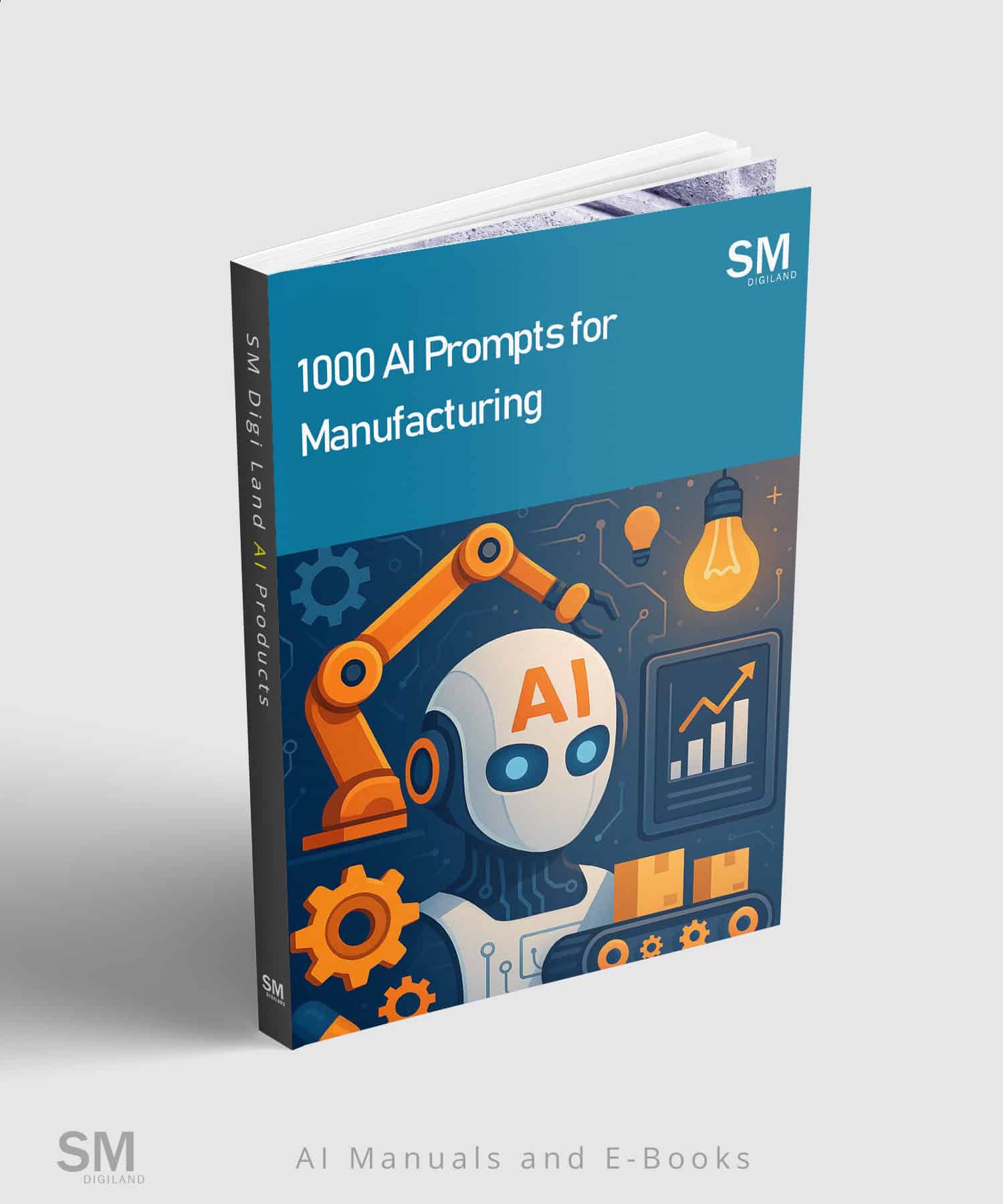
1000 AI Prompts for Manufacturing Operations and Process Improvement is an English digital guide containing customizable prompts for responsible AI-assisted planning, analysis, communication and professional development.
The book does not operate machinery, connect to industrial systems or provide validated engineering conclusions. Its outputs must always be reviewed against actual equipment documentation, operational data, approved procedures and applicable standards.
What the Prompt Collection Covers
Maintenance Planning and Failure Analysis
Structure maintenance-planning discussions, equipment-history reviews, inspection questions, failure-mode brainstorming and condition-monitoring requirements. The prompts do not predict equipment failure or replace approved maintenance schedules.
Quality Management and Defect Investigation
Develop draft inspection questions, defect-classification frameworks, corrective-action discussions and quality-review checklists. Final acceptance, rejection and product-release decisions must remain with authorized personnel using validated methods.
Production Planning and Process Improvement
Explore bottlenecks, process variations, changeover issues, capacity constraints and continuous-improvement opportunities through structured questions and draft analysis frameworks.
Inventory and Supply-Chain Analysis
Prepare initial demand-planning questions, inventory reviews, supplier-assessment criteria and disruption scenarios using verified operational information.
Monitoring and Alerting Strategy Design
Define possible monitoring requirements, escalation paths, dashboard concepts and human-reviewed alert-response procedures. The book does not include live monitoring, alarms, sensors or system integration.
Workforce Training and Task Planning
Develop training outlines, fictional exercises, knowledge checks, role descriptions and operational-communication drafts for review by qualified supervisors and safety personnel.
Energy Efficiency and Sustainability Planning
Organize questions about energy use, material waste, resource efficiency and sustainability initiatives without guaranteeing savings or environmental outcomes.
Root-Cause Analysis and Troubleshooting
Generate investigation questions and possible hypotheses while keeping facts, assumptions and unverified possibilities clearly separated. AI suggestions must not be treated as confirmed causes.
AI Project Planning for MES, ERP and IoT Environments
Explore requirements, stakeholders, data readiness, governance, cybersecurity and implementation risks before considering an AI-assisted industrial project. No software integration or technical deployment is included.
Implementation Scenarios and Lessons Learned
Use fictional or properly documented scenarios to examine possible implementation challenges, human-oversight requirements and change-management considerations.
What This Book Must Not Be Used For
- Direct control of machinery or production equipment
- PLC, SCADA, DCS or robot-control instructions used without validation
- Disabling guards, alarms, interlocks or emergency systems
- Changing operating limits, setpoints or calibration values without authorization
- Predicting a component’s remaining life without a validated model and suitable data
- Replacing equipment manuals or approved maintenance procedures
- Final quality acceptance, rejection or product-release decisions
- Unsupervised troubleshooting of hazardous equipment
- Safety, environmental or regulatory approval
- Substitution for qualified engineering or occupational-safety professionals
Professional Review and Validation
Before using an AI-generated output, appropriately qualified personnel should verify:
- Equipment specifications and manufacturer instructions
- Actual operating and maintenance data
- Applicable engineering standards and legal requirements
- Plant-specific operating and emergency procedures
- Assumptions, calculations, units and thresholds
- Citations, standards and technical references
- Possible safety, environmental and cybersecurity consequences
- Required testing, approvals and change-control procedures
AI-generated technical references may be fabricated or outdated. Every cited document, standard and specification must be checked against an authoritative source.
Confidentiality and Cybersecurity
Do not enter passwords, API keys, access credentials, OT network diagrams, machine configurations, proprietary formulas, production recipes, customer data, employee information or other confidential material into a public AI service.
Organizations should use only appropriately approved systems and follow their information-security, access-control, data-retention and confidentiality requirements.
How to Use the Book
- Select a prompt relevant to the task.
- Replace the variables with non-confidential and properly authorized information.
- State the facility context, equipment type and intended audience.
- Require the AI to separate facts, assumptions and hypotheses.
- Tell the AI not to invent measurements, standards, sources or technical details.
- Request alternative explanations and missing-data questions.
- Verify the output against primary technical sources.
- Conduct the required risk, safety and cybersecurity reviews.
- Obtain authorization before operational implementation.
Who Is This Book For?
- Manufacturing engineers
- Plant and operations managers
- Maintenance-planning teams
- Quality professionals
- Continuous-improvement teams
- Production planners
- Supply-chain professionals
- Industrial consultants
- Technical trainers
- Professionals studying responsible industrial AI adoption
What Is Not Included?
- An AI account or subscription
- API access or usage credits
- Real-time equipment monitoring
- A predictive-maintenance model
- MES, ERP, PLC, SCADA or IoT integration
- Sensor hardware or industrial software
- Machine-control or automation services
- Plant-specific engineering analysis
- Professional certification
- Installation, consulting or technical support services
Product Details
- Title: 1000 AI Prompts for Manufacturing Operations and Process Improvement
- Format: Digital PDF
- Language: English
- Number of prompts: 1000
- Number of chapters: 10
- Number of pages: 155
- Price: $20.00, excluding applicable taxes
- Delivery: Digital download after purchase
- SKU: SMDL-DL-028
- Edition: [ADD EDITION]
- Last updated: [ADD DATE]
Frequently Asked Questions
Does this book predict equipment failures?
No. It provides prompts for structuring maintenance questions and analysis. It does not include a validated predictive model, live equipment data or sensor integration.
Can the outputs be used to control machinery?
No. AI-generated text must not be used directly for machine control, safety-system changes or modifications to operating parameters.
Does it connect to MES, ERP, PLC, SCADA or IoT systems?
No. The purchase includes an English PDF only. No integration, software, API or technical deployment service is included.
Can AI make final quality-control decisions?
No. Final inspection and product-release decisions must be made by authorized personnel using validated processes and reliable evidence.
Can I upload confidential plant data?
Do not submit confidential, proprietary, personal or security-sensitive information to a public AI service. Follow your organization’s approved data and cybersecurity requirements.
Does the purchase include ChatGPT or another AI subscription?
No. AI accounts, subscriptions, APIs and usage costs are separate.
Is this a physical book?
No. It is delivered digitally as an English PDF. No physical product will be shipped.
Build More Structured Manufacturing Workflows
Use the prompt collection to organize questions, develop initial drafts, explore alternative explanations and prepare professional discussions while maintaining human oversight, technical validation and operational accountability.
This product is independently created and is not affiliated with, sponsored by, certified by or endorsed by OpenAI, Anthropic, Google, any equipment manufacturer, software provider, standards organization or regulatory authority. Third-party names and trademarks belong to their respective owners.


