


Use AI to Think More Deeply About Your Art—not to Replace Your Creativity
A blank canvas does not always mean a lack of skill. Sometimes the difficult part is finding the right concept, developing a visual direction, evaluating an unfinished work, or explaining the meaning behind a completed piece.
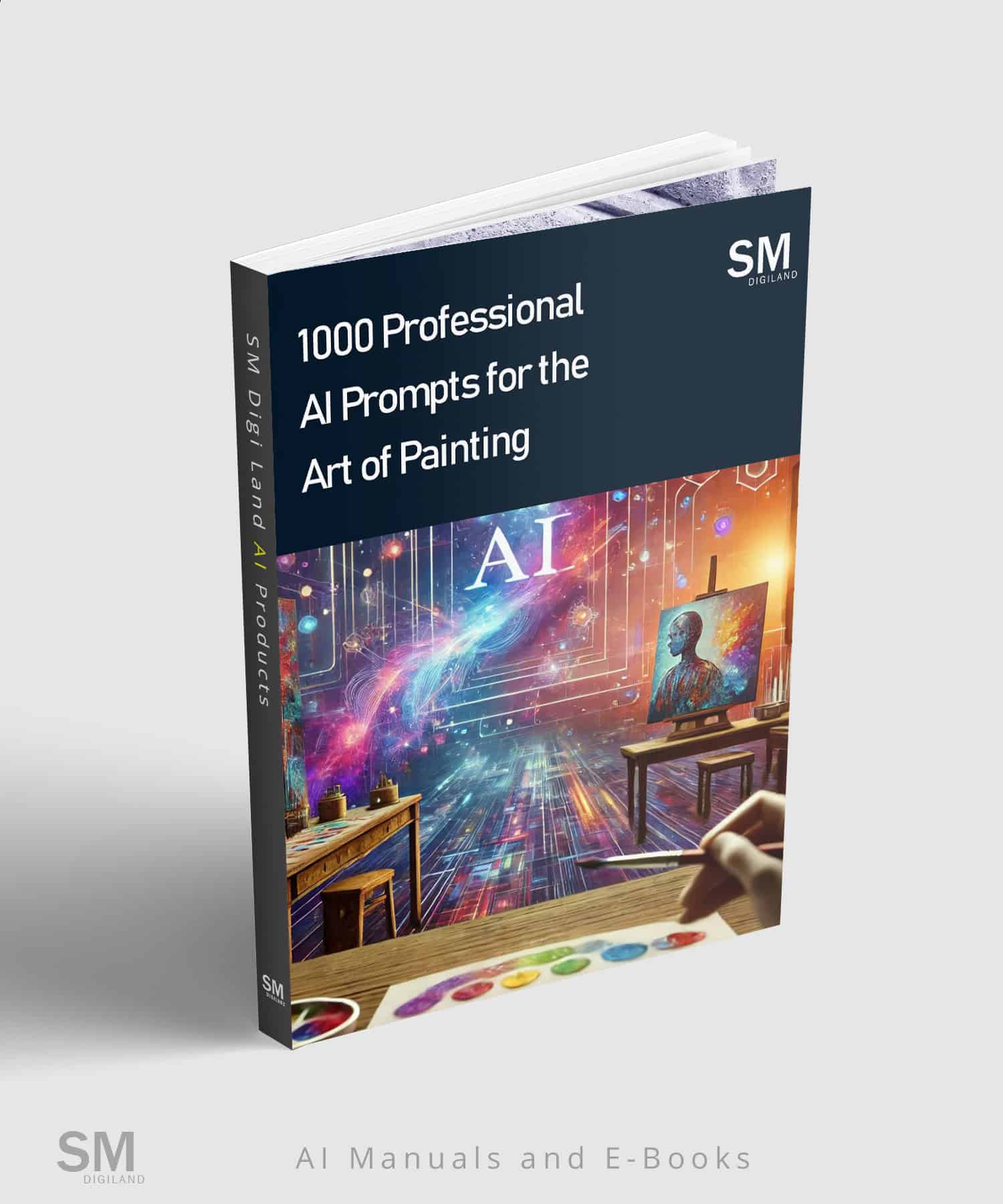
1000 AI Prompts for Painters and Visual Artists is a practical prompt library designed to help artists use AI as a creative thinking, planning, critique, writing, and marketing assistant. Instead of offering vague commands such as “give me a painting idea,” the book provides structured prompts that help you communicate your medium, subject, artistic goals, limitations, and intended audience.
The collection supports both the creative and professional sides of an artist’s practice. You can use it to explore new painting concepts, compare composition options, build color palettes, strengthen visual narratives, review work in progress, prepare artist statements, organize portfolio content, and communicate more effectively with collectors and audiences.
What Can These AI Prompts Help You Do?
- Develop original painting concepts from themes, memories, emotions, places, or social subjects
- Explore multiple compositions before committing to a final canvas
- Create purposeful color palettes based on mood, symbolism, lighting, and visual contrast
- Plan portraits, figures, environments, landscapes, and narrative scenes
- Experiment with abstract, mixed-media, and cross-genre approaches
- Evaluate an artwork through composition, color, technique, clarity, and emotional impact
- Turn a visual idea into a stronger story or cohesive collection
- Write artist statements, artwork descriptions, exhibition texts, and portfolio introductions
- Develop relevant content for social media without reducing your art to generic promotional posts
- Work through creative block with structured exercises and alternative directions
Inside the Book: 10 Focused Chapters
1. Concept and Theme Development
Generate and refine painting ideas by connecting personal experience, cultural references, emotions, symbolism, research, and visual metaphors.
2. Character and Figure Exploration
Develop poses, expressions, relationships, gestures, costumes, environments, and narrative context for portraits and figurative artworks.
3. Color Palette and Mood
Use AI to compare color relationships, emotional associations, lighting conditions, contrast levels, and alternative palettes before or during a painting.
4. Landscape and Environment Design
Plan natural, urban, imagined, historical, and symbolic environments with attention to depth, atmosphere, focal points, scale, and storytelling.
5. Abstract and Experimental Techniques
Explore unconventional mark-making, material combinations, abstraction methods, mixed-media ideas, and creative constraints that can lead to unexpected results.
6. Artwork Critique and Development
Request structured feedback on composition, visual hierarchy, balance, color, technique, originality, and communication without treating AI feedback as a replacement for artistic judgment.
7. Visual Storytelling
Strengthen the relationship between subject, setting, symbolism, sequence, emotion, and viewer interpretation across individual works or connected collections.
8. Artist Statements and Art Marketing
Translate your artistic intentions into clear artist statements, artwork descriptions, exhibition proposals, collector-facing text, and professional presentation materials.
9. Portfolio and Social Media Content
Create thoughtful studio updates, process stories, captions, portfolio introductions, content themes, and audience engagement ideas that remain consistent with your artistic identity.
10. Creative Block and Sustainable Practice
Identify the source of creative stagnation, generate manageable exercises, revisit unfinished ideas, and establish a more consistent creative routine.
Three Sample Prompts
Sample Prompt 1: Develop a Painting Concept
Goal: Transform a broad emotional theme into a paintable visual concept.
Usage: Use this when you have a subject or emotion in mind but need a clearer composition, visual metaphor, and artistic direction.
Prompt:
Act as a painting concept development partner. I am creating a [MEDIUM] painting about [THEME OR EMOTION] for [INTENDED AUDIENCE OR CONTEXT]. My preferred artistic influences are [INFLUENCES], but I do not want to imitate any artist directly.
Propose five distinctly different concepts. For each concept, provide: the central subject, setting, composition, focal point, color direction, lighting, symbolic elements, intended emotional response, and one potential visual risk or cliché to avoid. Conclude by comparing the five concepts and recommend the strongest option based on originality, visual clarity, and feasibility in my chosen medium.
Sample Prompt 2: Critique a Work in Progress
Goal: Receive structured feedback on an unfinished painting.
Usage: Provide a clear photograph of the artwork or describe its current stage, dimensions, medium, subject, and intention.
Prompt:
Act as a constructive studio critique partner. Evaluate the attached work-in-progress painting using the following context: medium [MEDIUM], dimensions [SIZE], subject [SUBJECT], intended mood [MOOD], intended focal point [FOCAL POINT], and current concern [PROBLEM].
Separate your response into: what is already working, composition and visual hierarchy, color and value relationships, spatial depth, technical execution, emotional communication, and the three highest-priority revisions. Explain why each revision matters and suggest a low-risk way to test it before I make a permanent change. Do not redesign the artwork or impose a different style unless the current choices conflict with my stated intention.
Sample Prompt 3: Write an Artist Statement
Goal: Create a credible artist statement based on the artist’s actual practice.
Usage: Replace the fields with real information and remove anything that does not accurately represent your work.
Prompt:
Act as an experienced art editor. Write a clear, specific artist statement using only the information I provide. My recurring subjects are [SUBJECTS]. I work primarily with [MEDIA AND TECHNIQUES]. My work investigates [IDEAS OR QUESTIONS]. My personal or cultural connection to the work is [CONNECTION]. I want viewers to experience or consider [INTENDED RESPONSE].
Create three versions: a concise 80-word statement, a professional 180-word portfolio statement, and a 250-word exhibition statement. Avoid exaggerated claims, vague phrases such as “pushing boundaries,” invented achievements, and overly academic language. Afterward, list any missing information that could make the statement more distinctive.
How to Use the Book
- Choose a prompt that matches your current creative or professional task.
- Replace bracketed fields with details about your medium, style, subject, goals, and limitations.
- Give the AI relevant context instead of relying on a one-line instruction.
- Review the response critically and keep only suggestions that support your artistic intention.
- Refine the prompt by asking for alternatives, comparisons, or more specific reasoning.
The prompts are starting frameworks, not fixed formulas. The more accurately you describe your practice and intentions, the more relevant the response becomes.
Who Is This Book For?
- Traditional painters working with oil, acrylic, watercolor, gouache, pastel, or mixed media
- Digital painters and visual artists
- Emerging artists developing a portfolio or cohesive body of work
- Professional artists preparing exhibitions, proposals, and collector-facing materials
- Art students looking for structured exercises and critique questions
- Art teachers developing classroom discussions or creative assignments
- Hobby painters who want to explore new subjects and techniques
Product Details
- Content: 1,000 structured sample prompts
- Organization: 10 chapters with 100 prompts per chapter
- Length: 150 pages
- Format: PDF
- Language: English
- Delivery: Instant digital download after purchase
- Recommended tools: ChatGPT, Claude, Gemini, and comparable text-based AI assistants
- Skill level: Suitable for beginners through professional artists
What This Product Is—and Is Not
This is a downloadable prompt book for artists who want to use AI for ideation, planning, critique, writing, and professional communication. It is not a painting course, physical book, AI subscription, or replacement for your artistic skill and judgment.
Some prompts may help you prepare concepts for visual AI tools, but this product is not primarily a Midjourney or AI image-generation prompt pack. If your main goal is generating images directly with AI, explore our dedicated AI image prompt collection instead.
Frequently Asked Questions
Do I need experience with AI?
No. The prompts are ready to customize, and the introductory guidance explains how to add the context needed for more useful responses.
Will AI create the paintings for me?
No. This book is designed mainly to support your thinking, planning, critique, writing, and marketing. You remain responsible for every artistic and creative decision.
Can traditional painters use these prompts?
Yes. Many prompts apply directly to oil, acrylic, watercolor, gouache, pastel, charcoal, mixed-media, and other studio practices.
Which AI tools can I use?
The prompts work best with conversational AI assistants such as ChatGPT, Claude, and Gemini. Results vary depending on the tool, model, and context you provide.
Are the prompts reusable?
Yes. You can reuse and adapt them for different paintings, collections, exhibitions, audiences, media, and stages of your artistic development.
Is this a physical book?
No. This is an English-language PDF delivered digitally after purchase. No physical item will be shipped.
Build a More Intentional Creative Practice
Use AI to ask better questions, explore alternatives, and communicate your artistic ideas more clearly. Download the book and turn its 1,000 customizable prompts into a practical resource for your studio, portfolio, and professional art practice.


