
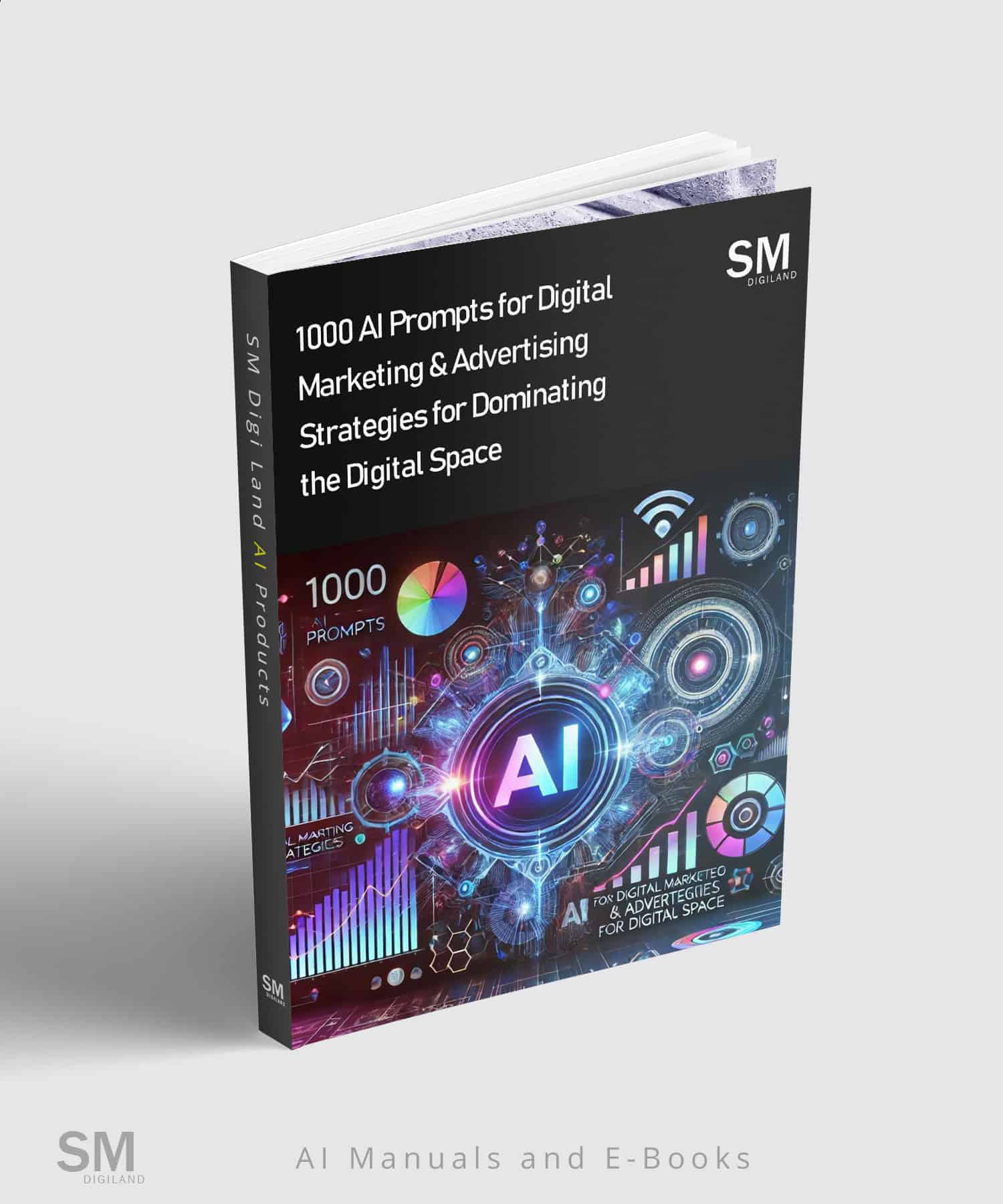


A Structured AI Prompt Library for Digital Marketing and Advertising
Effective digital marketing requires more than producing large volumes of content. Marketers must understand the offer, audience, evidence, channel, objective, budget, customer journey, brand requirements, measurement plan, legal constraints, and criteria for success.
1000 AI Prompts for Digital Marketing and Advertising is a 116-page digital prompt book designed to help users approach these tasks with clearer instructions and more structured workflows.
The collection contains 1,000 customizable prompt frameworks organized into 10 marketing and advertising areas. It supports campaign ideation, copy development, audience research, channel planning, search and social advertising, campaign scheduling, automation planning, performance review, A/B-test design, budget analysis, retargeting, upselling, cross-selling, and AI-assisted marketing workflows.
This is not a collection of one-line instructions promising instant growth or automatic campaign success. The prompts are designed to help users define context, document assumptions, provide verified information, identify missing data, draft possible approaches, compare alternatives, and establish measurable review criteria.
AI Can Support Marketing Decisions—but It Cannot Guarantee Performance
Generative AI can help organize information, develop drafts, compare options, and analyze data supplied by the user. It cannot independently confirm that a market exists, access private advertising accounts, know current campaign results, validate customer demand, verify a product claim, determine legal compliance, or guarantee financial performance.
Without reliable information, an AI system may:
- Invent market statistics, audience characteristics, trends, competitors, benchmarks, or customer behavior
- Create product claims, awards, certifications, testimonials, reviews, prices, discounts, or results that were never provided
- Recommend targeting based on sensitive, prohibited, outdated, or inappropriate characteristics
- Misinterpret advertising reports, attribution windows, conversion events, costs, revenue, or return calculations
- Present correlation as causation
- Recommend a campaign without considering sample size, seasonality, tracking errors, external events, or statistical uncertainty
- Produce copy that conflicts with brand guidelines or platform policies
- Create misleading urgency, scarcity, comparison, guarantee, or performance claims
- Generate email content without accounting for consent, identification, unsubscribe, or recordkeeping requirements
- Recommend automation without suitable permissions, testing, monitoring, security controls, or human approval
- Produce similar or non-exclusive language for different users
- Suggest tactics that are unsuitable for a particular industry, audience, country, or advertising channel
Users should treat AI-generated marketing output as provisional work requiring human judgment, factual verification, testing, approval, and ongoing performance monitoring.
What Is Included?
- 1,000 customizable AI prompt frameworks
- 10 chapters with 100 prompts in each chapter
- A defined Goal for every prompt
- A Usage section explaining the intended application
- An editable Prompt ready for personalization
- Frameworks for defining campaigns, audiences, channels, offers, budgets, evidence, constraints, and metrics
- Prompts for developing and reviewing marketing copy
- Prompts for organizing audience and customer research
- Prompts for campaign planning, testing, measurement, and optimization
- Prompts for analyzing verified marketing data supplied by the user
- Prompts for documenting assumptions, limitations, risks, and required approvals
- Reusable placeholders for adapting the frameworks to different business situations
Ten Digital-Marketing Areas Covered
1. Campaign Ideation and Creative Strategy
Develop campaign territories, creative angles, messaging themes, content concepts, hooks, offers, customer-journey ideas, and channel combinations based on a defined audience, objective, evidence, budget, and brand position.
2. Advertising, Email and Landing-Page Copy
Draft headlines, descriptions, calls to action, email sequences, landing-page sections, promotional messages, and copy variations while restricting the AI to approved product information and substantiated claims.
3. Audience Research, Segmentation and Targeting
Organize customer evidence, identify research questions, compare possible audience segments, develop provisional personas, and document targeting hypotheses. AI-generated personas and segments must be validated against real customer data and appropriate privacy requirements.
4. Social-Media Marketing
Develop channel-specific content directions, post concepts, campaign calendars, community-engagement ideas, paid-social variations, creator briefs, and measurable testing plans without promising organic reach or viral performance.
5. Search and Programmatic Advertising
Structure keyword research, search-intent analysis, ad-group concepts, negative-keyword reviews, creative briefs, display directions, placement considerations, and campaign checklists. Current keyword volumes, costs, competition, and platform rules require suitable data sources and direct verification.
6. Campaign Planning, Scheduling and Automation
Create campaign briefs, responsibility matrices, approval workflows, content schedules, quality-control checklists, automation maps, exception handling, and monitoring requirements. The prompts do not connect to marketing systems or execute campaigns.
7. Performance Measurement, Analytics and A/B Testing
Define KPIs, tracking requirements, test hypotheses, success criteria, reporting structures, data-quality checks, and questions for analyzing user-supplied campaign results.
8. Budget Review and ROI Analysis
Organize spend, revenue, attribution, customer-acquisition cost, conversion rate, return on ad spend, lifetime-value assumptions, and scenario analysis using verified figures. Calculations must disclose formulas, assumptions, time periods, data sources, and limitations.
9. Retargeting, Upselling and Cross-Selling
Develop customer-journey hypotheses, audience-exclusion rules, follow-up messages, retention offers, product recommendations, and test plans while respecting consent, frequency, data-minimization, fairness, and platform restrictions.
10. AI-Assisted Marketing Workflows
Explore responsible ways to use generative AI for research organization, briefing, ideation, drafting, review, localization, reporting, workflow documentation, and controlled automation without replacing factual verification or accountable human decisions.
How Every Prompt Is Structured
Every entry follows a consistent three-part format:
- Goal: Defines the intended marketing task
- Usage: Explains when and how the framework may be applied
- Prompt: Provides a detailed instruction ready to customize
Editable fields may include [BUSINESS], [PRODUCT OR SERVICE], [CAMPAIGN OBJECTIVE], [TARGET AUDIENCE], [MARKET], [CHANNEL], [OFFER], [APPROVED CLAIMS], [SUPPORTING EVIDENCE], [BUDGET], [CAMPAIGN PERIOD], [BRAND VOICE], [CUSTOMER-JOURNEY STAGE], [AVAILABLE DATA], [PRIMARY KPI], [CONVERSION EVENT], [RESTRICTIONS], [JURISDICTION], and [REQUIRED APPROVALS].
Illustrative Digital-Marketing Prompt Examples
The following examples demonstrate the type of structured workflow supported by the collection. They should not be presented as verbatim excerpts from the PDF unless compared directly with the published book.
Sample 1: Develop an Evidence-Based Campaign Brief
Goal: Build a campaign brief without inventing customer evidence, product claims, or performance expectations.
Usage: Use before developing creative concepts, copy, media plans, or campaign assets.
Prompt:
Act as a digital-marketing strategist. Develop a campaign brief using only the verified information provided below. Clearly separate supplied facts, reasonable assumptions, unanswered questions, and recommendations.
Business: [BUSINESS]
Product or service: [OFFER]
Campaign objective: [OBJECTIVE]
Target market: [MARKET]
Target audience and evidence: [AUDIENCE EVIDENCE]
Customer problem: [VERIFIED PROBLEM]
Approved value proposition: [VALUE PROPOSITION]
Approved product claims and supporting evidence: [CLAIMS AND EVIDENCE]
Primary channel: [CHANNEL]
Budget range: [BUDGET]
Campaign period: [PERIOD]
Primary conversion event: [CONVERSION EVENT]
Primary KPI: [KPI]
Brand guidelines: [GUIDELINES]
Legal, regulatory or platform restrictions: [RESTRICTIONS]Do not invent market statistics, customer pain points, product capabilities, endorsements, awards, prices, discounts, urgency, scarcity, or expected results.
Provide:
- A concise campaign objective
- A provisional audience definition with evidence gaps identified
- A message hierarchy based on approved information
- Three creative territories
- A channel and customer-journey rationale
- A measurement plan
- Required assets, owners, approvals, and deadlines
- Risks and unresolved questions
- A pre-launch verification checklist
Do not claim that the campaign will generate a specific level of reach, leads, revenue, conversions, ROI, or profitability.
Sample 2: Create Controlled Advertising Copy Variations
Goal: Draft testable advertising variations using only approved and substantiated information.
Usage: Use when preparing provisional copy for search, social, display, email, or landing-page campaigns.
Prompt:
Act as a conversion-copywriting assistant. Draft advertising variations using only the approved information and evidence supplied below.
Offer: [OFFER]
Audience: [AUDIENCE]
Customer-journey stage: [STAGE]
Channel and placement: [CHANNEL]
Campaign objective: [OBJECTIVE]
Approved benefits: [BENEFITS]
Approved factual claims: [CLAIMS]
Evidence supporting each claim: [EVIDENCE]
Price and conditions: [PRICE AND CONDITIONS]
Brand voice: [VOICE]
Character or word limits: [LIMITS]
Required disclosures: [DISCLOSURES]
Prohibited language: [PROHIBITED LANGUAGE]Do not create fabricated reviews, testimonials, endorsements, certifications, guarantees, comparisons, statistics, discounts, deadlines, scarcity, or performance claims. Do not use fear, discrimination, impersonation, or personal-attribute assumptions.
Create five variations, each using a different approved messaging angle. For every variation, provide:
- Headline
- Body copy
- Call to action
- Claim-evidence mapping
- Required disclosure
- Reason for testing the variation
- Potential compliance or interpretation risk
Flag any statement that cannot be supported by the supplied evidence. Do not fill missing information with invented details.
Sample 3: Analyze Verified Campaign Performance
Goal: Review supplied campaign data without fabricating missing metrics or overstating conclusions.
Usage: Use after exporting data from relevant advertising, analytics, CRM, e-commerce, or sales systems.
Prompt:
Act as a marketing-performance analyst. Analyze only the verified campaign data supplied below. Do not invent missing values, benchmarks, attribution results, customer behavior, statistical significance, or causal explanations.
Campaign objective: [OBJECTIVE]
Campaign period: [PERIOD]
Channel: [CHANNEL]
Currency: [CURRENCY]
Spend: [SPEND]
Impressions: [IMPRESSIONS]
Clicks: [CLICKS]
Verified conversions: [CONVERSIONS]
Verified conversion value: [VALUE]
Attribution model and window: [ATTRIBUTION]
Audience segments: [SEGMENTS]
Creative variations: [CREATIVES]
Tracking limitations: [LIMITATIONS]
Comparison period or control: [COMPARISON]
Raw dataset and source: [DATA]First, audit the dataset for missing values, duplicate records, tracking changes, inconsistent definitions, sample-size limitations, and possible attribution gaps.
Then provide:
- Calculations with formulas shown
- Performance by audience, creative, placement, and period where supported
- Observed patterns separated from possible explanations
- Alternative explanations and confounding factors
- Questions that cannot be answered from the available data
- Recommendations ranked by evidence strength, impact, cost, and risk
- A controlled follow-up test plan
- Metrics and guardrails for the next review
Do not describe a result as statistically significant unless the required test, assumptions, sample size, and confidence criteria have been supplied and validated. Do not present correlation as proof of causation.
Who Is This Book For?
- Digital-marketing professionals
- Advertising and media teams
- Marketing managers and coordinators
- Social-media strategists
- Performance and growth marketers
- Copywriters and content marketers
- Search and paid-social specialists
- Email and lifecycle marketers
- Marketing analysts
- Advertising agencies and consultants
- Freelancers managing client campaigns
- E-commerce and product-marketing teams
- Entrepreneurs and small-business owners
- Students developing practical marketing workflows
How to Use the Prompts Effectively
- Select a prompt that matches the specific marketing task.
- Replace every placeholder with accurate and relevant information.
- Provide approved product details, brand guidelines, customer evidence, and campaign constraints.
- Identify the source and retrieval date of important market or performance data.
- Separate verified facts from assumptions, estimates, hypotheses, and recommendations.
- Tell the AI to identify missing information instead of inventing it.
- Define the channel, placement, audience, customer-journey stage, budget, and campaign objective.
- List approved claims and provide evidence supporting each material claim.
- Specify prohibited language, sensitive subjects, required disclosures, and applicable restrictions.
- Review outputs against current platform policies and local requirements.
- Use controlled tests instead of assuming that a creative variation will perform better.
- Analyze results using verified exports from appropriate marketing and business systems.
- Document formulas, attribution settings, measurement limitations, and tracking changes.
- Protect personal, customer, employee, and client information when using AI systems.
- Require human approval before publishing content or activating campaigns.
Product Details
- Title: 1000 AI Prompts for Digital Marketing and Advertising
- Format: PDF digital book
- Length: 116 pages
- Language: English
- Number of prompts: 1,000
- Structure: 10 chapters with 100 prompts per chapter
- Prompt format: Goal, Usage, and Prompt
- Delivery: Instant digital download after purchase
- SKU: SMDL-DL-018
- Price: $17
Important Information About AI-Assisted Marketing
Generative-AI systems may produce inaccurate, incomplete, outdated, biased, misleading, or invented information. This can include fabricated market statistics, customer insights, reviews, endorsements, competitor information, advertising benchmarks, platform rules, keyword data, prices, discounts, conversion results, and financial calculations.
Users must independently verify all product claims, comparisons, statistics, testimonials, endorsements, prices, promotional conditions, deadlines, disclosures, and factual statements before publication.
AI-generated audience segments or personas must not be treated as verified customer research. Targeting decisions should use lawful, appropriate, and authorized data while accounting for privacy, discrimination, fairness, sensitive-data, and platform-policy restrictions.
Email, SMS, direct marketing, cookies, tracking technologies, remarketing, customer matching, profiling, and marketing databases may be subject to consent, notice, identification, opt-out, data-minimization, retention, security, and recordkeeping requirements that vary by jurisdiction.
Users should not provide passwords, advertising-account credentials, payment information, unpublished campaign plans, confidential client assets, trade secrets, customer records, personal data, or restricted datasets to an AI platform unless they are authorized and have reviewed its privacy, security, and data-retention terms.
Campaign measurements depend on tracking implementation, attribution rules, consent settings, conversion definitions, platform reporting, customer journeys, offline activity, refunds, taxes, fees, and data quality. AI analysis cannot correct incomplete or unreliable tracking automatically.
Marketing activities in regulated sectors—including healthcare, financial services, credit, employment, housing, gambling, alcohol, political advertising, products for children, supplements, and professional services—may require additional review and restrictions.
What This Product Is—and Is Not
This product is a downloadable educational collection of customizable AI prompt frameworks for marketing research organization, campaign planning, creative development, copy drafting, workflow documentation, testing, analytics, and performance-review preparation.
It is not a marketing agency, advertising account, campaign-management service, media-buying service, keyword database, audience database, CRM, analytics platform, email service, marketing-automation system, copywriting service, legal review, privacy audit, compliance service, or financial guarantee.
The purchase does not include access to ChatGPT, Claude, Gemini, Jasper, Copy.ai, Google Ads, Meta Ads, TikTok Ads, LinkedIn Ads, an email platform, CRM, analytics system, keyword-research tool, advertising data, API, automation software, or another third-party service. Separate accounts, subscriptions, credits, datasets, exports, permissions, configurations, and advertising budgets may be required.
This product is independently created and is not affiliated with, sponsored by, or endorsed by OpenAI, Google, Meta, TikTok, LinkedIn, Jasper, Copy.ai, or another marketing or AI provider. Product and company names belong to their respective owners.
The book does not guarantee campaign approval, audience reach, impressions, clicks, followers, leads, subscribers, conversions, sales, revenue, funding, market share, customer retention, profitability, reduced advertising costs, improved productivity, ROAS, ROI, or business growth.
Frequently Asked Questions
Does the book contain exactly 1,000 prompts?
Yes. It contains 10 chapters with 100 prompts in each chapter, providing a total of 1,000 customizable prompt frameworks.
Does the book connect to advertising platforms?
No. It is a PDF prompt book. It does not connect to, configure, publish, monitor, or modify campaigns in Google Ads, Meta Ads, TikTok Ads, LinkedIn Ads, or another platform.
Can the prompts guarantee more conversions or a higher ROI?
No. Campaign performance depends on the offer, audience, pricing, competition, creative execution, budget, tracking, distribution, website experience, sales process, market conditions, and many other factors.
Can AI create accurate audience personas?
AI can organize supplied research and develop provisional hypotheses. Without reliable customer evidence, it may invent demographic details, motivations, objections, behavior, or demand. Personas should be validated through appropriate research and real customer data.
Can the prompts analyze my advertising results?
They can help analyze data that you accurately supply. The AI does not automatically access advertising accounts, analytics systems, sales records, or CRM data. Incomplete tracking or unclear attribution can lead to unreliable conclusions.
Can AI calculate ROI or ROAS?
It can help apply formulas to supplied figures, but users must verify spend, revenue, fees, refunds, attribution, currency, taxes, conversion definitions, and time periods. Calculated results are not forecasts or guarantees.
Can the prompts create legally compliant advertising copy?
They can help create drafts and review checklists, but cannot guarantee compliance. Applicable requirements depend on the product, claim, audience, channel, jurisdiction, platform, and campaign context.
Can I use the prompts for email marketing?
Yes, they can support email strategy and drafting. Users remain responsible for consent, sender identification, subject lines, required business information, unsubscribe mechanisms, suppression lists, privacy obligations, and local direct-marketing rules.
Can the book help create testimonials or reviews?
The prompts should not be used to fabricate customer experiences, endorsements, case studies, ratings, or reviews. Published testimonials must come from genuine, authorized experiences and include appropriate disclosures where required.
Are AI tools or advertising budgets included?
No. The product includes only the downloadable PDF. AI subscriptions, advertising accounts, media budgets, software, datasets, APIs, and third-party services are not included.
Will the prompts work identically with every AI platform?
No. General frameworks can be adapted to different generative-AI systems, but context limits, data handling, browsing, file support, integrations, output quality, and subscription requirements vary.
Is this a physical book?
No. It is a 116-page English PDF delivered digitally. No physical product will be shipped.
Build More Accountable Marketing Workflows
Use these 1,000 customizable prompts to structure campaign ideas, improve briefs, develop controlled copy variations, document audience assumptions, plan measurable experiments, review supplied performance data, and identify important risks more clearly.
Download the 116-page PDF and adapt the prompts to your business, offer, audience, market, channel, evidence, budget, brand guidelines, data, jurisdiction, and campaign objectives.


