


Use AI as a Fashion Design Assistant—from Research to Collection Launch
Fashion design involves far more than drawing an attractive garment. Designers must research changing customer expectations, interpret trends without copying them, develop a coherent collection, select appropriate materials, consider production limitations, communicate with collaborators, and present their work to buyers and audiences.
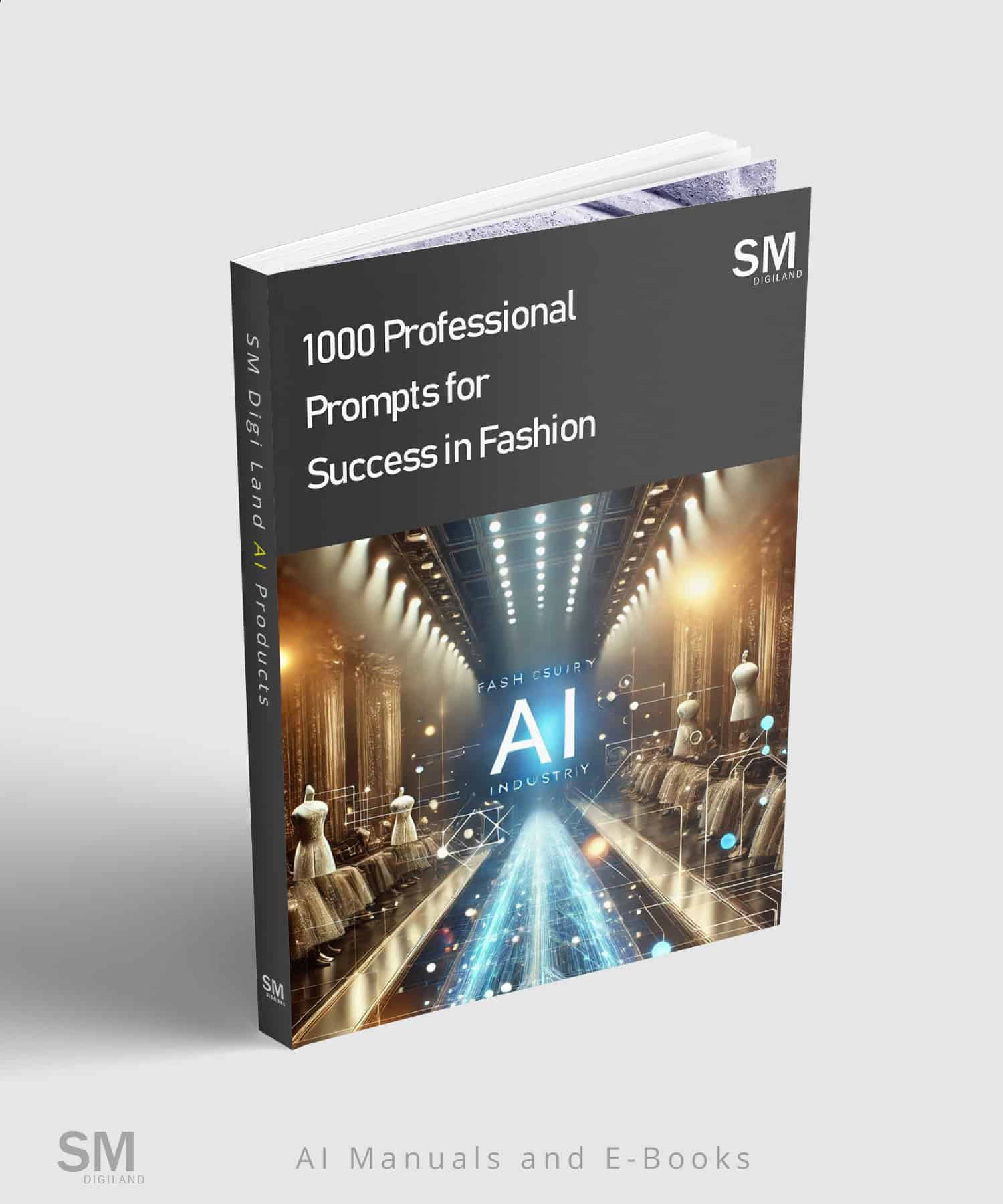
1000 AI Prompts for Fashion Designers: From Concept to Collection is a practical prompt library created to support these creative and commercial decisions. It helps fashion designers communicate detailed context to AI instead of relying on vague instructions such as “give me a clothing idea” or “create a fashion collection.”
The prompts can help you explore alternatives, organize research, compare design directions, question assumptions, and convert early inspiration into a more structured collection plan. They are designed to support your judgment—not replace your creativity, technical knowledge, or responsibility as a designer.
What Can These Fashion AI Prompts Help You Do?
- Turn broad themes, cultural references, emotions, and customer insights into collection concepts
- Research fashion movements, consumer behavior, emerging aesthetics, and market signals
- Develop mood-board directions without directly imitating another designer
- Explore silhouettes, garment categories, color systems, details, and styling combinations
- Compare fabrics and materials based on drape, durability, climate, cost, care, and intended use
- Integrate sustainability and ethical-production considerations into design decisions
- Build a coherent visual story across garments, styling, photography, and runway presentation
- Define brand positioning, customer profiles, price direction, and competitive differentiation
- Create product descriptions, campaign concepts, social media content, and launch plans
- Evaluate collection gaps, commercial risks, and opportunities before production
Ten Practical Areas Covered in the Book
1. Fashion Concepts and Collection Themes
Develop original collection directions from personal stories, cultural research, social themes, architecture, nature, historical references, emotions, and defined customer needs.
2. Trend Research and Forecasting
Organize trend research, distinguish short-lived aesthetics from longer consumer shifts, compare evidence, and translate relevant signals into practical design opportunities.
3. Mood Boards, Color and Silhouette
Build a consistent visual direction through color palettes, proportions, shapes, garment categories, styling references, materials, and emotional tone.
4. Textiles, Materials and Surface Development
Compare fabric properties, explore prints and textures, plan embellishments, and select materials according to function, climate, customer expectations, budget, and design intention.
5. Garment and Collection Development
Move from a broad concept toward a balanced collection by developing hero pieces, commercial garments, variations, coordinated looks, and clearer design specifications.
6. Sustainable and Ethical Fashion
Explore lower-impact materials, durability, waste reduction, circular-design ideas, transparent communication, responsible sourcing questions, and practical sustainability trade-offs.
7. Styling, Runway and Visual Storytelling
Create a cohesive presentation through garment sequencing, accessories, casting direction, set design, lighting, music, movement, lookbooks, campaign photography, and runway narratives.
8. Fashion Branding and Personal Positioning
Clarify brand identity, visual language, audience, value proposition, founder story, tone of voice, differentiation, and the relationship between the designer’s identity and the label.
9. Fashion Marketing and E-commerce
Prepare product descriptions, campaign concepts, editorial content, social posts, email ideas, website messaging, product-page content, launch calendars, and customer-engagement plans.
10. Fashion Business Development and Innovation
Examine pricing, assortment planning, collaborations, wholesale opportunities, customer feedback, collection performance, technology adoption, operational risks, and future growth options.
Three Sample AI Prompts for Fashion Designers
Sample Prompt 1: Develop an Original Collection Concept
Goal: Transform a broad source of inspiration into a coherent and commercially relevant fashion collection.
Usage: Use this before sketching when you need several distinct creative directions rather than one generic theme.
Prompt:
Act as a fashion collection development partner. I am designing a [SEASON OR COLLECTION TYPE] collection for [TARGET CUSTOMER] in the [MARKET OR LOCATION]. The starting inspiration is [THEME, STORY, PLACE, EMOTION, OR RESEARCH SUBJECT]. My intended price level is [PRICE POSITION], and the collection must account for [CLIMATE, MATERIAL, PRODUCTION, CULTURAL, OR BUDGET CONSTRAINTS].
Develop five clearly differentiated collection concepts. For each, provide a concept title, central narrative, target-customer relevance, silhouette direction, proposed garment categories, color family, material direction, signature details, styling approach, and one potential cliché or imitation risk to avoid. Do not copy a living designer or existing collection. Conclude with a comparison and recommend the strongest direction based on originality, coherence, wearability, and production feasibility.
Sample Prompt 2: Compare Fabrics for a Garment
Goal: Evaluate materials according to design, performance, commercial, and sustainability requirements.
Usage: Add real supplier information and fabric samples before making a final sourcing decision.
Prompt:
Act as a textile and apparel development assistant. I am designing a [GARMENT TYPE] for [CUSTOMER AND USE CASE]. The garment should achieve [DESIRED SILHOUETTE, MOVEMENT, TEXTURE, OR PERFORMANCE]. It will be worn in [CLIMATE OR ENVIRONMENT], sold at approximately [RETAIL PRICE], and produced in [QUANTITY OR PRODUCTION MODEL]. My current material options are [LIST MATERIAL OPTIONS].
Compare the options by drape, weight, breathability, durability, care requirements, construction difficulty, likely cost implications, availability, comfort, visual effect, and relevant environmental trade-offs. Present the comparison in a table. Then recommend a primary option, a lower-cost alternative, and a lower-impact alternative. Identify any information that must be confirmed with the supplier before ordering or production.
Sample Prompt 3: Plan a Fashion Collection Launch
Goal: Build a coordinated launch plan connecting the collection story, content, sales channels, and measurable outcomes.
Usage: Customize the timeline according to production readiness, available assets, audience size, and sales model.
Prompt:
Act as a fashion launch strategist. Create an eight-week launch plan for a [COLLECTION TYPE] by a [NEW, EMERGING, OR ESTABLISHED] fashion label. The collection is designed for [TARGET CUSTOMER], positioned at [PRICE LEVEL], and will be sold through [SALES CHANNELS]. Its central story is [COLLECTION STORY], and the available marketing resources are [TEAM, BUDGET, CONTENT, PARTNERS, AND AUDIENCE].
Organize the plan into pre-launch, reveal, launch, and post-launch stages. For each week, define the objective, key message, content assets, channel actions, audience interaction, sales action, and performance metric. Include a contingency plan for production delays or weak early engagement. Avoid recommending artificial scarcity, fabricated social proof, or sustainability claims that cannot be verified.
How to Get Better Results from the Prompts
- Select a prompt related to the decision or task you are currently working on.
- Replace every bracketed field with real information about your customer, collection, market, materials, budget, and limitations.
- Provide reference images, sketches, research notes, or product information when your chosen AI tool supports attachments.
- Ask the AI to compare alternatives and explain trade-offs instead of generating only one answer.
- Verify technical, cultural, legal, material, and sustainability claims before using them professionally.
- Adapt the output to your own design language rather than publishing it without critical review.
AI responses depend heavily on the context you provide. A prompt becomes more useful when it includes specific constraints, intended customers, design goals, and production realities.
Who Is This Book For?
- Independent and professional fashion designers
- Fashion design students and recent graduates
- Emerging clothing labels and fashion entrepreneurs
- Stylists, creative directors, and fashion content creators
- Designers preparing portfolio or graduate collections
- E-commerce fashion brands developing products and campaigns
- Educators creating fashion-design exercises and discussions
- Creative professionals exploring practical uses of conversational AI
Product Details
- Content: 1,000 customizable AI prompts
- Format: PDF digital book
- Length: 129 pages
- Language: English
- Delivery: Instant digital download after purchase
- SKU: SMDL-DL-001
- Recommended tools: ChatGPT, Claude, Gemini, and comparable conversational AI assistants
- Access: One-time purchase with continued personal access to the downloaded file
Using the Prompts with Different AI Tools
Most prompts in this book are written for text-based conversational AI assistants. Their outputs can help you develop concepts, briefs, descriptions, comparisons, research plans, campaign ideas, and structured creative directions.
When a prompt produces a visual brief, you may adapt that brief for an image-generation tool such as Midjourney, DALL·E, or Stable Diffusion. Compatibility and results vary by platform, model, subscription, and tool capabilities.
What This Product Is—and Is Not
This product is a downloadable collection of prompt frameworks for fashion-related ideation, research, planning, communication, branding, and marketing. It is not a physical book, fashion-design qualification, technical pattern-making course, manufacturing service, AI subscription, or collection of finished garment designs.
The prompts do not guarantee commercial success or replace professional judgment. Fabric performance, construction methods, sizing, intellectual-property questions, supplier claims, production costs, and sustainability statements should always be independently verified.
Frequently Asked Questions
Do I need previous experience with AI?
No. You can copy a relevant prompt, replace its editable fields, and continue refining the response through conversation. The quality of the result will improve when you provide detailed and accurate context.
Will the book design an entire collection for me?
The prompts can help you explore and structure collection ideas, but creative direction and final design decisions remain yours. The book is intended to support the designer rather than automate authorship.
Can fashion students use these prompts?
Yes. Students can use them for concept development, research questions, collection planning, portfolio writing, presentation preparation, and critical evaluation. Academic rules concerning AI use should still be followed.
Can I use the prompts for an existing fashion brand?
Yes. The prompts can be customized with your existing brand identity, customer profile, price position, collection history, sales channels, and operational constraints.
Does the book include ready-made clothing designs?
No. It provides written prompt frameworks, not finished sketches, patterns, technical packs, manufactured garments, or exclusive design ownership.
Which AI platforms are suitable?
The prompts work best with conversational tools such as ChatGPT, Claude, and Gemini. Some outputs can also be adapted into briefs for visual-generation platforms.
Can the prompts be reused?
Yes. The same prompt can be customized for different collections, seasons, garments, customers, price levels, markets, and brand objectives.
Is this a physical book?
No. It is a 129-page English PDF delivered digitally. No physical product will be shipped.
Develop Fashion Ideas with More Structure and Clarity
Use the 1,000 prompts to investigate ideas, compare creative directions, organize collection decisions, and communicate your fashion concepts more clearly. Download the book and build a repeatable AI-assisted workflow that remains guided by your own creative identity and professional judgment.


