


“`html
A Practical AI Prompt Library for Legal Work
Legal professionals rarely need generic text generation. They need structured assistance that accounts for jurisdiction, procedural posture, client objectives, evidentiary limitations, document hierarchy, professional obligations, and the difference between confirmed authority and an unverified suggestion.
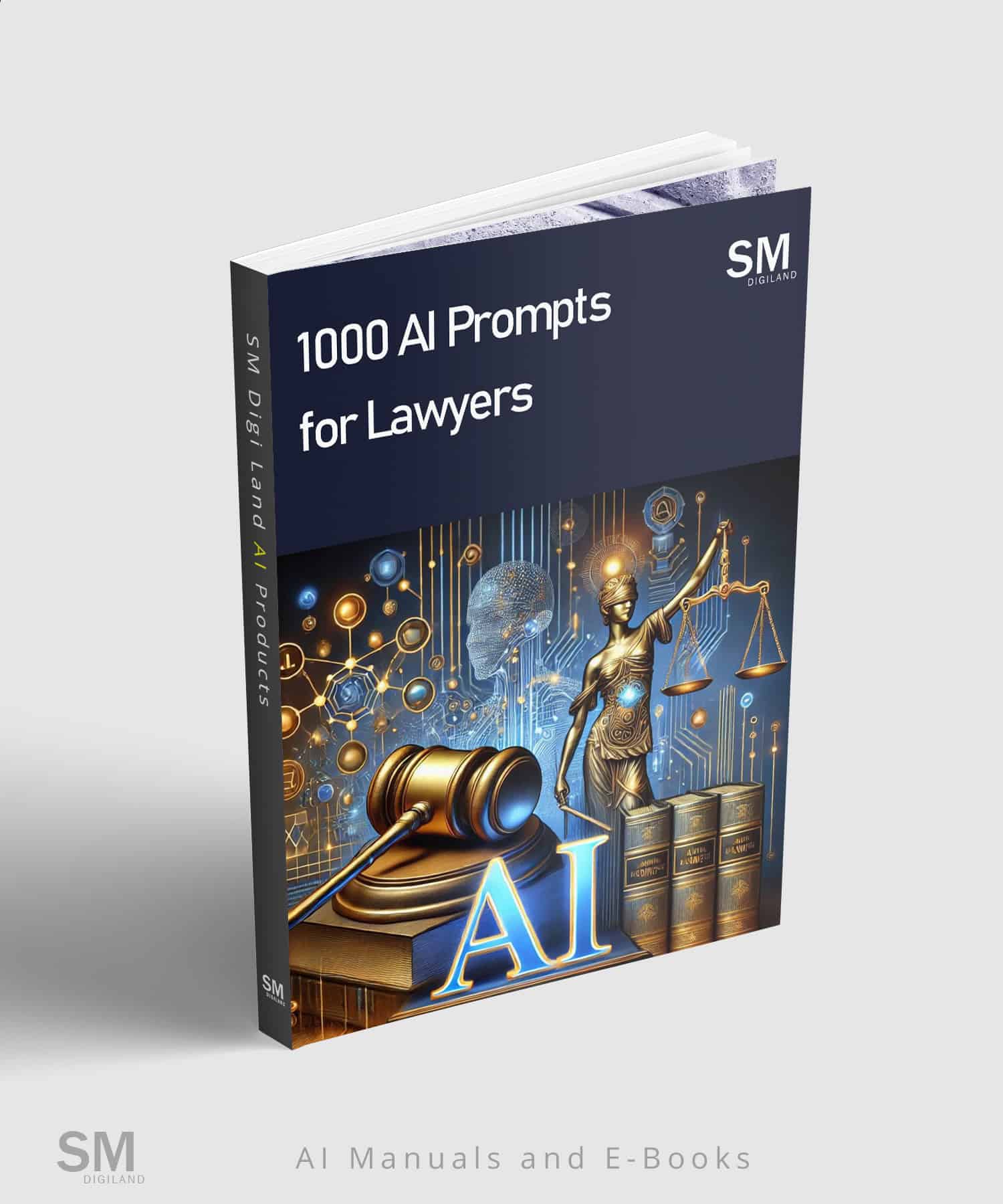
1000 AI Prompts for Lawyers and Legal Practice is a 115-page digital prompt book designed to help lawyers and legal teams give generative-AI tools clearer, more controlled, and more task-specific instructions.
The collection contains 1,000 customizable prompt frameworks organized into 10 focused chapters. Each prompt helps define the task, relevant context, expected output, limitations, required sources, and information that must be verified by a qualified legal professional.
The book may support legal research planning, matter analysis, contract workflows, litigation preparation, client communication, negotiation, compliance reviews, knowledge management, and other recurring legal activities. It does not replace legal research databases, official authorities, professional supervision, or jurisdiction-specific legal advice.
Why Legal AI Prompts Require More Structure
A short instruction such as “review this contract” or “find cases supporting this argument” does not give an AI system enough context to produce a dependable legal-work draft. The result may overlook governing law, confuse jurisdictions, invent citations, make unsupported assumptions, or treat an incomplete document as sufficient evidence.
The prompts in this book are designed to help users provide more useful information, including:
- Relevant country, state, province, court, regulator, or legal system
- Practice area and type of legal matter
- Procedural stage and intended audience
- Client objective and known factual background
- Documents and authorities supplied for analysis
- Required output structure and level of detail
- Confidentiality and data-handling restrictions
- Facts, citations, deadlines, and conclusions requiring verification
This additional context does not make AI output legally authoritative. It helps create a more organized starting point for professional review.
What Is Included?
- 1,000 editable AI prompt frameworks
- 10 chapters covering major legal-work activities
- 100 prompts in each chapter
- A clear Goal for every prompt
- A Usage section explaining when the prompt may be relevant
- A detailed Prompt ready to customize
- Placeholders for jurisdiction, matter type, facts, parties, authorities, objectives, documents, risks, and output format
- Workflows for drafting, analysis, comparison, preparation, and quality control
- Prompts suitable for individual lawyers, legal departments, law firms, students, and supervised support teams
- Instructions that encourage users to identify missing information and distinguish facts from assumptions
Ten Legal Workflow Areas Covered
1. Client Intake and Matter Framing
Structure initial matter information, prepare intake questions, identify missing facts, organize client objectives, develop preliminary issue lists, define the intended scope of work, and separate confirmed information from unverified statements.
2. Legal Research Planning and Authority Verification
Develop research questions, search strategies, jurisdiction-specific source hierarchies, authority-verification checklists, case-comparison frameworks, statutory research plans, and methods for recording unresolved legal questions.
3. Legal Analysis and Issue Spotting
Organize facts, identify possible legal issues, apply analytical structures such as IRAC or CRAC, compare competing interpretations, test assumptions, map elements of claims or defenses, and identify information requiring further investigation.
4. Litigation, Pleadings, Discovery and Evidence
Prepare chronology frameworks, deposition questions, discovery plans, pleading outlines, evidence matrices, witness-preparation topics, hearing checklists, argument structures, and document-review workflows for professional refinement.
5. Contract Drafting and Clause Review
Analyze supplied provisions, locate ambiguity, compare alternative language, identify undefined terms, map obligations and dependencies, prepare negotiation questions, develop clause checklists, and organize contract-review comments.
6. Corporate, Commercial, Regulatory and Compliance Work
Support entity-document workflows, commercial matter planning, policy reviews, compliance questionnaires, regulatory issue lists, governance checklists, risk registers, internal investigations, and due-diligence organization.
7. Client Communication and Legal Explanations
Draft structured client updates, matter summaries, information requests, engagement communications, plain-language explanations, meeting agendas, follow-up messages, and correspondence that remains subject to professional review.
8. Negotiation, Mediation and Settlement Preparation
Identify interests and constraints, prepare negotiation scenarios, organize settlement variables, develop question lists, assess supplied proposals, compare possible concessions, and create mediation-preparation frameworks.
9. Law-Practice Operations and Knowledge Management
Create internal checklists, matter-closing workflows, precedent indexes, document-naming conventions, meeting templates, legal project plans, team handover notes, training materials, and reusable knowledge-management processes.
10. Legal Quality Control, Professional Responsibility and AI Governance
Develop human-review checklists, citation-verification steps, confidentiality questions, AI-use policies, output-audit procedures, supervision workflows, disclosure considerations, and safeguards for responsible use of generative AI in legal environments.
How Every Prompt Is Structured
Each of the 1,000 prompts follows a consistent three-part format:
- Goal: Identifies the legal-work objective supported by the prompt
- Usage: Explains when and how the prompt may be applied
- Prompt: Provides an editable instruction with placeholders for relevant legal context
Depending on the task, placeholders may include [JURISDICTION], [COURT], [PRACTICE AREA], [MATTER TYPE], [PROCEDURAL STAGE], [CLIENT OBJECTIVE], [CONFIRMED FACTS], [SUPPLIED AUTHORITIES], [DOCUMENT TEXT], [DEADLINE], [OUTPUT FORMAT], and [RESTRICTIONS].
Sample AI Prompts for Legal Professionals
These product-page samples demonstrate the type of structured workflow the collection supports. They should not be presented as verbatim excerpts from the PDF unless compared directly with the published book.
Sample 1: Develop a Jurisdiction-Specific Legal Research Plan
Goal: Convert a legal question into a structured research plan without inventing authorities.
Usage: Use before beginning substantive research in official sources or an authorized legal database.
Prompt:
Act as a legal research planning assistant. Do not provide a final legal opinion and do not invent cases, statutes, regulations, quotations, citations, or procedural rules.
Jurisdiction: [JURISDICTION]
Court or authority, if applicable: [COURT OR AUTHORITY]
Practice area: [PRACTICE AREA]
Legal question: [QUESTION]
Confirmed facts: [FACTS]
Procedural posture: [PROCEDURAL STAGE]
Relevant dates: [DATES]
Authorities already supplied: [AUTHORITIES]
Client objective: [OBJECTIVE]
Known limitations: [LIMITATIONS]Provide:
- A precise statement of the research question
- Possible sub-issues requiring separate research
- A recommended hierarchy of primary and secondary sources
- Suggested search terms and alternative terminology
- Facts that may affect the legal analysis
- Potential jurisdictional or procedural complications
- A checklist for validating every authority located
- Questions that must be answered before reaching a conclusion
Clearly label hypotheses and incomplete information. If a citation cannot be verified from the material supplied, state that it requires independent verification in an official source or authorized legal database.
Sample 2: Review a Supplied Contract Clause
Goal: Identify drafting issues and negotiation questions within contract language supplied by the user.
Usage: Use during an initial clause review before jurisdiction-specific legal analysis and final drafting.
Prompt:
Act as a contract-review assistant. Analyze only the clause and contextual information I provide. Do not determine enforceability, invent missing provisions, or assume facts that are not stated.
Contract type: [CONTRACT TYPE]
Jurisdiction or governing law: [JURISDICTION]
Party represented: [PARTY]
Commercial objective: [OBJECTIVE]
Risk tolerance: [RISK TOLERANCE]
Related provisions: [RELATED PROVISIONS]
Clause text: [PASTE CLAUSE]
Known negotiation history: [HISTORY]
Specific concerns: [CONCERNS]Provide:
- A plain-language explanation of the clause
- The obligations, rights, conditions, exceptions, and deadlines it creates
- Ambiguous, inconsistent, undefined, or unusually broad language
- Dependencies on other contract provisions
- Potential commercial and drafting risks for the represented party
- Questions to raise with the client or opposing party
- Alternative drafting approaches clearly labelled as examples
- Items requiring jurisdiction-specific legal verification
Quote the relevant supplied language when identifying an issue. Do not invent legal requirements, market standards, case law, or missing facts.
Sample 3: Build a Case Chronology and Evidence-Gap Matrix
Goal: Organize supplied case information while preserving the distinction between evidence, allegation, inference, and missing information.
Usage: Use when preparing for case assessment, discovery, witness interviews, hearings, or litigation strategy discussions.
Prompt:
Act as a litigation matter-organization assistant. Analyze only the facts and documents supplied below. Do not decide credibility, invent events, calculate legal deadlines without an identified rule, or reach a legal conclusion.
Jurisdiction: [JURISDICTION]
Matter type: [MATTER TYPE]
Procedural stage: [STAGE]
Claims or defenses under consideration: [CLAIMS OR DEFENSES]
Confirmed facts: [FACTS]
Allegations: [ALLEGATIONS]
Documents and evidence: [EVIDENCE]
Witness information: [WITNESSES]
Important dates: [DATES]
Known disputes: [DISPUTES]Create:
- A chronological table of events with a source for each entry
- A separate list of allegations not yet supported by supplied evidence
- A matrix connecting evidence to possible factual issues
- Conflicts or inconsistencies within the supplied material
- Missing documents or information
- Questions for witnesses, clients, or subject-matter experts
- Issues requiring legal research
- A list of dates that may require deadline analysis by counsel
Label every inference as an inference. If the available material does not support a statement, mark it as unverified rather than completing the gap.
Who Is This Book For?
- Lawyers and attorneys
- In-house counsel and corporate legal departments
- Law-firm associates and partners
- Paralegals and supervised legal assistants
- Legal researchers and legal writers
- Legal operations professionals
- Compliance and governance teams
- Contract-management professionals
- Law students and legal educators
- Professionals developing internal AI-use procedures for legal teams
How to Use the Prompts Responsibly
- Select a prompt that matches the legal task and current procedural stage.
- Enter the correct jurisdiction, governing law, court, regulator, and practice area.
- Distinguish confirmed facts from allegations, assumptions, and disputed information.
- Use authorized and appropriately secured tools for confidential work.
- Remove or anonymize client information where required.
- Ask the AI to identify missing information instead of filling gaps.
- Verify every case, statute, regulation, quotation, citation, deadline, and procedural rule.
- Compare output with primary authorities and current official sources.
- Review all drafting for accuracy, privilege, confidentiality, professional obligations, and client interests.
- Apply the rules and professional standards governing the relevant jurisdiction.
Product Details
- Title: 1000 AI Prompts for Lawyers and Legal Practice
- Format: PDF digital book
- Length: 115 pages
- Language: English
- Number of prompts: 1,000
- Structure: 10 chapters with 100 prompts per chapter
- Prompt format: Goal, Usage, and Prompt
- Delivery: Instant digital download after purchase
- SKU: SMDL-DL-010
- Price: $18
Important Information About AI and Legal Work
Generative-AI systems can produce inaccurate, incomplete, outdated, biased, or invented information. They may fabricate authorities, misquote sources, confuse jurisdictions, overlook procedural requirements, or draw conclusions that are unsupported by the supplied facts.
Users must independently verify all legal authorities, citations, quotations, filing requirements, deadlines, factual statements, and analytical conclusions. An AI-generated draft should never be filed, sent to a client, relied upon in a transaction, or used as the basis of legal advice without appropriate professional review.
Client confidences, privileged communications, personal data, litigation strategy, non-public contracts, evidence, and internal legal documents should not be entered into a third-party AI service unless its security, retention, training, access, and confidentiality terms have been assessed and the use is properly authorized.
Legal and professional-responsibility requirements differ between jurisdictions. Users are responsible for applying the rules governing their own work, organization, court, regulator, and professional role.
What This Product Is—and Is Not
This product is a downloadable educational collection of customizable AI prompt frameworks for legal research planning, writing, document analysis, contract workflows, litigation preparation, client communication, compliance, negotiation, practice management, and quality control.
It is not legal advice, a law-firm service, an attorney-client relationship, legal research database, contract-review service, compliance certification, case-strategy consultation, document-automation platform, or substitute for qualified counsel.
The purchase does not include access to ChatGPT, Claude, Gemini, Microsoft Copilot, a legal research database, or another third-party platform. Separate accounts, licenses, or subscriptions may be required.
The book does not guarantee accurate legal conclusions, valid citations, favorable case outcomes, enforceable contracts, regulatory compliance, time savings, reduced legal costs, court acceptance, or improved professional performance.
Frequently Asked Questions
Does this book provide legal advice?
No. It provides customizable prompt frameworks that may support legal-work planning, drafting, organization, and analysis. Legal conclusions and advice must come from an appropriately qualified professional applying current law to verified facts.
Does the book contain exactly 1,000 prompts?
Yes. It contains 10 chapters with 100 prompts in each chapter, providing a total of 1,000 customizable prompt frameworks.
Can the prompts conduct legal research for me?
The prompts can help structure research questions, search plans, comparison frameworks, and verification checklists. AI-generated authorities and citations must be independently checked in current official sources or authorized legal databases.
Can I use the prompts for contract drafting and review?
Yes. The collection includes workflows relevant to clause analysis, drafting questions, ambiguity detection, obligation mapping, negotiation preparation, and contract-review organization. Final language and enforceability must be assessed under the applicable law.
Are the prompts limited to one country or legal system?
No. Many frameworks include editable jurisdiction fields. However, users must supply the appropriate legal context and verify the output against the current law and professional rules of the relevant jurisdiction.
Can I enter confidential client information into an AI tool?
Confidential or privileged information should not be uploaded unless the tool and intended use have been properly assessed, secured, and authorized. Data-handling requirements vary by jurisdiction, organization, client, and AI provider.
Is the book useful for law students?
It may support supervised learning, issue spotting, research planning, argument comparison, writing practice, and study organization. Students must follow their institution’s academic-integrity and AI-use policies.
Will the prompts work with every AI model?
The general frameworks may be adapted to different generative-AI tools, but capabilities, source access, context limits, privacy terms, accuracy, and output quality vary between products and model versions.
Can AI-generated content be submitted directly to a court or client?
No AI-generated legal content should be submitted or communicated without careful professional review. Citations, quotations, facts, procedural requirements, confidentiality, and applicable professional duties must all be checked.
Is this a physical book?
No. It is a 115-page English PDF delivered digitally. No physical product will be shipped.
Build More Controlled AI Workflows for Legal Practice
Use these 1,000 customizable prompts to structure legal tasks more carefully, communicate context clearly, identify missing information, organize complex materials, and build repeatable workflows with verification and professional review built into the process.
Download the 115-page PDF and adapt the prompts to your jurisdiction, practice area, matter type, professional responsibilities, and internal legal-work standards.
“`


