


A Structured AI Prompt Library for Startup and Online-Business Workflows
Building an online business requires more than generating an attractive idea or asking an AI tool for a growth strategy. Founders must investigate a real customer need, test assumptions, evaluate competition, understand costs, define a viable offer, comply with applicable requirements, measure actual results, and adjust their decisions as new evidence becomes available.
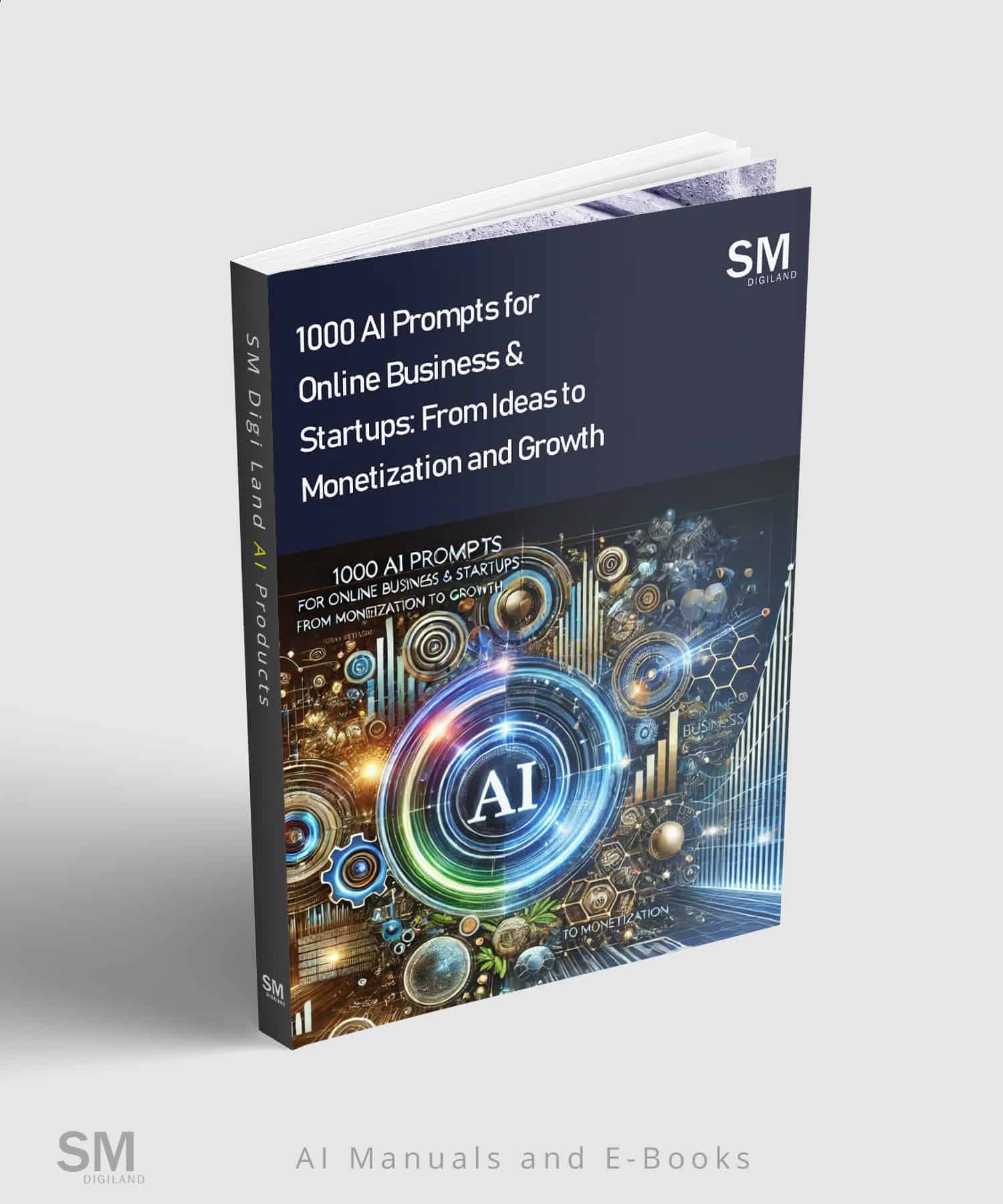
1000 AI Prompts for Online Business and Startup Strategy is a 135-page digital prompt book designed to help entrepreneurs give generative-AI systems clearer context, constraints, evidence, assumptions, and output requirements.
The collection contains 1,000 customizable prompt frameworks organized into 10 focused chapters. It supports recurring workflows across idea validation, MVP planning, customer research, positioning, branding, marketing, sales funnels, operations, automation planning, website content, analytics, fundraising preparation, partnerships, and expansion.
This is not a business-in-a-box or a collection of vague instructions such as “find a profitable idea” or “make my startup successful.” The prompts encourage users to define the business stage, market, customer, available evidence, budget, business model, risks, jurisdiction, assumptions, and decision criteria before requesting AI assistance.
Use AI to Structure Analysis—Not Replace Evidence
Generative AI can help organize research, identify assumptions, develop interview questions, compare strategic options, draft business documents, prepare test plans, analyze supplied data, and communicate decisions more clearly.
However, an AI model does not automatically have access to current market-research databases, private customer information, company accounts, live competitor data, banking records, tax systems, legal requirements, advertising platforms, analytics dashboards, or investor networks.
Without reliable inputs, AI may invent or misrepresent:
- Market size, growth rates, trends, and demand
- Customer personas, interviews, quotations, and purchase intent
- Competitor products, pricing, revenue, traffic, and market share
- Startup costs, operating expenses, margins, and cash requirements
- Conversion rates, customer-acquisition costs, churn, and lifetime value
- Financial projections, valuation, runway, and break-even timing
- Available grants, loans, investors, and fundraising eligibility
- Licensing, registration, employment, privacy, tax, and reporting requirements
- SEO rankings, website traffic, advertising results, and campaign performance
- Predictions about profitability, funding, growth, or business success
The prompts are most effective when users provide accurate inputs such as:
- Business concept and current development stage
- Target customer and documented customer problem
- Geographic market and applicable jurisdiction
- Verified customer interviews, surveys, or transaction data
- Current competitor research with sources and retrieval dates
- Pricing, costs, margins, budget, and available resources
- Website, sales, advertising, and analytics exports
- Existing operational processes and team responsibilities
- Approved brand, product, and legal information
- Known risks, uncertainties, and missing information
- Specific assumptions that must be tested
- Decisions requiring professional approval
This approach keeps accountability, validation, professional judgment, and final decision-making under human control.
What Is Included?
- 1,000 customizable AI prompt frameworks
- 10 chapters with 100 prompts in each chapter
- A clear Goal for every prompt
- A Usage section explaining the intended application
- An editable Prompt with contextual placeholders
- Workflows for business research, planning, execution, measurement, and review
- Prompts for early-stage ideas, new online businesses, existing ventures, and expansion planning
- Frameworks for separating evidence, assumptions, estimates, and recommendations
- Instructions for identifying missing data and validation requirements
- Reusable prompts for founders, marketers, consultants, agencies, and business teams
Ten Startup and Online-Business Areas Covered
1. Idea Generation, Validation and MVP Planning
Explore business concepts, define customer problems, document assumptions, design interviews and experiments, compare possible business models, define minimum viable products, and establish evidence-based go, revise, or stop criteria.
2. Customer Personas and Audience Research
Organize verified customer evidence, develop provisional audience segments, prepare interview and survey questions, map customer journeys, identify information gaps, and distinguish documented customer behavior from untested assumptions.
3. Branding, Positioning and Value Propositions
Clarify business positioning, develop value-proposition options, define brand voice, compare naming directions, organize messaging hierarchies, and test whether marketing claims accurately reflect the available product evidence.
4. Marketing Experiments and Customer Acquisition
Develop channel hypotheses, campaign concepts, referral ideas, content plans, acquisition experiments, test budgets, measurement criteria, and review procedures without assuming that a tactic will become viral or produce profitable growth.
5. Fundraising and Investor Communications
Prepare provisional pitch structures, due-diligence checklists, investor questions, use-of-funds summaries, risk disclosures, fundraising-readiness assessments, and communication drafts using verified company and financial information.
6. Digital Sales Funnels and Conversion Planning
Map customer journeys, develop lead-magnet concepts, prepare email sequences, organize offer pages, identify funnel drop-off points, design controlled tests, and evaluate supplied conversion data without inventing customer behavior or guaranteed results.
7. Operations, Automation and Team Productivity
Document processes, identify repetitive work, develop standard operating procedures, compare automation opportunities, define human-approval checkpoints, assign responsibilities, and evaluate operational risks before implementing new workflows.
8. Websites, Landing Pages and Startup SEO
Plan website structures, develop accurate landing-page copy, organize content briefs, improve calls to action, review supplied keyword data, create information architectures, and prepare SEO experiments using verified research and current platform guidance.
9. Metrics, KPIs and Business Analytics
Define measurable objectives, prepare KPI dictionaries, analyze supplied performance data, investigate changes, document limitations, compare reporting periods, and distinguish measured results from interpretations, assumptions, and forecasts.
10. Scaling, Partnerships and Market Expansion
Assess operational readiness, evaluate partnership criteria, compare possible markets, identify localization requirements, prepare expansion checklists, model provisional scenarios, and document the evidence needed before committing significant resources.
How Every Prompt Is Structured
Every prompt follows a consistent three-part format:
- Goal: Defines the specific startup or online-business task
- Usage: Explains when and how the prompt can be applied
- Prompt: Provides a detailed instruction ready to customize and use
Depending on the task, editable fields may include [BUSINESS IDEA], [BUSINESS STAGE], [INDUSTRY], [LOCATION], [JURISDICTION], [TARGET CUSTOMER], [CUSTOMER EVIDENCE], [BUSINESS MODEL], [COMPETITORS], [BUDGET], [PRICING], [COST DATA], [ANALYTICS], [OBJECTIVE], [ASSUMPTIONS], [KNOWN RISKS], [SOURCE MATERIAL], and [DESIRED OUTPUT].
Sample AI Prompts for Startups and Online Businesses
The following examples demonstrate the type of structured workflow supported by the collection. They should not be described as verbatim excerpts from the PDF unless compared directly with the published book.
Sample 1: Validate a Business Idea Using Available Evidence
Goal: Evaluate a business concept without inventing market demand, customer interest, or commercial potential.
Usage: Use before investing substantial time or money in product development.
Prompt:
Act as a startup research and validation assistant. Evaluate the business concept using only the evidence provided below. Do not invent market sizes, customer interviews, search volumes, competitor performance, purchase intent, costs, regulations, or revenue potential.
Business concept: [CONCEPT]
Customer problem: [PROBLEM]
Target customer: [CUSTOMER]
Geographic market: [MARKET]
Business model: [MODEL]
Proposed offer: [OFFER]
Expected price: [PRICE]
Verified customer evidence: [EVIDENCE]
Verified competitor research: [COMPETITOR DATA]
Available budget and resources: [RESOURCES]
Known restrictions: [RESTRICTIONS]
Sources and retrieval dates: [SOURCES]Provide:
- A concise description of the concept
- The customer and problem assumptions being made
- Evidence that supports or challenges each assumption
- Important information that is still missing
- Five low-cost validation experiments
- The metric and decision threshold for each experiment
- Estimated time and resources, clearly labeled as provisional
- Possible legal, financial, privacy, operational, or market risks
- Go, revise, or stop criteria
- A prioritized validation plan for the next 30 days
Clearly separate verified facts, user-supplied claims, interpretations, estimates, and assumptions. Do not conclude that the concept is profitable, fundable, scalable, or validated without sufficient evidence.
Sample 2: Design a Measurable Sales-Funnel Experiment
Goal: Create a controlled funnel test with accurate claims and defined evaluation criteria.
Usage: Use when testing an offer, landing page, lead magnet, or customer-acquisition channel.
Prompt:
Act as a conversion-experiment planner. Design a limited sales-funnel experiment using the verified business and customer information supplied below. Do not invent testimonials, customer results, urgency, discounts, product capabilities, conversion benchmarks, or advertising-platform data.
Product or service: [OFFER]
Target customer: [CUSTOMER]
Verified customer need: [NEED]
Primary acquisition channel: [CHANNEL]
Available evidence supporting the offer: [EVIDENCE]
Current funnel: [FUNNEL]
Current verified metrics: [METRICS]
Test budget: [BUDGET]
Test period: [PERIOD]
Approved claims: [CLAIMS]
Prohibited claims: [RESTRICTIONS]
Privacy and consent requirements: [REQUIREMENTS]Create:
- A clear funnel hypothesis
- The audience segment and entry point
- A truthful value proposition
- A step-by-step funnel structure
- Landing-page message options
- A call-to-action strategy
- One primary and three secondary metrics
- A test design and minimum evaluation period
- Decision criteria for continuing, revising, or stopping
- A pre-launch compliance and quality-control checklist
Identify missing data explicitly. Do not predict a conversion rate, customer-acquisition cost, profit, or return on advertising spend unless a transparent calculation based on supplied data is possible.
Sample 3: Assess Fundraising Readiness
Goal: Organize fundraising preparation without inventing financial performance, valuation, investor interest, or legal compliance.
Usage: Use before preparing investor outreach or a pitch presentation.
Prompt:
Act as a fundraising-readiness assistant, not as a lawyer, accountant, investment adviser, broker, or valuation professional. Review only the verified company information supplied below. Do not create false traction, customers, partnerships, financial results, intellectual-property rights, investor commitments, or regulatory conclusions.
Company stage: [STAGE]
Jurisdiction and legal structure: [STRUCTURE]
Product and market: [PRODUCT AND MARKET]
Verified traction: [TRACTION]
Historical financial information: [FINANCIALS]
Current cash position and burn rate: [DATA]
Ownership and capitalization information: [CAP TABLE DATA]
Funding requested: [AMOUNT]
Proposed use of funds: [USE OF FUNDS]
Known risks: [RISKS]
Existing professional advisers: [ADVISERS]
Supporting documents: [DOCUMENTS]Provide:
- A summary of the information supplied
- A list of missing or inconsistent information
- A preliminary fundraising-readiness checklist
- Questions investors may reasonably ask
- A provisional use-of-funds structure
- A runway calculation using only supplied figures
- Material risks requiring accurate disclosure
- Documents requiring legal, accounting, or management approval
- A pitch-deck information outline
- Recommended next steps before investor outreach
Label every projection and estimate clearly. Do not recommend a valuation, securities structure, legal exemption, investor return, or fundraising claim without review by qualified professionals in the applicable jurisdiction.
Who Is This Book For?
- Startup founders and co-founders
- Aspiring entrepreneurs
- Online-business and e-commerce owners
- Digital-product creators
- Small-business owners
- Marketing and growth teams
- Product managers and MVP teams
- Business consultants and coaches
- Freelancers developing new services
- Agencies advising early-stage businesses
- Incubators and entrepreneurship programs
- Business and marketing students
Suitable Business Contexts
The prompt frameworks can be adapted for:
- Service businesses
- E-commerce stores
- Digital products and subscriptions
- Software and SaaS concepts
- Creator-led businesses
- Online education and membership models
- Marketplaces and platforms
- Agency and consulting businesses
- Business-to-business ventures
- Direct-to-consumer businesses
- Local businesses developing online channels
- Existing businesses evaluating new markets or offers
Users must customize every prompt for their market, customer, industry, stage, resources, risk tolerance, business model, jurisdiction, and applicable professional requirements.
How to Use the Prompts Effectively
- Select a prompt that matches the specific business task.
- Replace every placeholder with accurate and relevant information.
- Provide current research, customer evidence, financial records, or analytics where appropriate.
- State the source and retrieval date of important information.
- Separate verified evidence from assumptions, estimates, and recommendations.
- Ask the AI to identify missing information rather than filling gaps with invented details.
- Validate customer and market assumptions through appropriate real-world research.
- Review financial, legal, tax, privacy, employment, and fundraising matters with qualified professionals.
- Test operational or automation changes in a controlled environment before full implementation.
- Measure results using verified business data rather than assuming that a recommendation was successful.
Product Details
- Title: 1000 AI Prompts for Online Business and Startup Strategy
- Format: PDF digital book
- Length: 135 pages
- Language: English
- Number of prompts: 1,000
- Structure: 10 chapters with 100 prompts per chapter
- Prompt format: Goal, Usage, and Prompt
- Delivery: Instant digital download after purchase
- SKU: SMDL-DL-016
- Price: $22
Important Information About AI and Business Planning
Generative-AI systems may produce inaccurate, incomplete, outdated, biased, misleading, or invented information. This may include fabricated customer insights, market figures, competitors, pricing, regulations, financial projections, tax obligations, investor information, operational requirements, and performance data.
AI-generated business plans, forecasts, contracts, policies, advertisements, investor communications, employment documents, tax explanations, and compliance recommendations require independent verification and appropriate professional review.
Users should not provide confidential business information, personal data, customer records, passwords, payment information, trade secrets, or restricted documents to an AI platform unless they are authorized to do so and have reviewed the platform’s privacy, security, and data-retention terms.
Financial projections and market estimates are uncertain and depend on assumptions. Every assumption, formula, source, limitation, and scenario should be documented and reviewed before it is used for investment, lending, hiring, purchasing, or operational decisions.
Business registration, licensing, taxation, employment, advertising, privacy, consumer protection, fundraising, securities, and reporting requirements vary by jurisdiction and business activity.
What This Product Is—and Is Not
This product is a downloadable educational collection of customizable AI prompt frameworks for startup research, online-business planning, customer discovery, branding, marketing, sales, operations, analytics, fundraising preparation, and expansion planning.
It is not a business consultancy, market-research database, incorporation service, accounting system, legal service, tax service, investment adviser, broker, fundraising platform, investor database, financial model, CRM, advertising platform, website builder, analytics platform, or automation service.
The purchase does not include access to ChatGPT, Claude, Gemini, Microsoft Copilot, a CRM, analytics platform, automation system, advertising account, keyword database, investor network, financial-data provider, website builder, or another third-party product. Separate accounts, subscriptions, exports, licenses, configurations, or integrations may be required.
The book does not guarantee idea validation, product-market fit, customers, leads, conversions, funding, investment, grants, loans, partnerships, profitability, revenue, growth, scalability, regulatory approval, or business success.
Frequently Asked Questions
Does the book contain exactly 1,000 prompts?
Yes. It contains 10 chapters with 100 prompts in each chapter, providing a total of 1,000 customizable prompt frameworks.
Can the prompts identify a guaranteed profitable business idea?
No. AI can help organize ideas and validation plans, but it cannot guarantee demand, profitability, product-market fit, or business success. Real-world research and testing are required.
Can AI conduct complete market research?
AI can help structure research and analyze information supplied by the user. Without reliable current data, it may invent market sizes, trends, customer behavior, competitors, pricing, or demand.
Can the prompts write a complete business plan?
They can support research organization, business-plan sections, assumptions, scenarios, drafts, and review checklists. The final plan still requires verified evidence, accurate financial information, management judgment, and professional review where appropriate.
Can the prompts create financial projections?
They can help organize supplied figures and build provisional scenarios. Projections are not guarantees and must clearly disclose assumptions, formulas, sources, uncertainties, and limitations.
Can the book help me find investors or raise funding?
The prompts can support fundraising preparation, pitch structure, investor questions, due-diligence organization, and outreach drafts. The product does not include investor introductions, fundraising services, securities advice, or any guarantee of funding.
Can these prompts automate my business?
They can help document processes and design possible automation workflows. They do not connect to business systems or execute automation unless the user separately configures suitable tools, permissions, integrations, testing, monitoring, and human approvals.
Does the book provide legal, tax or accounting advice?
No. The prompts are educational frameworks. Business structure, contracts, taxes, employment, privacy, advertising, intellectual property, and compliance matters should be reviewed by qualified professionals in the applicable jurisdiction.
Will the prompts work with every AI platform?
The general frameworks can be adapted to different generative-AI systems. Features, privacy terms, context limits, file support, integrations, and output quality vary between platforms and versions.
Is this a physical book?
No. It is a 135-page English PDF delivered digitally. No physical product will be shipped.
Build More Evidence-Based Business Workflows
Use these 1,000 customizable prompts to investigate business ideas, define assumptions, organize customer research, improve positioning, plan measurable marketing experiments, document operations, analyze supplied data, and prepare important business decisions more clearly.
Download the 135-page PDF and adapt the prompts to your business stage, customer, market, resources, evidence, risks, jurisdiction, and objectives.


