


A Structured AI Prompt Library for SEO Workflows
Effective search engine optimization is not simply about inserting keywords, publishing large volumes of content, or following every new tactic discussed online. It requires a clear understanding of the audience, search intent, website structure, technical accessibility, content quality, competition, available evidence, and the business objective behind each page.
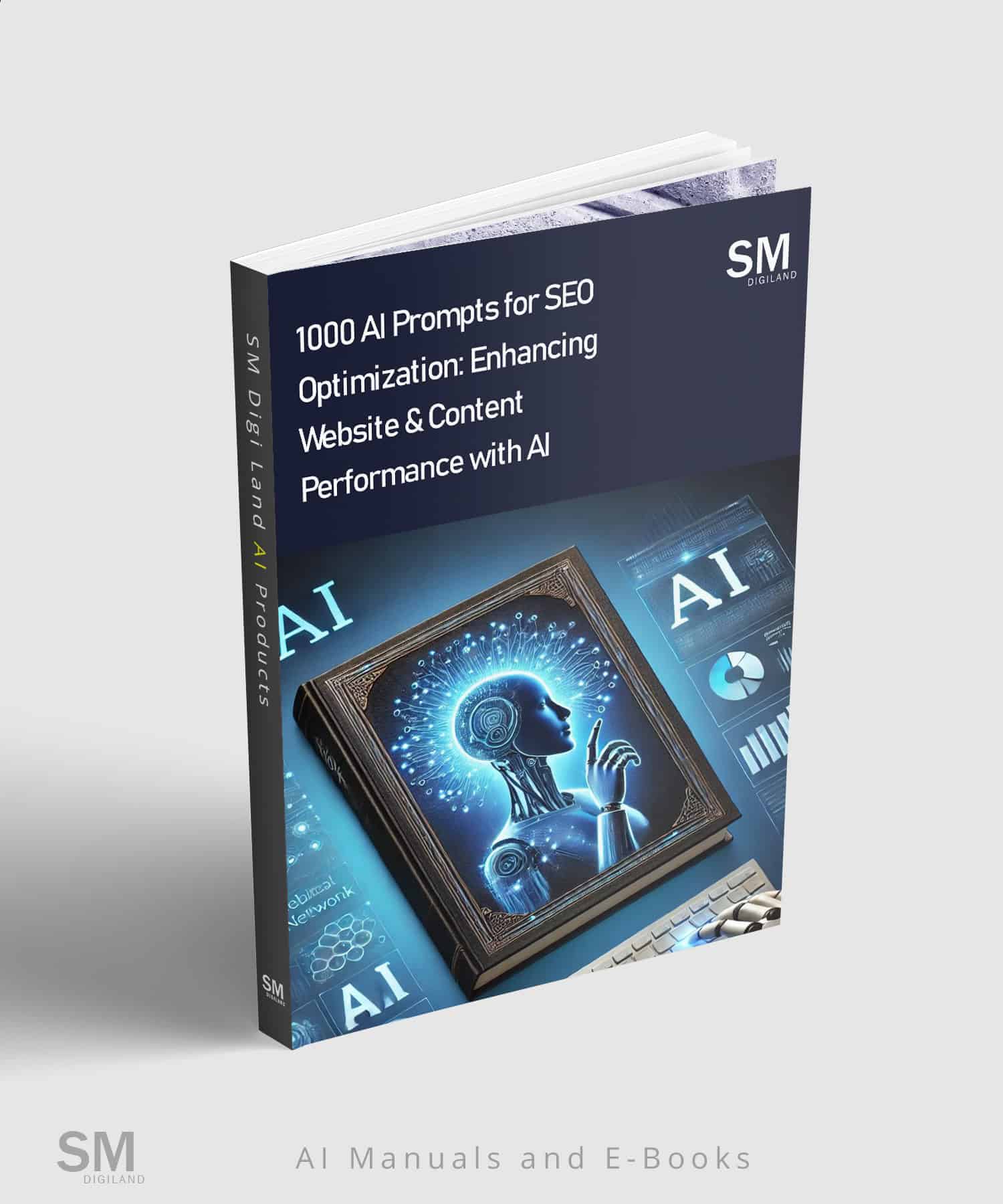
1000 AI Prompts for SEO Strategy and Content Optimization is a 115-page digital prompt book designed to help users provide generative-AI tools with the context, data, constraints, and output requirements needed for more controlled SEO assistance.
The collection contains 1,000 customizable prompt frameworks organized into 10 focused chapters. It supports recurring workflows across keyword research, search-intent analysis, competitor research, on-page optimization, SEO content planning, internal linking, technical audits, outreach, multimedia optimization, local SEO, performance reporting, and algorithm monitoring.
This is not a collection of vague one-line requests such as “rank my website” or “write an SEO article.” The prompts encourage users to define the website, audience, market, location, business goal, available data, approved sources, target page, technical limitations, search intent, and desired deliverable before asking AI for assistance.
Use AI Without Treating Its Output as SEO Evidence
Generative AI can help organize supplied keyword data, compare page structures, prepare content briefs, identify questions, classify search intent, review metadata, interpret crawl exports, and develop testing checklists. However, an AI model does not automatically have live or complete access to search results, keyword databases, Google Search Console, analytics platforms, website crawlers, backlink indexes, or competitor accounts.
Without reliable inputs, an AI system may generate plausible but unsupported search volumes, keyword difficulty scores, rankings, backlinks, competitor traffic, click-through rates, algorithm explanations, technical problems, or performance forecasts.
The prompts encourage users to supply relevant context such as:
- Website type, industry, products, and services
- Target countries, cities, languages, and audiences
- SEO objective and intended business outcome
- Target page or page template
- Verified keyword and search-performance data
- Search Console and analytics exports
- Website crawl findings and technical reports
- Known competitors and verified competitor evidence
- Current page content, metadata, and internal links
- Brand voice and editorial requirements
- Content quality, legal, and compliance restrictions
- Known limitations and information that must not be invented
This approach helps users obtain more useful working material while keeping measurement, validation, publishing decisions, and accountability under human control.
What Is Included?
- 1,000 customizable AI prompt frameworks
- 10 chapters with 100 prompts in each chapter
- A clear Goal for every prompt
- A Usage section explaining the intended application
- An editable Prompt with contextual placeholders
- Workflows for research, planning, drafting, analysis, and review
- Prompts for content, technical, local, and off-page SEO activities
- Instructions for separating verified data from assumptions
- Frameworks for identifying missing information and validation requirements
- Reusable prompts for individual websites, clients, campaigns, and content portfolios
Ten SEO Areas Covered
1. Keyword Research and Search-Intent Analysis
Organize supplied keyword data, group related queries, compare possible search intents, develop topic clusters, identify long-tail opportunities, create research priorities, and distinguish verified metrics from AI-generated suggestions.
2. Competitive Search Analysis
Compare known competitors, analyze supplied search-result evidence, review competing page structures, identify possible content gaps, examine positioning differences, and prepare questions for further competitor research without inventing traffic, rankings, links, or performance data.
3. On-Page SEO and Metadata
Review title elements, meta descriptions, headings, URLs, copy structure, image descriptions, anchor text, entity coverage, and page relevance while preserving clarity, accuracy, brand voice, and user value.
4. SEO Content Planning and Writing
Develop content briefs, article structures, landing-page plans, editorial requirements, FAQs, supporting evidence lists, and revision checklists for people-first content designed around genuine audience needs.
5. Content Architecture and Internal Linking
Plan topic clusters, hub-and-spoke structures, navigation relationships, contextual internal links, orphan-page reviews, content consolidation, page updates, and cannibalization investigations using supplied website information.
6. Technical SEO and Site Audits
Interpret supplied crawl data, organize indexing questions, review canonicalization, redirects, status codes, robots directives, sitemaps, structured data, mobile usability, page experience, and performance findings that require technical verification.
7. Link Earning, Digital PR and Outreach
Develop legitimate outreach ideas, identify linkable assets, prepare personalized communications, evaluate prospective websites, document relationship-building opportunities, and avoid tactics intended primarily to manipulate search rankings.
8. Image, Video and Multimedia Optimization
Create descriptive filenames and alternative-text options, organize image context, plan video metadata, develop transcript workflows, review multimedia accessibility, and identify structured-data requirements that need validation.
9. Local SEO and Google Business Profile
Organize local keyword research, review location-page content, prepare Google Business Profile information, develop review-response frameworks, improve local consistency, and create location-specific content plans without generating fake reviews or inaccurate business details.
10. SEO Measurement, Reporting and Change Monitoring
Analyze supplied Search Console and analytics exports, compare periods, investigate changes, develop dashboards, organize experiments, report limitations, monitor confirmed search-engine announcements, and distinguish correlation from demonstrated causation.
How Every Prompt Is Structured
Every prompt follows a consistent three-part format:
- Goal: Defines the specific SEO outcome the prompt is intended to support
- Usage: Explains when and how the prompt can be applied
- Prompt: Provides a detailed instruction ready to customize and use
Depending on the task, editable fields may include [WEBSITE], [INDUSTRY], [TARGET AUDIENCE], [LOCATION], [LANGUAGE], [TARGET PAGE], [PRIMARY TOPIC], [KEYWORD DATA], [SEARCH CONSOLE DATA], [CRAWL FINDINGS], [COMPETITORS], [BUSINESS OBJECTIVE], [BRAND VOICE], [APPROVED SOURCES], [KNOWN LIMITATIONS], and [DESIRED OUTPUT].
Sample AI Prompts for SEO
The following examples demonstrate the type of structured workflow supported by the collection. They should not be described as verbatim excerpts from the PDF unless compared directly with the published book.
Sample 1: Build an Evidence-Based Keyword Map
Goal: Organize supplied keyword data into a page-level SEO plan without inventing metrics or assuming search intent.
Usage: Use after exporting keyword data from an approved SEO platform, advertising account, Search Console, or another verified source.
Prompt:
Act as an SEO research assistant. Use only the keyword data and website information supplied below. Do not invent search volumes, keyword difficulty scores, rankings, CPC values, trends, SERP features, conversion rates, or competitor performance.
Website: [WEBSITE]
Business model: [BUSINESS MODEL]
Products or services: [PRODUCTS OR SERVICES]
Target audience: [AUDIENCE]
Target market and language: [LOCATION AND LANGUAGE]
Business objective: [OBJECTIVE]
Existing important pages: [PAGES]
Verified keyword dataset: [PASTE OR ATTACH DATA]
Data source and export date: [SOURCE AND DATE]
Known limitations: [LIMITATIONS]Create:
- A cleaned keyword list that preserves the supplied metrics
- Possible topic clusters based on semantic and commercial relationships
- A provisional search-intent classification for each cluster
- A confidence label for each intent classification
- A proposed primary page for each cluster
- Possible supporting pages where justified
- Potential keyword overlap or cannibalization questions
- Existing pages that require manual review
- Missing data that prevents a reliable recommendation
- A prioritized validation checklist before implementation
Clearly separate supplied data, calculated fields, interpretations, and recommendations. Do not treat semantic similarity alone as proof that queries should target the same page. Mark uncertain classifications for manual SERP review.
Sample 2: Review a Technical SEO Crawl Export
Goal: Convert supplied crawl findings into an organized investigation plan without claiming that every detected pattern is a confirmed problem.
Usage: Use after crawling an authorized website and exporting the relevant URLs, response codes, metadata, canonical tags, directives, and link data.
Prompt:
Act as a technical SEO analysis assistant. Analyze only the crawl data, configuration details, and verified evidence supplied below. Do not claim to have crawled the website, accessed Search Console, tested live URLs, or confirmed an indexing problem unless supporting output has been supplied.
Website: [WEBSITE]
Website platform: [CMS OR FRAMEWORK]
Crawl scope: [SCOPE]
Crawl date: [DATE]
Crawler settings: [SETTINGS]
Crawl export: [ATTACH OR PASTE DATA]
Known migrations or recent changes: [CHANGES]
Search Console evidence: [VERIFIED EVIDENCE]
Technical constraints: [CONSTRAINTS]
Priority business pages: [PAGES]Provide:
- A summary of what the supplied crawl does and does not establish
- Findings grouped by response codes, indexability, canonicals, metadata, internal links, and structured data
- A distinction between confirmed errors, possible issues, and informational observations
- Examples of affected URLs from the supplied data
- Likely causes presented as hypotheses
- Checks required to confirm or reject each hypothesis
- Possible business impact without unsupported traffic estimates
- A priority framework based on scope, severity, and page importance
- A developer-ready validation checklist
- A post-implementation testing plan
Do not recommend changing robots directives, canonicals, redirects, pagination, JavaScript rendering, or URL structures without explaining the potential consequences and the evidence required.
Sample 3: Create a People-First SEO Content Brief
Goal: Develop a useful content brief based on a real audience need, supplied evidence, and a defined business purpose.
Usage: Use before drafting or updating an article, service page, product page, guide, or landing page.
Prompt:
Act as an SEO content-planning assistant. Create a content brief using the supplied audience research, keyword data, existing page information, and verified source material. Do not invent expert experience, customer stories, statistics, quotations, product capabilities, legal requirements, or search-result findings.
Website: [WEBSITE]
Page type: [PAGE TYPE]
Primary audience: [AUDIENCE]
User problem or task: [PROBLEM]
Business objective: [OBJECTIVE]
Primary topic: [TOPIC]
Verified keyword data: [DATA]
Current page content: [CONTENT]
Verified competitor or SERP observations: [OBSERVATIONS]
Original expertise or evidence available: [EVIDENCE]
Approved sources: [SOURCES]
Brand voice: [VOICE]
Required disclosures or restrictions: [REQUIREMENTS]Create:
- A concise statement of the audience need
- The primary purpose of the page
- A provisional search-intent assessment
- Questions the content should answer
- A recommended heading structure
- Original evidence, experience, or examples that should be included
- Claims that require sources or internal approval
- Sections that should not be added merely to increase word count
- Suggested internal-link opportunities based only on supplied pages
- A review checklist for accuracy, usefulness, originality, accessibility, and conversion relevance
Do not recommend keyword repetition targets or a predetermined word count. Prioritize completeness, clarity, evidence, and usefulness for the intended reader.
Who Is This Book For?
- SEO specialists and consultants
- Content strategists and content marketers
- Website owners and small-business teams
- Digital-marketing agencies
- Bloggers and publishers
- E-commerce managers
- Copywriters and editors
- Web developers and technical teams
- Local-business marketers
- Freelancers managing client websites
- Marketing students and instructors
- In-house growth and acquisition teams
Suitable Website and SEO Contexts
The prompt frameworks can be adapted for:
- Business and corporate websites
- Service-business and professional websites
- E-commerce stores and product catalogs
- Blogs, publications, and educational resources
- Local and multi-location businesses
- Multilingual and international websites
- SaaS and subscription platforms
- Portfolio and personal-brand websites
- Website redesigns and content migrations
- Agency and client SEO projects
Users must adapt each prompt according to their website, audience, market, technology, available evidence, brand requirements, search-engine guidance, applicable laws, and business objectives.
How to Use the Prompts Effectively
- Select a prompt that matches the specific SEO task you are working on.
- Replace every placeholder with accurate and relevant information.
- Provide current exports, page content, crawl findings, or source material where appropriate.
- State the source and retrieval date of important data.
- Separate verified evidence from assumptions, interpretations, and recommendations.
- Ask the AI to label missing information instead of filling gaps with invented details.
- Review the output against current official search-engine documentation.
- Validate technical recommendations in a testing or staging environment where appropriate.
- Do not publish AI-generated content without editorial, factual, brand, and compliance review.
- Measure results using appropriate analytics and search-performance data rather than assuming that a change was successful.
Product Details
- Title: 1000 AI Prompts for SEO Strategy and Content Optimization
- Format: PDF digital book
- Length: 115 pages
- Language: English
- Number of prompts: 1,000
- Structure: 10 chapters with 100 prompts per chapter
- Prompt format: Goal, Usage, and Prompt
- Delivery: Instant digital download after purchase
- SKU: SMDL-DL-014
- Price: $19
Important Information About AI and SEO
Generative-AI systems may produce inaccurate, incomplete, outdated, biased, or invented information. This may include fabricated keyword metrics, search rankings, backlinks, traffic figures, algorithm updates, competitor findings, technical errors, structured-data requirements, and search-engine policies.
An AI-generated statement that a page is indexed, a keyword has a particular volume, a competitor ranks for a query, or a technical issue affects performance is not evidence unless it is supported by reliable current data.
AI-generated content should be reviewed for accuracy, originality, usefulness, brand consistency, factual support, accessibility, intellectual-property concerns, and applicable disclosure requirements before publication.
Large-scale production of low-value pages, manipulative links, misleading structured data, keyword stuffing, copied content, fake reviews, or other attempts to manipulate rankings may violate search-engine policies.
SEO results are influenced by many factors outside the control of this book or any individual prompt. Search engines may crawl, index, display, rank, change, or remove pages according to their own systems and policies.
What This Product Is—and Is Not
This product is a downloadable educational collection of customizable AI prompt frameworks for keyword research, SEO planning, content optimization, technical review, internal linking, local SEO, outreach, measurement, and reporting.
It is not an SEO agency, ranking service, website audit, keyword database, backlink database, crawler, analytics platform, content-writing service, Google service, consulting engagement, or search-engine submission service.
The purchase does not include access to ChatGPT, Claude, Gemini, Microsoft Copilot, Google Search Console, Google Analytics, Ahrefs, Semrush, Surfer SEO, a website crawler, keyword database, or another third-party platform. Separate accounts, subscriptions, exports, or integrations may be required.
The book does not guarantee higher rankings, indexing, organic traffic, backlinks, conversions, revenue, featured snippets, local visibility, recovery from a search update, or approval by any search engine.
Frequently Asked Questions
Does the book contain exactly 1,000 prompts?
Yes. It contains 10 chapters with 100 prompts in each chapter, providing a total of 1,000 customizable prompt frameworks.
Can these prompts guarantee a first-page Google ranking?
No. No prompt, book, tool, or SEO provider can guarantee a particular organic ranking. The prompts can help structure SEO tasks, but outcomes depend on the website, competition, content, technical implementation, market, links, user needs, and search-engine systems.
Can AI perform keyword research without external data?
AI can suggest possible topics and query patterns, but it may invent search volumes, difficulty scores, trends, or commercial values. Reliable keyword decisions require current data from appropriate sources and manual review of actual search results.
Can the prompts write complete SEO articles?
They can support research organization, content briefs, structures, drafts, editing, and review. Published content still requires human expertise, original value, factual verification, source checking, and editorial approval.
Do the prompts connect directly to Ahrefs, Semrush or Search Console?
No direct connection or third-party subscription is included. Users can adapt relevant prompts using authorized exports or verified information obtained from their own tools and accounts.
Can the prompts help with technical SEO?
Yes. They can help organize crawl data, investigate possible causes, prepare validation checklists, and communicate findings. They do not crawl the website or confirm technical problems unless valid technical evidence is supplied.
Can I use the book for local SEO?
Yes. The collection includes workflows for local keywords, location pages, business information, reviews, local content, and Google Business Profile planning. Users must provide accurate business information and follow current platform policies.
Does Google penalize all AI-generated content?
The use of AI alone does not determine whether content is useful or compliant. Content should be accurate, helpful, original, relevant, and created for people rather than primarily to manipulate search rankings.
Will the prompts remain useful after algorithm updates?
The general research, evidence, quality-control, and analysis frameworks can be adapted over time. However, platform-specific recommendations and search-engine policies must always be checked against current official documentation.
Is this a physical book?
No. It is a 115-page English PDF delivered digitally. No physical product will be shipped.
Develop More Controlled SEO Workflows
Use these 1,000 customizable prompts to define SEO tasks more precisely, organize keyword and performance data, develop content briefs, evaluate pages, investigate technical findings, improve internal linking, prepare local SEO workflows, and communicate recommendations more clearly.
Download the 115-page PDF and adapt the prompts to your website, audience, market, available evidence, technology, content standards, and business objectives.


