


A Practical Starting Point for Understanding and Using AI
Artificial intelligence is becoming part of everyday writing, research, communication, design, planning, and digital work. However, beginners are often presented with technical terminology, exaggerated promises, rapidly changing interfaces, and conflicting advice.
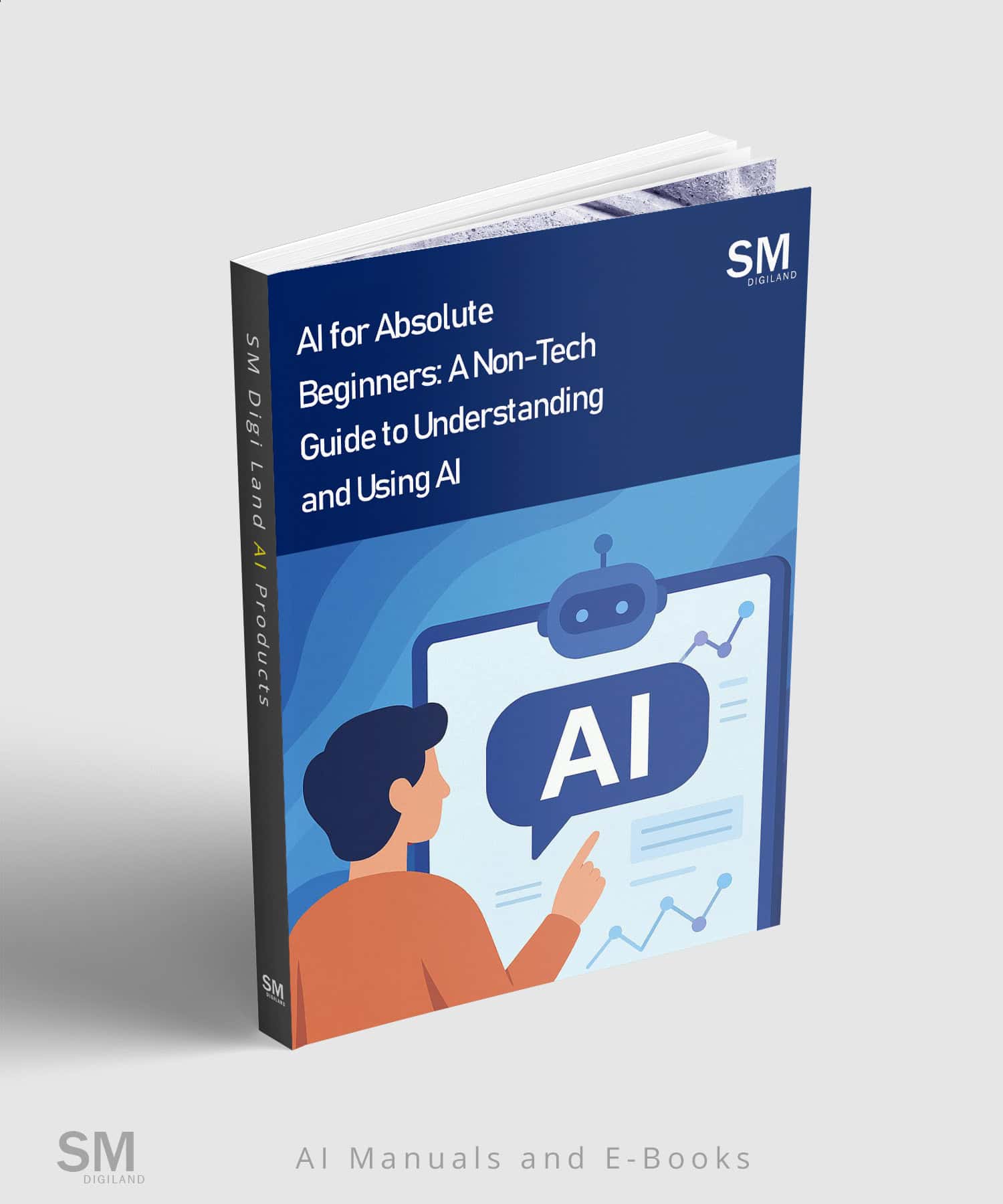
AI for Beginners: A Practical Guide to ChatGPT and Everyday AI is a 33-page introductory PDF designed to help non-technical users develop a clearer understanding of generative AI and explore practical ways to use it.
The guide introduces essential AI concepts, prompting, conversational AI, image generation, writing assistance, study support, personal organization, basic automation, privacy, safety, and responsible use.
No coding knowledge is required for the introductory material. However, certain advanced workflows, integrations, and automation ideas may require separate tools, paid plans, account permissions, or additional technical configuration.
What You Can Learn from the Guide
- What artificial intelligence and generative AI mean in practical terms
- How conversational AI systems such as ChatGPT respond to instructions
- How clearer prompts can improve the relevance and structure of AI output
- How AI may assist with drafting, summarizing, brainstorming, and organization
- How text prompts can be used with AI image-generation tools
- How students and educators can explore AI while respecting academic requirements
- How AI can support provisional plans, reminders, lists, and personal workflows
- What basic automation means and where human approval remains necessary
- How to protect private, personal, confidential, and copyrighted information
- Why AI-generated answers, images, references, and recommendations require review
Ten Beginner-Focused Topics
1. Understanding Artificial Intelligence
Explore introductory concepts behind AI and generative AI, common terminology, practical capabilities, important limitations, and frequent misconceptions. The objective is not to explain every technical detail, but to establish a useful foundation for further learning.
2. Getting Started with ChatGPT and Conversational AI
Learn how to begin a conversation, provide context, define an objective, request a suitable output format, refine an answer, and ask follow-up questions. AI responses should be treated as provisional material rather than automatically reliable conclusions.
3. Prompting More Clearly
Understand how details such as audience, purpose, background information, constraints, tone, examples, and output format can affect an AI response. Clear prompts can improve relevance, but they cannot guarantee factual accuracy.
4. Exploring AI Image Generation
Discover how text descriptions can guide AI image-generation tools and how subject, composition, style, lighting, color, perspective, and aspect ratio can be communicated through a prompt.
Users remain responsible for checking current platform rules, subscription requirements, commercial-use terms, privacy settings, trademarks, copyrighted material, and rights associated with reference images or recognizable people.
5. Using AI in Everyday Organization
Explore ways AI may assist with provisional schedules, checklists, meal ideas, travel questions, reminders, comparison tables, personal planning, and information organization.
Dates, prices, opening hours, travel requirements, medical information, financial information, and other changing or high-impact details must be verified through reliable current sources.
6. AI-Assisted Writing and Summarization
Use AI to help prepare first drafts of emails, documents, outlines, blog ideas, summaries, and alternative wording. Users should review facts, tone, confidentiality, originality, citations, and suitability before sharing or publishing any output.
7. Visual Content and Presentation Ideas
Explore how AI can support early-stage ideas for presentations, social-media content, visual directions, captions, layouts, and creative briefs. Final assets should be reviewed for accuracy, accessibility, disclosure requirements, and intellectual-property concerns.
8. AI for Learning, Teaching and Research
Develop study questions, explanations, practice exercises, provisional outlines, flashcards, and learning plans. AI can support learning, but it should not replace required reading, independent reasoning, genuine research, or compliance with school and university policies.
Students must not submit AI-generated work as entirely their own when doing so violates academic rules. Citations, quotations, calculations, sources, and references generated by AI must be checked independently.
9. Basic Automation Concepts
Understand how approved tools may connect repetitive actions, move information, create draft tasks, or trigger predefined workflows. A PDF cannot configure or execute these automations on the purchaser’s behalf.
Automated workflows should first be tested with fictional or non-sensitive data. Human approval should remain in place before sending messages, publishing content, creating purchases, deleting files, changing records, or performing other important actions.
10. Privacy, Safety, Ethics and Continued Learning
Learn why personal information, confidential business documents, private messages, account credentials, customer data, unpublished work, and sensitive records should not be uploaded without appropriate authorization and review.
The guide also encourages continued learning because AI products, interfaces, models, prices, policies, and capabilities change frequently.
AI Can Be Helpful Without Always Being Correct
Generative-AI systems can produce fluent and convincing responses that contain incorrect, incomplete, biased, outdated, misleading, or entirely fabricated information.
An AI system may:
- Invent facts, quotations, statistics, studies, links, citations, or references
- Provide outdated information about products, prices, regulations, events, or software
- Misunderstand an ambiguous instruction or omit important context
- Produce incorrect calculations, code, technical steps, or recommendations
- Generate stereotypical, culturally inappropriate, or biased content
- Create images containing unwanted details, distorted elements, or inaccurate text
- Reproduce similarities to protected brands, characters, styles, or existing content
- Present a provisional suggestion with unjustified confidence
- Offer information that is unsuitable for medical, legal, financial, safety, or other high-impact decisions
Important information should always be checked against reliable and current sources. Professional decisions may also require review by a suitably qualified person.
Who Is This Guide For?
- Adults exploring AI for the first time
- Non-technical professionals and office workers
- Entrepreneurs and small-business owners
- Freelancers and independent creators
- Teachers and educators exploring responsible AI use
- Students using AI within their institution’s rules
- Parents who want to understand the tools their families may encounter
- Writers, designers, marketers, and content creators
- People curious about ChatGPT and generative AI
- Users who want an introductory resource before exploring more specialized guides
Where a child or young person uses an AI service, a parent, guardian, or educator should review the provider’s current age requirements, privacy terms, content controls, and educational policies.
How to Use the Guide Effectively
- Begin with the foundational chapters before experimenting with specific tools.
- Choose one simple, low-risk task with a clearly defined outcome.
- Provide relevant context without sharing unnecessary personal or confidential information.
- Ask for a specific structure, such as a list, table, outline, draft, or step-by-step explanation.
- Request clarification when an answer is uncertain or overly general.
- Verify important facts, citations, calculations, quotations, dates, and recommendations.
- Compare the AI output with the original source material.
- Check the current documentation and policies of the selected AI provider.
- Review rights and permissions before publishing AI-assisted text, images, audio, or video.
- Keep human approval before important, public, financial, academic, or irreversible actions.
- Record which prompts work well and refine them for future use.
- Continue learning as AI tools and interfaces change.
Product Details
- Title: AI for Beginners: A Practical Guide to ChatGPT and Everyday AI
- Format: PDF digital guide
- Length: 33 pages
- Language: English
- Structure: 10 beginner-focused chapters
- Level: Introductory
- Coding required: No coding required for the introductory material
- Delivery: Instant digital download after purchase
- SKU: SMDL-OTH-002
- Price: $8
Important Information About Third-Party AI Tools
The purchase includes only the downloadable PDF. It does not include access to ChatGPT, Midjourney, DALL·E, ChatGPT Images, Gemini, Claude, automation platforms, design applications, APIs, plugins, usage credits, cloud storage, or another third-party service.
Separate accounts, subscriptions, payment methods, supported devices, internet access, usage credits, permissions, or technical configurations may be required. Free access, feature availability, generation limits, commercial-use terms, privacy options, and supported countries can vary or change.
Interfaces and product names shown in a static guide may become outdated. Users should consult the current official documentation before relying on interface instructions, pricing information, plan comparisons, privacy settings, or platform capabilities.
Privacy and Confidentiality
Do not provide passwords, payment information, API keys, identity documents, private conversations, confidential company information, customer records, employee data, medical records, student information, unpublished intellectual property, or restricted documents to an AI service unless you are authorized and have reviewed its current privacy, security, retention, and data-use terms.
Removing a person’s name may not fully anonymize a document. Other information can sometimes identify an individual, organization, project, client, or transaction.
What This Product Is—and Is Not
This product is a downloadable educational introduction to AI concepts, prompting, ChatGPT, AI-assisted writing, image generation, everyday applications, basic automation concepts, privacy, and responsible use.
It is not an AI tool, chatbot, software subscription, image-generation service, automation service, certification program, accredited course, live class, technical-support plan, consulting service, academic-writing service, professional assessment, or guarantee of expertise.
This product is independently created and is not affiliated with, sponsored by, certified by, or endorsed by OpenAI, Midjourney, Google, Anthropic, Microsoft, Adobe, or another AI or software provider. Product and company names belong to their respective owners.
The guide does not guarantee mastery of AI, improved grades, increased productivity, greater creativity, reduced workload, business growth, professional advancement, accurate output, successful automation, or access to any particular feature.
Frequently Asked Questions
Is this guide suitable for someone with no AI experience?
Yes. The guide is designed as an introductory resource for users who are new to generative AI. It does not assume programming experience.
Will this guide make me an AI expert?
No. A 33-page introductory guide can provide a starting point, but expertise requires continued learning, experimentation, verification, and experience.
Do I need to know how to code?
No coding is required for the introductory material. Some advanced automation or integration workflows may require additional technical knowledge or assistance.
Are ChatGPT and other AI tools included?
No. The purchase includes only the PDF. Third-party accounts, subscriptions, credits, applications, APIs, and services are not included.
Can I use the guide with free AI tools?
Some concepts may be used with free plans, but features, generation limits, file support, availability, and usage conditions vary by provider and can change.
Does the guide teach ChatGPT?
It introduces ChatGPT and foundational prompting concepts. It should not be presented as complete mastery or comprehensive training in every ChatGPT feature.
Does it cover AI image generation?
The product page presents AI image generation as one of the covered topics. Access to image-generation tools and any required subscription are separate from the PDF.
Is Midjourney included?
No. Midjourney is a separate third-party service with its own account, subscription, terms, privacy settings, and usage requirements.
Can students use AI for assignments?
Students can use AI only in ways permitted by their teacher, school, university, or examination authority. AI-generated work should not be misrepresented as original independent work.
Can I trust the information generated by AI?
Not automatically. AI systems can produce incorrect or fabricated information. Important facts, quotations, calculations, links, and citations require independent verification.
Can I upload private documents to an AI tool?
Only when authorized and after reviewing the provider’s current privacy, security, retention, and data-use terms. Sensitive information should not be uploaded merely for convenience.
Can I commercially use AI-generated content?
Commercial-use conditions depend on the selected service, subscription, jurisdiction, source material, intended use, and rights of other parties. Users must review current terms and obtain necessary permissions.
Will every screenshot or interface instruction remain current?
No. AI interfaces, models, features, subscription plans, and settings change frequently. Current instructions should be confirmed through the relevant provider’s official documentation.
Is this a physical book?
No. It is a 33-page English PDF delivered digitally. No physical product will be shipped.
Begin with the Fundamentals
Start with one simple task, provide clear context, review the result carefully, and learn how to recognize both the usefulness and limitations of generative AI.
Download the 33-page guide and build a practical foundation for exploring ChatGPT, AI-assisted writing, image generation, organization, study workflows, and responsible everyday AI use.


