


A Practical AI Prompt Library for E-Commerce Work
Running an online store involves far more than adding products and processing orders. Store owners and e-commerce teams regularly work on product research, supplier evaluation, listings, customer questions, marketing campaigns, pricing, inventory, SEO, retention and performance analysis.
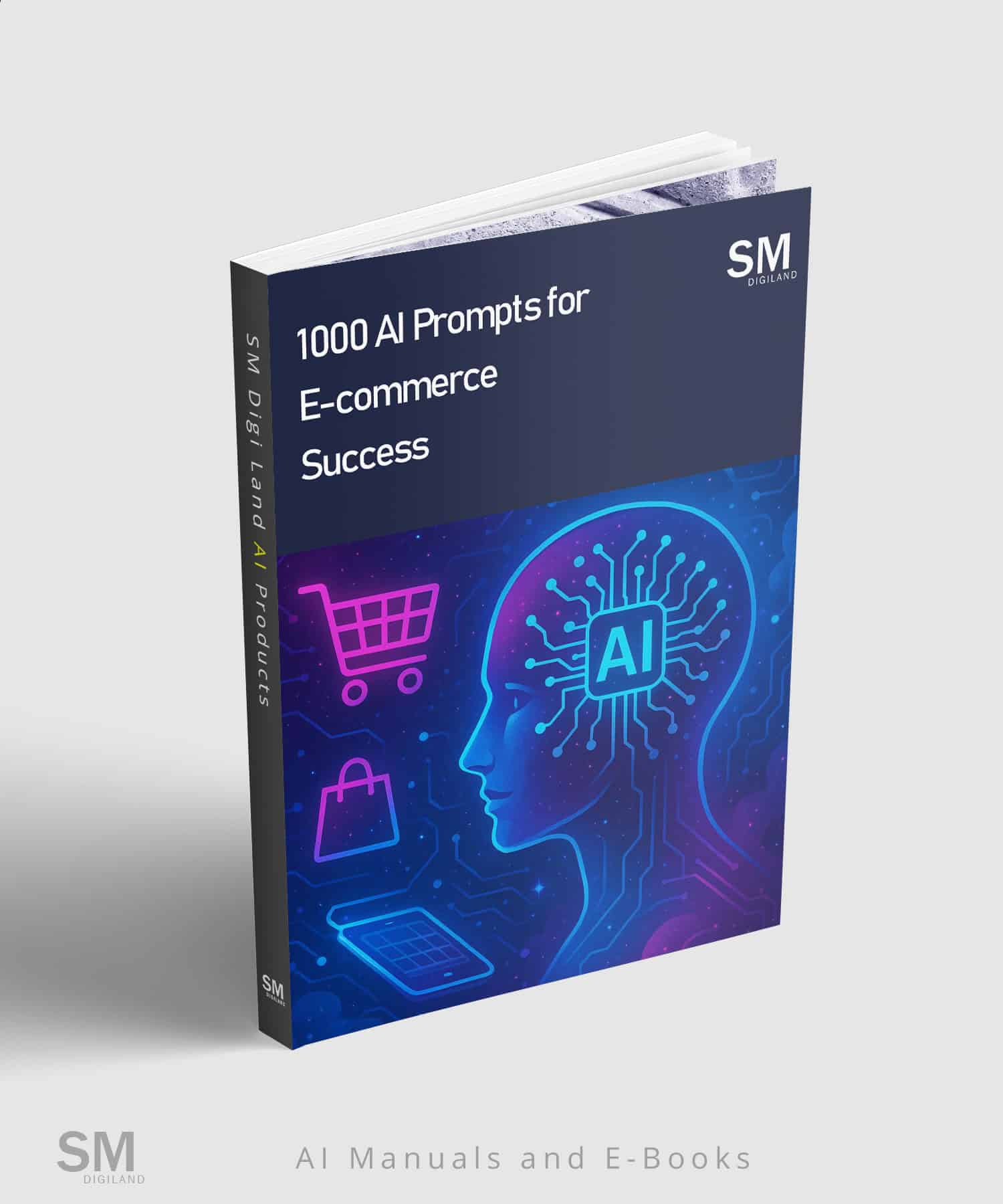
1000 AI Prompts for E-Commerce Growth and Store Optimization is a 159-page English PDF containing 1,000 sample prompts designed to help users approach these recurring activities in a more structured way.
The book is organized into 10 focused chapters, with 100 prompts dedicated to each major e-commerce area. The prompts can be customized with information about a store, product, audience, market, platform, brand voice, campaign objective or operational constraint.
The material is designed to support brainstorming, drafting, comparison, organization and preliminary analysis. It does not guarantee sales growth, higher conversion rates, improved rankings, lower costs or successful automation.
What Is Included?
- 1,000 sample AI prompts for e-commerce activities
- 10 focused chapters containing 100 prompts each
- Prompts for product research, listings, marketing and customer communication
- Applications for pricing, inventory, SEO, retention and performance analysis
- Customizable fields that can be adapted to different stores, products and markets
- Ideas relevant to Shopify, WooCommerce, Amazon and other online-selling contexts
- Material for store owners, marketers, consultants, dropshippers and e-commerce teams
- A 159-page English PDF available as an instant digital download
Ten E-Commerce Areas Covered
1. Product Research and Selection
Explore prompts for identifying product ideas, defining research criteria, comparing product categories, evaluating preliminary demand signals, studying competitors, organizing supplier questions and documenting product-selection assumptions.
AI-generated market information, supplier details, prices, demand estimates and competitor data must be verified through reliable and current sources.
2. Product Listings and Descriptions
Develop provisional product titles, descriptions, feature lists, benefit statements, comparison tables, FAQs, category copy and marketplace listing structures based on verified product information.
AI must not be allowed to invent specifications, materials, certifications, guarantees, performance claims, safety information, country of origin or product benefits.
3. Customer Service and Support
Prepare draft replies, support templates, escalation questions, return-process explanations, order-status messages and customer-service knowledge-base ideas.
Names, order details, refund eligibility, delivery dates, policies and commitments must be checked before any message is sent. Sensitive customer information should not be uploaded without authorization.
4. E-Commerce Marketing Campaigns
Generate provisional ideas for email, social media, paid advertising, SMS, promotions, launches and seasonal campaigns. Prompts can help define audiences, messages, formats, calls to action and testing variations.
Advertising claims, prices, availability, discounts, testimonials, endorsements and promotional conditions must be accurate and compliant with applicable rules.
5. Conversion Review and Cart Recovery
Explore prompts for reviewing store journeys, identifying possible checkout friction, developing test hypotheses, organizing abandoned-cart messages and comparing conversion-improvement ideas.
AI suggestions are hypotheses rather than proven conversion improvements. Changes should be tested carefully using reliable store data.
6. Inventory and Order Operations
Develop inventory-review questions, reorder frameworks, stock-status communication, order-processing checklists, fulfillment documentation and operational workflow ideas.
AI should not be trusted to make unsupervised purchasing, inventory or fulfillment decisions. Stock levels, supplier lead times and order records must be verified in the appropriate source system.
7. Pricing, Promotions and Margin Analysis
Use prompts to organize pricing considerations, compare promotion structures, document assumptions, review cost components and explore preliminary margin scenarios.
AI-generated calculations may be incorrect. Product costs, platform fees, taxes, shipping, discounts, refunds, currencies and payment-processing charges must be verified before a pricing decision is made.
8. E-Commerce SEO and Content Marketing
Create provisional keyword themes, category-page structures, content briefs, internal-linking ideas, product-page questions and educational content concepts.
No prompt or content strategy can guarantee search rankings, traffic or sales. Keywords, search intent, platform requirements and current search-engine guidance should be reviewed independently.
9. Reviews, Loyalty and Customer Retention
Explore ethical approaches to review requests, post-purchase communication, loyalty concepts, customer segmentation, retention campaigns and re-engagement messages.
Reviews and testimonials must be genuine. Businesses should not fabricate feedback, suppress legitimate criticism or create misleading representations of customer experience.
10. Analytics and Store Development
Organize supplied store data, define metrics, compare periods, identify missing information, prepare reporting structures and develop questions for further investigation.
AI-generated analysis is only as reliable as the supplied data and definitions. Revenue, conversion, attribution, customer-acquisition cost, lifetime value and profitability calculations require human verification.
How to Customize the Prompts
- Select a prompt that matches the task you are currently working on.
- Replace the placeholder information with verified details about your store, product, audience and market.
- Define the platform, objective, tone, output format and relevant constraints.
- Remove confidential, personal or unnecessary information before submitting the prompt.
- Ask the AI to identify missing information rather than invent details.
- Review the response for factual accuracy, brand consistency and commercial suitability.
- Verify prices, specifications, claims, policies, calculations and platform requirements.
- Edit the output before publishing, sending or implementing it.
- Test important changes on a limited and reversible basis.
- Measure actual results instead of assuming that AI improved performance.
Who Is This Book For?
- E-commerce store owners
- Shopify and WooCommerce merchants
- Marketplace sellers
- Digital marketers and content teams
- Product-listing and merchandising professionals
- Customer-support and retention teams
- E-commerce consultants and agencies
- Dropshipping businesses
- Small-business teams selling online
- Entrepreneurs developing an online-store concept
Use AI Output as a Draft, Not as Verified Store Data
Generative-AI systems can produce incorrect, outdated, incomplete, biased, misleading or fabricated information. They can also write convincing product claims that are not supported by the information provided.
AI may invent or misinterpret:
- Product materials, dimensions, features or compatibility
- Certifications, warranties, guarantees or safety claims
- Supplier identities, prices, lead times or minimum order quantities
- Competitor prices, product availability or market demand
- Customer reviews, testimonials or survey findings
- Keywords, search volumes or SEO performance
- Advertising results and conversion projections
- Revenue, margins, taxes, fees or profitability calculations
- Shipping times, return eligibility or refund commitments
- Marketplace rules, consumer requirements or legal obligations
All important output must be compared with current records, reliable sources and applicable platform requirements before use.
Privacy and Customer Information
Do not upload customer names, addresses, phone numbers, payment information, account credentials, private messages, complete order histories, employee information, supplier contracts, API keys, unpublished product data or other restricted information unless you are authorized and have reviewed the selected provider’s privacy, security, retention and data-use terms.
When possible, use fictional, anonymized or aggregated information while testing prompts. Removing a customer’s name may not be sufficient to anonymize a record if other details can identify the person or transaction.
Platform Compatibility and Third-Party Services
The prompts may be adapted to stores operating through Shopify, WooCommerce, Amazon and other online-selling platforms. However, the PDF does not connect to these platforms, retrieve live store information, publish products, modify prices, process orders, send messages or execute automations.
The purchase does not include access to ChatGPT, Jasper, Copy.ai, Shopify, WooCommerce, Amazon Seller Central, advertising platforms, analytics tools, email services, APIs, plugins, integrations or automation credits.
Separate accounts, subscriptions, licenses, permissions and technical configuration may be required. Platform features, interfaces, policies, fees, limits and availability can change.
Product Details
- Title: 1000 AI Prompts for E-Commerce Growth and Store Optimization
- Format: PDF digital book
- Length: 159 pages
- Language: English
- Number of prompts: 1,000
- Structure: 10 chapters with 100 prompts in each chapter
- Delivery: Instant digital download after purchase
- SKU: SMDL-DL-020
- Price: $19
What This Product Is—and Is Not
This product is a downloadable educational prompt library designed to support e-commerce brainstorming, drafting, organization and preliminary analysis.
It is not an e-commerce platform, AI subscription, store-management service, automation system, live-data integration, product-research database, supplier directory, marketing agency, SEO service, analytics platform, legal service, tax service, financial service or business-growth guarantee.
This product is independently created and is not affiliated with, sponsored by, certified by or endorsed by OpenAI, Shopify, WooCommerce, Amazon, Jasper, Copy.ai or another AI, marketplace or e-commerce provider. Product and company names belong to their respective owners.
The book does not guarantee sales, conversions, traffic, rankings, profit, customer retention, inventory accuracy, successful advertising, marketplace approval or business growth.
Frequently Asked Questions
Does the book contain exactly 1,000 prompts?
The product is presented as containing 1,000 sample AI prompts organized into 10 chapters, with 100 prompts in each chapter.
Will these prompts increase my sales?
No specific result is guaranteed. Performance depends on the product, pricing, market, traffic, offer, competition, store experience, implementation quality and many other factors.
Does the PDF connect to my online store?
No. It is a downloadable prompt library and cannot access, operate or modify a store.
Are Shopify, WooCommerce or Amazon included?
No. They are separate third-party platforms. The prompts can be adapted to relevant scenarios, but platform access and subscriptions are not included.
Can I use the prompts with ChatGPT?
Yes, the text prompts can be adapted for ChatGPT and other suitable text-based AI assistants. Outputs and functionality may vary by model, plan and provider.
Does the book include an AI subscription?
No. The purchase includes only the PDF. AI accounts, subscriptions, APIs and usage credits are separate.
Can AI write my product listings?
AI can assist with provisional drafts, but every specification, benefit, claim, price and policy must be checked before publication.
Can the prompts automate inventory or orders?
No. Prompts can help design or document possible workflows, but the PDF cannot execute automation. Connected workflows require separate tools, permissions, testing and monitoring.
Can I upload customer or order data?
Only when authorized and after reviewing the AI provider’s current privacy, security, retention and data-use terms. Fictional, anonymized or aggregated data is safer for testing.
Will the SEO prompts guarantee rankings?
No. Search rankings depend on many technical, competitive and content-related factors that can change over time.
Can AI determine the best selling price?
AI can organize supplied information and develop preliminary scenarios, but it cannot guarantee an optimal price. Costs, fees, taxes, competition and margin calculations must be verified.
Is the book suitable for beginners?
Many prompts can be used by beginners, but useful results still require accurate context, careful customization and review. Some operational or analytical topics may require e-commerce experience.
Will the prompts remain current?
The core prompting concepts may remain useful, but platform interfaces, policies, fees, advertising rules and AI capabilities change. Current requirements must be checked directly with the relevant provider.
Is this a physical book?
No. It is a 159-page English PDF delivered digitally. No physical product will be shipped.
Build a More Structured E-Commerce Workflow
Select the area that matches your current challenge, customize a relevant prompt with verified store information and use the AI response as a starting point for further review.
Download the 159-page PDF and explore 1,000 customizable prompts across product research, listings, marketing, customer support, pricing, SEO, retention, operations and e-commerce analysis.


