


A Structured AI Prompt Library for Academic Research
Academic research requires more than generating polished text. Researchers must define answerable questions, identify appropriate sources, evaluate evidence, justify methodological choices, protect research data, document analytical decisions, acknowledge limitations, and communicate conclusions that are supported by the results.
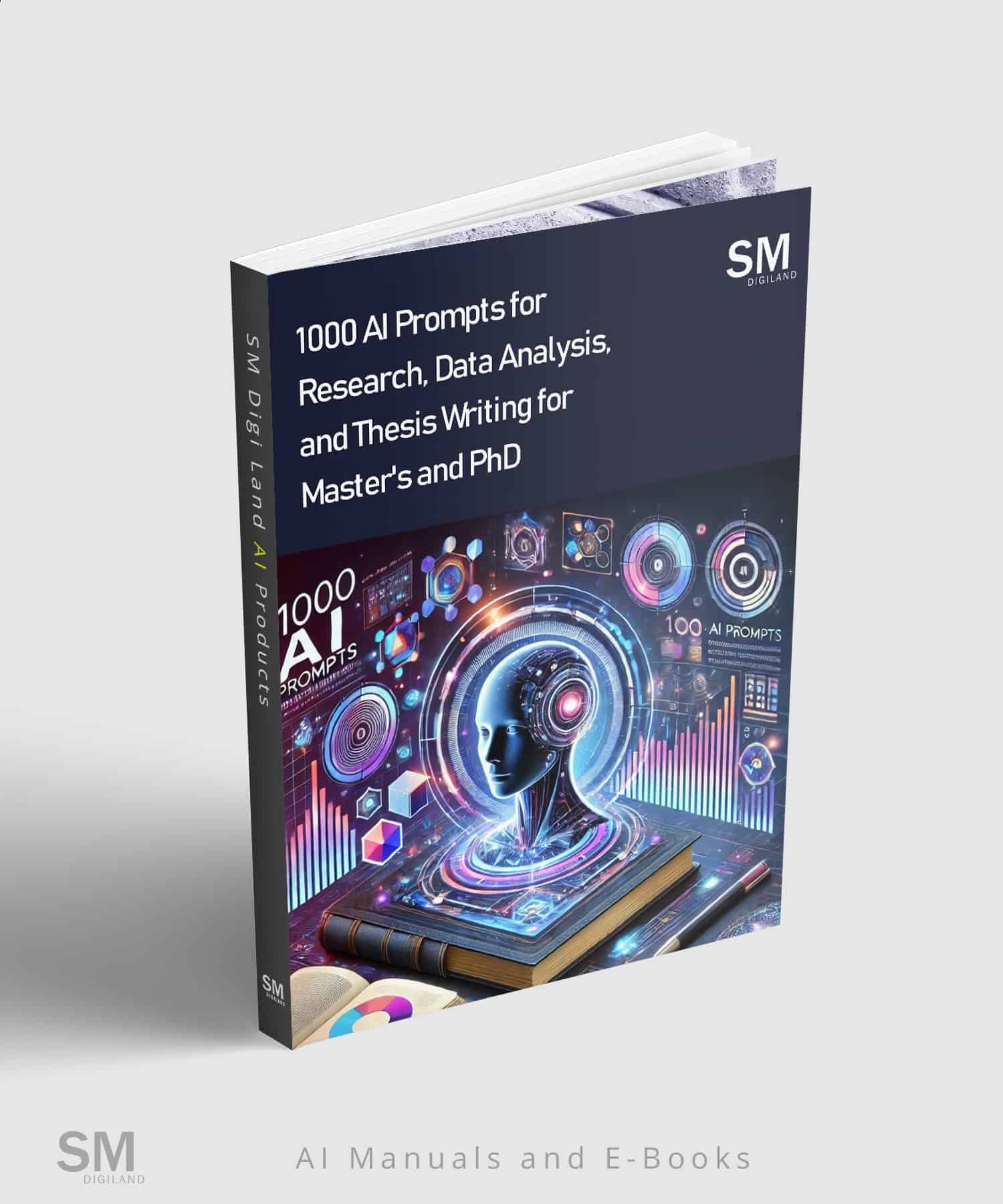
1000 AI Prompts for Academic Research, Data Analysis and Thesis Writing is a 118-page digital prompt book designed to help researchers provide generative-AI tools with clearer context, boundaries, evidence, and output requirements.
The collection contains 1,000 customizable prompt frameworks organized into 10 focused chapters. It supports recurring tasks across research planning, literature-review organization, methodology development, qualitative and quantitative analysis, thesis writing, academic editing, publication preparation, and viva defense.
This is not a collection of one-line instructions such as “write my thesis” or “analyze my data.” The prompts encourage users to specify the discipline, research objective, theoretical framework, confirmed evidence, methodology, dataset characteristics, institutional requirements, limitations, citation style, and desired output before requesting assistance.
From Research Question to Defensible Conclusion
Generative AI can help organize ideas, prepare comparison frameworks, identify questions, explain concepts, and draft material for human review. However, it does not automatically know whether a source exists, whether a study has been retracted, whether a statistical method is appropriate, whether an interpretation is supported by the data, or whether a particular use of AI is permitted by a university, journal, supervisor, ethics committee, or funder.
The prompts encourage users to provide relevant research context, including:
- Academic discipline and research area
- Degree level or intended publication type
- Research problem and objective
- Confirmed research questions or hypotheses
- Theoretical or conceptual framework
- Research design and methodological approach
- Available sources, evidence, or anonymized data
- Known limitations and unresolved questions
- Institutional, ethical, and publication requirements
- Required citation style and output format
- Information that must be verified independently
This structure makes AI output more useful as a starting point while keeping the researcher responsible for every source, analytical decision, interpretation, citation, and submitted statement.
What Is Included?
- 1,000 customizable AI prompt frameworks
- 10 chapters with 100 prompts in each chapter
- A clear Goal for every prompt
- A Usage section explaining the intended research task
- An editable Prompt with contextual fields and output instructions
- Workflows for research planning, organization, analysis, writing, and quality control
- Prompts for both qualitative and quantitative research contexts
- Customizable fields for discipline, methodology, evidence, variables, theoretical framework, limitations, and citation style
- Frameworks that separate supplied evidence from assumptions and AI-generated suggestions
- Instructions that encourage source verification and human review
Ten Academic Research Areas Covered
1. Research Topics, Problems and Questions
Explore topic directions, define research problems, assess feasibility, narrow broad subjects, formulate objectives, compare possible research questions, identify stakeholders, and distinguish exploratory, descriptive, explanatory, and evaluative research aims.
2. Literature Search and Evidence Organization
Develop search concepts, generate alternative terminology, define inclusion and exclusion criteria, organize supplied studies, build evidence matrices, compare theoretical positions, identify research gaps, and prepare questions for systematic source verification.
3. Research Proposals and Methodology
Structure proposals, compare methodological options, identify sampling questions, examine validity and reliability considerations, plan data collection, document assumptions, prepare ethics-related questions, and connect research methods to stated objectives.
4. Qualitative Research and Analysis
Develop interview questions, improve coding frameworks, organize anonymized transcripts, compare themes, identify contradictory evidence, prepare reflexivity questions, examine alternative interpretations, and create audit-trail structures.
5. Quantitative and Statistical Analysis Planning
Define variables, inspect data requirements, compare analytical methods, identify assumptions, plan diagnostic checks, organize descriptive statistics, prepare questions for a statistician, and build interpretation frameworks without inventing results.
6. Thesis and Dissertation Structure
Plan chapter functions, connect research questions to sections, develop argument maps, organize evidence, improve transitions, distinguish findings from discussion, and review whether conclusions answer the original research objectives.
7. Academic Writing and Argumentation
Improve clarity, structure paragraphs, compare claims, identify unsupported statements, strengthen logical connections, refine definitions, adjust academic tone, reduce repetition, and make limitations more explicit.
8. Citations, Editing and Quality Assurance
Create source-verification checklists, identify citation gaps, review terminology, inspect tables and figure descriptions, assess internal consistency, prepare revision plans, and check supplied references without treating AI-generated citations as verified.
9. Publication and Peer-Review Preparation
Prepare journal-comparison criteria, structure abstracts, draft cover-letter frameworks, organize reviewer responses, plan revisions, create research summaries, develop presentation materials, and document appropriate AI-use disclosures.
10. Viva, Defense and Research Communication
Generate practice questions, test methodological justifications, identify vulnerable claims, prepare concise explanations, compare alternative interpretations, rehearse responses to limitations, and adapt research communication for academic and non-specialist audiences.
How Every Prompt Is Structured
Every prompt follows a consistent three-part format:
- Goal: Defines the specific research task the prompt is intended to support
- Usage: Explains when and how the prompt can be used
- Prompt: Provides a detailed, editable instruction ready for customization
Depending on the task, editable fields may include [DISCIPLINE], [RESEARCH TOPIC], [RESEARCH QUESTION], [THEORETICAL FRAMEWORK], [METHODOLOGY], [DATASET], [VARIABLES], [SUPPLIED SOURCES], [KNOWN LIMITATIONS], [INSTITUTIONAL REQUIREMENTS], [CITATION STYLE], and [DESIRED OUTPUT].
Sample AI Prompts for Academic Researchers
The following examples demonstrate the type of structured research workflow supported by the collection. They should not be described as verbatim excerpts from the PDF unless compared directly with the published book.
Sample 1: Build an Evidence-Synthesis Matrix from Supplied Sources
Goal: Organize supplied research materials without inventing studies, findings, quotations, or citations.
Usage: Use after collecting relevant papers and confirming that you are permitted to process the supplied material with the selected AI tool.
Prompt:
Act as an academic evidence-organization assistant. Analyze only the source information I provide. Do not invent authors, publications, quotations, sample sizes, methods, findings, identifiers, page numbers, or citations.
Research topic: [TOPIC]
Research question: [QUESTION]
Academic discipline: [DISCIPLINE]
Review type: [REVIEW TYPE]
Inclusion criteria: [CRITERIA]
Theoretical framework: [FRAMEWORK]
Supplied source material: [PASTE NOTES, ABSTRACTS OR AUTHORIZED TEXT]
Required comparison dimensions: [DIMENSIONS]Create:
- An evidence matrix with one row for each supplied source
- The stated objective, design, sample, method, findings, and limitations of each source
- A separate column indicating whether each detail is explicit, inferred, or unavailable
- Areas of agreement and disagreement across the supplied sources
- Methodological differences that may affect comparison
- Potential evidence gaps relevant to the research question
- Questions requiring examination of the complete original publication
- A list of every bibliographic detail requiring independent verification
Paraphrase rather than reproduce long passages. Clearly label inferences and missing information. Do not create a reference entry unless all necessary details have been supplied and verified by the user.
Sample 2: Prepare a Statistical Analysis Decision Plan
Goal: Organize possible analysis options and required diagnostic checks without fabricating results or replacing statistical supervision.
Usage: Use before conducting quantitative analysis or when preparing questions for a supervisor, statistician, or methodology adviser.
Prompt:
Act as a statistical-analysis planning assistant. Do not fabricate data, calculate results that have not been supplied, select a final method without sufficient information, or claim that an assumption has been satisfied without evidence.
Discipline: [DISCIPLINE]
Research objective: [OBJECTIVE]
Research questions or hypotheses: [QUESTIONS]
Study design: [DESIGN]
Population and sampling method: [POPULATION AND SAMPLE]
Outcome variables: [OUTCOMES]
Predictor or grouping variables: [PREDICTORS]
Measurement levels: [MEASUREMENT LEVELS]
Repeated or clustered observations: [STRUCTURE]
Missing-data information: [MISSING DATA]
Planned software: [SOFTWARE]
Known limitations: [LIMITATIONS]Provide:
- A variable-role and measurement-level table
- Possible descriptive analyses
- Candidate analytical methods connected to each research question
- The assumptions and data conditions required by each candidate method
- Diagnostic checks to perform before interpretation
- Possible alternatives if assumptions are not met
- Missing information that prevents method selection
- Questions to discuss with a qualified statistician or supervisor
- A reporting checklist appropriate to the proposed analysis
Explain the reasoning behind each candidate option. Do not produce numerical findings, p-values, confidence intervals, effect sizes, or conclusions unless valid data and calculation output have been supplied.
Sample 3: Simulate a Thesis-Defense Question Session
Goal: Test the researcher’s ability to explain and defend the supplied study without introducing unsupported claims.
Usage: Use during viva or thesis-defense preparation after the dissertation has reached a stable draft.
Prompt:
Act as a thesis-defense preparation assistant. Base every question on the research summary supplied below. Do not invent results, limitations, methodological decisions, examiner requirements, or disciplinary rules.
Degree level: [DEGREE]
Discipline: [DISCIPLINE]
Thesis title: [TITLE]
Research problem: [PROBLEM]
Research questions: [QUESTIONS]
Theoretical framework: [FRAMEWORK]
Methodology: [METHODOLOGY]
Key findings: [VERIFIED FINDINGS]
Claimed contribution: [CONTRIBUTION]
Limitations: [LIMITATIONS]
Areas of concern: [CONCERNS]Create:
- Five introductory questions about the purpose and importance of the study
- Ten challenging questions about methodology and research design
- Five questions testing interpretation of the findings
- Five questions about limitations and alternative explanations
- Five questions about theoretical and practical contribution
- Follow-up questions for answers that appear vague or unsupported
- A rubric for evaluating clarity, evidence, precision, and intellectual honesty
Ask one question at a time and wait for my response. After each response, identify what was clear, what was unsupported, and what should be checked in the thesis or original evidence. Do not write a model answer until I have attempted my own response.
Who Is This Book For?
- Master’s students and thesis writers
- PhD and doctoral candidates
- Academic and independent researchers
- University lecturers and research supervisors
- Research assistants and laboratory teams
- Qualitative and quantitative researchers
- Academic writers and editors
- Research-methodology instructors
- Professionals preparing journal manuscripts
- Students preparing for a viva or thesis defense
- Research-support and graduate-school teams
- Professionals developing responsible AI-use procedures for research
Suitable Research Contexts
The prompt frameworks can be adapted across a wide range of fields, including:
- Social sciences and humanities
- Business, management, and economics
- Engineering and technology
- Natural and environmental sciences
- Education and learning sciences
- Health and medical research under qualified supervision
- Arts, design, and practice-based research
- Interdisciplinary and mixed-methods studies
Users must customize each prompt according to their discipline, methodology, institutional requirements, ethical approvals, publication policies, and supervisory guidance.
How to Use the Prompts Responsibly
- Select a prompt that matches the current stage of the research process.
- Replace every placeholder with accurate and relevant context.
- Separate verified evidence from assumptions, interpretations, and unresolved questions.
- Use original publications and authorized academic databases to verify sources.
- Do not rely on AI-generated references, quotations, page numbers, or identifiers without independent verification.
- Remove or anonymize personal, confidential, proprietary, participant, and unpublished research data where required.
- Do not upload manuscripts, peer-review materials, restricted datasets, or third-party intellectual property unless the intended use is authorized and appropriately secured.
- Validate methodological and statistical recommendations with disciplinary standards and qualified advisers.
- Check your university, journal, funder, supervisor, and ethics-committee policies concerning AI use and disclosure.
- Review and take responsibility for every statement included in submitted academic work.
Product Details
- Title: 1000 AI Prompts for Academic Research, Data Analysis and Thesis Writing
- Format: PDF digital book
- Length: 118 pages
- Language: English
- Number of prompts: 1,000
- Structure: 10 chapters with 100 prompts per chapter
- Prompt format: Goal, Usage, and Prompt
- Delivery: Instant digital download after purchase
- SKU: SMDL-DL-012
- Price: $20
Important Information About AI and Academic Research
Generative-AI systems can produce inaccurate, incomplete, biased, outdated, or entirely invented information. They may fabricate authors, publications, quotations, citations, DOIs, datasets, statistical results, theoretical positions, or methodological requirements.
Every source should be located and checked in its original publication or an authorized academic database. Retraction status, publication details, quotations, page numbers, research methods, findings, and limitations must be independently verified.
AI-generated statistical or methodological suggestions may be unsuitable for the research design, sample, measurement scale, assumptions, or discipline. A plausible explanation is not evidence that a method is valid or that a finding is correct.
Researchers must comply with the AI, academic-integrity, authorship, disclosure, ethics, data-protection, confidentiality, intellectual-property, and assessment policies that govern their institution and intended publication.
Participant information, unpublished findings, restricted datasets, confidential manuscripts, peer-review materials, proprietary research, and identifiable personal data should not be entered into third-party AI tools unless the environment and intended use have been properly assessed, secured, and authorized.
What This Product Is—and Is Not
This product is a downloadable educational collection of customizable AI prompt frameworks for academic research planning, literature organization, methodology development, data-analysis planning, academic writing, editing, publication preparation, and thesis defense practice.
It is not a research service, thesis-writing service, statistical consultancy, data-analysis platform, academic database, citation-verification service, plagiarism checker, proofreading service, supervisor, ethics review, or guarantee of academic acceptance.
The purchase does not include access to ChatGPT, Claude, Gemini, Microsoft Copilot, statistical software, reference-management software, an academic database, or another third-party platform. Separate accounts, licenses, or subscriptions may be required.
The book does not guarantee thesis approval, publication, accurate citations, valid statistical conclusions, academic originality, higher grades, faster degree completion, successful defense, supervisor acceptance, journal acceptance, or improved research outcomes.
Frequently Asked Questions
Does the book contain exactly 1,000 prompts?
Yes. It contains 10 chapters with 100 prompts in each chapter, providing a total of 1,000 customizable prompt frameworks.
Can the prompts write my thesis for me?
The prompts can help organize ideas, compare evidence, structure sections, identify questions, and prepare drafts for review. The researcher remains responsible for the scholarship, analysis, citations, originality, accuracy, and submitted work.
Can AI find academic sources for me?
AI can suggest search terms and research strategies, but it may invent publications and citations. Every source must be independently located and verified through original publications, official repositories, library systems, or authorized academic databases.
Can the prompts analyze qualitative data?
They can support coding questions, theme organization, comparison frameworks, and audit-trail planning. Researchers must protect participant data and validate interpretations against the original material and chosen methodology.
Can the prompts perform statistical analysis?
The collection can help structure analytical questions, compare possible methods, identify assumptions, and prepare reporting checklists. It does not replace statistical software, valid data, methodological judgment, or a qualified statistician.
Are the prompts limited to one academic discipline?
No. Many frameworks are adaptable across disciplines. Users must supply the appropriate theoretical, methodological, ethical, and institutional context for their own field.
Can I upload my complete thesis or research dataset?
Only if the selected AI environment and intended use have been properly assessed, secured, and authorized. Confidential, identifiable, restricted, proprietary, or unpublished information may require anonymization or may not be suitable for upload at all.
Do I need to disclose my use of AI?
Disclosure requirements vary between universities, journals, funders, supervisors, and disciplines. Users should check the current policies governing their work and document AI use where required.
Can AI-generated text be submitted without revision?
No AI-generated academic content should be submitted without careful human review. Evidence, citations, arguments, methods, originality, policy compliance, and disclosure requirements must all be checked.
Is this a physical book?
No. It is a 118-page English PDF delivered digitally. No physical product will be shipped.
Develop More Controlled AI Workflows for Research
Use these 1,000 customizable prompts to define research tasks more precisely, organize academic evidence, evaluate methodological options, improve thesis structure, prepare for revision, and identify information that requires further verification.
Download the 118-page PDF and adapt the prompts to your discipline, research question, methodology, evidence, institutional policies, and academic responsibilities.


